Wednesday, December 13, 2006

Because I'm a people person...

...and whore myself out for nearly every social networking site dangled in front of me, you can find me on ComicSpace. That photo is nearly a year old and doesn't really look like me anymore...but it was one of the less repellent ones I had available. Really seems like it cries out for a funny caption, though. Like "RAB tries to induce a moment of psychic nosebleed zen in himself by sheer concentration." Or "RAB enters the Zach Galifianakis lookalike contest." Or "Step away from the Interrositer, Doctor Meacham." Please feel free to suggest more captions in the comments section.

On a related note, my friend Mark from Northern Ireland writes to ask, "So, what didja think of ENDLESS WIRE then?" A fair question, young man, and one which in recent weeks has been much on my mind. I've been meaning to write something about the new Who album, and the reason I haven't done so is simply that I haven't decided what I think of it yet. And the weird part is, in the past year we've also had AERIAL from Kate Bush and LOVE from The Beatles, and I haven't entirely figured out what I think of those yet either!

A span of twelve months saw new releases from the artists who were the biggest formative influences on my musical tastes ever since I was a teenager...but none of these totally fulfilled my hopes and expectations in the way that a new release (or a remastering, in the case of the Beatles) would have done in the past. I have to withhold judgement a little because it might just be the misguided conservatism of the "true fan" who only wants his favorite artists to plow the same furrow over and over again, and complains when they go off in a different direction. Or it might be that they've lost the plot somewhere along the way and need a kick in the ass to get reminded of what made them great in the first place.

(With the Beatles album it's obviously a whole different question. I can't decide if I find the new versions too radical or too faithful to the original...but it's the one of the three I like the most, and Paul and Ringo kept their distance from it.)

Anyway, I have more to say about these albums, but perhaps I should save it for another post...

Sunday, December 10, 2006

What the...?

Lisa at Sequentially Speaking posted about this and I've ranted about it there, but I've still got a bit of rant left in me and need to get it out of my system.

Back in July, the Skiffy Channel broadcast Who Wants To Be A Superhero? -- a six episode "reality series" so obviously scripted and contrived that the word "reality" itself might be able to sue the producers for defamation -- in which Stan Lee supposedly auditioned contestants who competed to become the new superhero featured in a comic book to be published by Dark Horse. Stan himself has real charisma on screen, and in spite of my contempt for the idea and the silliness of its execution, the show became one of my guilty almost-pleasures during its mercifully short run.

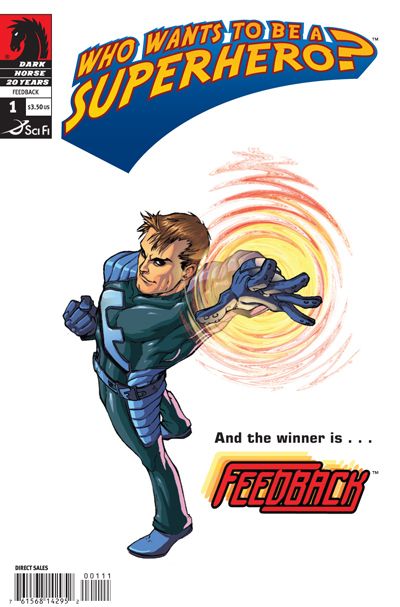
Months later, with the show almost entirely forgotten, Dark Horse has announced that the resultant comic book allegedly written by Stan Lee, originally due to come out in October, will ship in January. And they provide this cover preview:


Logic says the cover should be a photo of the winning competitor. Not an awkward pose (and that is one seriously awkward pose there) on a white background! Even the shoestring budget of the the tv version managed to produce more interesting visuals, including a mockup cover featuring the character that was pedestrian, but still more interesting than this. And that mockup had the considerable benefit of actually having been shown on the program itself.

I have no idea what the ratings were on the series -- apparently high enough that a second series is being planned -- but let's assume that the show had genuine fans who, even at this late date, would still be interested in the comic promised by the very premise of the show. I mean, that's the presumed target audience here, right? So why not do everything you can to appeal to that audience and get their attention? By not using a photo of the guy, or the cover that appeared on the air, Dark Horse has possibly thrown away thousands in sales.

And what else is missing here? Stan Lee's presence was a big part of the show, and his name was prominently mentioned in all the publicity, and the comic is purportedly written by Stan. Anyone who watched that show certainly came away knowing the name "Stan Lee" if they didn't before. And his name doesn't appear on the cover? They passed up a chance to put the name "Stan Lee" in honking giant letters across the cover when it would have been entirely right and appropriate to do so? That's, what, maybe thousands more in sales lost right there.

(Some comics have blazoned a famous creator's name on the cover with less reason or even no reason at all.)

Let me make it clear that I had no interest in the comic itself; what bothers me is seeing something done poorly when it could just as easily have been done well. Dark Horse publishes a lot of good comics and has most of the best creators in comics available to them...and they've been very canny about integrating with other media for cross-promotion. To see them doing something this amateurish is disappointing.

I mean...they didn't even put Stan's name on the cover? What's up with that?

Saturday, December 02, 2006

An idle thought

This one's for comics fans who watch The Daily Show, which I assume is a fairly large overlap:

If they ever made a film version of American Flagg...


...wouldn't Rob Riggle be perfect casting to play Reuben Flagg?


From the first time I saw this guy on the air, all I could think was "Holy crap, it's like he stepped right off a Howard Chaykin page!"

What do you think...too obvious?

Friday, December 01, 2006

A secret power none of us can match

I've wanted to say something worthwhile about Dave Cockrum for days now...but I just can't find the words. So many things are caught up in this: the way in which Cockrum's career intersected with a shift in the way comics companies treated their creators...what comparing X-Men and The Futurians says about the challenges of creator-owned comics versus corporate properties...and what it says about the tension between comics writers and artists...why Cockrum's advent on the Legion of Super-Heroes and the X-Men had so much impact at the time...how much I loved those Superboy issues...how the death of a once-favorite creator makes me feel like a treasured part of my own life has just been put away in a sealed box, never to be opened again to prove that I'll never be able to go back to it again...

...and something about the condescending and inappropriate "Story Highlights" from the AP coverage, affirming every crass stereotype of comic books as kid stuff and comics creators as overgrown kids, though when I reread them in just the right skewed angle they reveal something oddly touching.

But do I really have anything worthwhile to add that hasn't already been said? Fortunately, Charles Yoakum does, from both the perspective of a fan who knows what Cockrum's presence meant in comics and the perspective of an artist who actually worked with the guy and got to interact with him. I don't know that I ever met or even saw Dave Cockrum in person, even at a convention; it seems like I must have, given the years of my convention-going coinciding with the peak of his convention appearances, but if so, why don't I remember it? Possibly I saw him and was too shy to say anything, not being able to find the words to convey what a big fan I was...which is right where I find myself now.

Grant Morrison has said in interviews that for him, Superman is more real than Grant Morrison: Superman existed long before he was born and will exist long after he's gone, and is known to many millions of people who'll never know the name of any of his writers. The same goes for DC and Marvel themselves. Characters like Nightcrawler and Storm and Colossus and Wildfire are more real than the tiny publishing houses which put out comic books featuring them. It doesn't matter that these characters owe their fame to commercial exploitation by publishers -- however they got out into the world, they're out there now, and they have an independent life in the minds of people all over the world. No action or policy by a publishing company can undo that. Those characters are effectively immortal. A company -- a collective entity of contracts and licenses and copyrights and marketing strategies -- doesn't create immortality, but a person can. Dave Cockrum, with his intuitive sense of what would catch the eye and work its way into our brains, was that kind of person.

Anyway, go read what Charles has to say.

Sunday, November 19, 2006

Another Kirby meme

Longtime contributor to The Jack Kirby Collector Sean Kleefeld has launched a Kirby character design meme, and that meddling Canadian plok has not only joined in with his choice but roped me into participating as well.

I couldn't pick just one single character as being Jack Kirby's single best visual design: there are so many of them that have become iconic and stood the test of time, as demonstrated by the fact that every subsequent artist to draw the character has followed Kirby's original design faithfully. Galactus is one of those characters who will always look like the Kirby original no matter who draws him. So is the cult favorite villain Modok. In design terms these guys are like the original Volkswagen Beetle or the first iMac, with its white-and-Bondi-blue case -- they came seemingly out of nowhere and instantly defined an idea space so completely that other designers couldn't improve on them or even evolve them much.

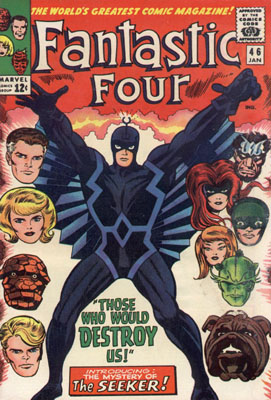
I could very easily pick Galactus as my choice here, but I have another "dark horse" candidate in mind: another character who has never been improved or altered, but worked perfectly on his first appearance and looks as striking today as he did back then:


Even in repose Black Bolt, King of the Inhumans, is dynamic. The ribbed glider wings and flaring gloves (the latter a bit underplayed on this cover) mean there are always lines radiating from his figure, and as a result he dominates any panel in which he appears, the way his character dominates his subjects. By contrast it seems as if two of his Inhuman subjects, Karnak and Gorgon, are almost always drawn in a slight crouch, lower than their monarch.

The electron-gathering antenna on his forehead is primarily there to look cool -- though Lee and Kirby gave it some rationale so that we could see it crackle with Kirby dots -- and the ziggurat trim on his uniform is solely decorative. Basically, he's the best-known Art Deco character ever in comics.

It's interesting that although Black Bolt is not a superhero per se, Kirby designed him with superhero tights and mask. A number of the Inhumans -- among the leads, Medusa and Karnak as well as Black Bolt -- always wear tights and masks. The Inhumans were Kirby's first use of an idea he'd return to with the New Gods and the Eternals: characters who were not crime fighters with secret identities, but who borrowed the trappings and design elements of superhero comics simply for their visual appeal as sheer ornamentation. I don't think the continuing primacy of superheroes in comics can solely be laid at stunted development and innate conservatism on the part of creators and readers. Superheroes (or at least characters with a lot of the features of superheroes) are one of the ideas that just work really well in comics and use the distinctive traits of the medium. But with the Inhumans -- with Black Bolt especially -- Kirby started exploring how the visual conventions of the superhero could be applied to other sorts of characters who could be used to tell other sorts of stories.

When other creators have taken Kirby characters like these and just used them as slightly more outre and unusual superheroes, they've totally missed the point. We didn't need Orion and Big Barda and Mister Miracle in the JLA or Sersi in the Avengers, putting the smack down on super-villains. These characters represent a new genre. Yes, I know Medusa got her start as a member of the Frightful Four...but even in the original Lee-Kirby issues of FF she shucked that off quickly for a more interesting role.

And a side note on Black Bolt: it's well known among Kirby fans that Jack had a lot of trouble drawing Spider-Man. He managed it for the cover of Spidey's first appearance...but once Steve Ditko defined how the costume and the character's body language worked, Kirby could never do it that well again. This always struck me as odd considering the way Joe Simon and Kirby owned the "slim athletic superhero in tights" all the way back in the Forties with characters like Manhunter. Look at how well Kirby handled the yellow-and-purple-tights version of Sandman, swinging across the city skyline with his wirepoon gun, and explain why he could never do Spidey well. I suspect that when another artist had defined a character in Kirby's mind, he became inhibited...and Kirby was the antithesis of inhibition.

By the same token, Kirby never drew a persuasive Batman...but his Black Bolt looks more like Batman than any drawing of Batman Kirby ever did. If he'd drawn Black Bolt instead and merely altered the costume afterward, we might have seen a very different result.

Wednesday, November 15, 2006

The mind of a crank

Radar has been following the story of Chad Conrad Castagana, who was arrested Monday on suspicion of sending venomous hate mail in envelopes filled with white powder (the recipients were meant to think it was anthrax) to such left-wing icons Keith Olbermann, Jon Stewart, Sumner Redstone, David Letterman, Nancy Pelosi, and Chuck Schumer. Keith Olbermann has been covering this story (and his personal connection to it) on Countdown, but omitted some details that may be of interest.

One story on Radar Online offered the additional detail that he was a b-movie buff who once sent a letter to Joe Bob Briggs. (Curiously, Briggs was previously a contributor to The Daily Show in his other identity as John Bloom, host of the "God Stuff" segment. I expect this guy didn't know that.) The text of the letter to Briggs can be found at the preceding link, and also here if you scroll halfway down the page.

Turns out this wasn't the limit of this guy's science fiction-related correspondence. Check out the batty e-mail he sent to Sci-Fi.com:

With the passing away of Lexx ends an intriguing albeit smarmy experiment in sci-fantasy. One that breaks with conventions, or should I say, cliches of TV sci-fi of the '90s. The politically correct pabulum, the multicultural indoctrination, the Bladerunner motifs, and not the least—the steroid mutated superbabes that can punch the lights out of men, but never get punched back in return!?

How about creating a new sci-fi anthology with none of the puerile baggage of Rod Serling, Gene Roddenberry, Rockne O' Bannon, etc., etc. It is time to end their reign of Left-wing innuendo, their anti-American, anti-mankind cynicism and fatalism.


There's more of the same to be found at the link above. I'm kind of guessing this means he wasn't a big fan of Farscape, which is a source of great personal comfort to me.

Entertainingly, although the culprit was caught by the FBI in the act of mailing still more threatening letters in powder-filled envelopes, a few of the posters at Olbermann Watch are still insisting that Olbermann made the whole thing up.

Friday, November 10, 2006

My head won't wrap around this

I know this exchange got a lot of play in the media yesterday, but did it really get enough play?


Let's try to look at this objectively for a moment. The President of the United States casually admits that he lied solely to affect the outcome of an election and doesn't seem to think it's any big deal. What shocks me is not that he lied for partisan reasons or that he subsequently admitted it...but the fact that he describes this as if it's a perfectly reasonable justification for lying, and the reporters present seem to accept it as such.

Leave aside anything else you or I may have thought about this President over the past six years, favorable or otherwise; even if he were the greatest President in American history I'd still say the same thing. The President of the United States just said "I boldly lied to the American people about my plans for the defense of our nation because I wanted my party to win the election."

How is this not scandalous all by itself? Are we so accustomed to his insincerity and the naked partisanship which allows not even a pretense of being the President of the entire nation -- not merely the percentage that voted for him or his party -- that we just take this in stride as "more of the same"?

If only real life was like this


Belly dancers and a comics convention in one place.

So...does this mean every bizarre fantasy I had as a boy is going to come true? Please note that I write these words on a computer inside my home which is connected to a worldwide information network of some sort. I can only assume that my personal jet pack is coming soon. And after my torrid affair with Barbara Feldon, I will be married to Kate Bush. And I will be able to read minds.

Photos from the 2004 event can be found here.

Monday, November 06, 2006

This post is so gay

Salon offers a look at New Life Church in Colorado Springs following the dismissal of Ted Haggard, with special emphasis on how very gay Haggard's ministry was all along. And this leads me to a thought which is not especially original, but always bears repeating:

By definition, every homophobe is either a closet case or desperately afraid he or she might be one.

I'm not saying that every gay-basher has actually had gay sex with a male prostitute while hyped up on methamphetamines. Of those who have done this, we might define two categories: those who are cynically hiding in the anti-gay ranks because they think "they'll never look for me here" (hello, Mark Foley) and those who are genuinely so full of self-loathing at their own same-sex impulses that they take an anti-gay position out of a misplaced penance and self-punishment. But even those who rail against the nefarious evil of homosexuality and have never had a gay experience themselves still live in constant terror that they might.

You do not fear something unless you believe it has greater power than you do. These people think of gayness as something that overpowering and overwhelming, something waiting to seize them and convert them, something that if they allow it to merely exist will be so tempting and attractive that no one will be able to resist it. Their vision of human sexuality must be something like the end of The Rocky Horror Picture Show. This is the logic by which such people decide that gay marriage is a threat to straight marriage, and allowing it would debase the whole institution...because if you could get gay married, who would ever want to be straight married? The whole practice would die out! For these people, heterosexuality isn't something that a person might simply prefer -- much less a trait beyond conscious choice -- but something that must be enforced and protected. Who thinks like that unless they first believe gayness is more attractive and offers more pleasure than boring old straightness?

I think this pattern holds true even for the many decent and compassionate people who make up the congregations of churches like New Life across the country. Many of these people wouldn't hurt a fly, let alone lynch a gay man or lesbian. But they've been taught all their lives that these things are abominations that will spread unchecked and claim them too if they aren't stopped...and who teaches them this? Closeted bullies and hypocrites like Haggard.

In case I haven't made the point clear enough: it is not just coincidence or some ironic twist that so many gay-bashers are outed as closet gays -- believing that homosexuality is more powerful and tempting than heterosexuality is an absolutely necessary precursor to being homophobic. And once we recognize this, it's easier to see that if you've been taught all your life that being gay is something evil and loathesome, you have to smash and destroy that thing you must never ever be allowed to express in yourself.

Now, I have lived in the heart of Greenwich Village since I was eleven years old, and all this open gayness all around me for all these years has never cured me of my obsessive fixation on having sex with women. This is not to say I've emerged completely unscathed: I spend an immoderate amount of time thinking about hair care products, I have a weakness for certain Broadway musicals, and though I wish I could deny it, I think Liza Minelli is actually a very interesting person. These are all worrisome traits. But as to the man-sex, not so much. And I never liked Doogie Houser.

All this said, I will not tolerate or support any efort to legalize interspecies love between humans and dogs or cats. Because I know I'm not strong enough to resist that temptation. My next door neighbors have a pretty Wheaten terrier and a positively flirtatious Bichon Frise, and if it were legal I'd totally tap that.

Wednesday, November 01, 2006

Seven Soldiers in six words

The six words are at the end of this post. Before I get there, some musings that will make no sense at all if you haven't read the comics in question.

On first reading Seven Soldiers #1 my immediate reaction was mild disappointment. The promotional copy leading up to this denouement had been pretty specific about what to expect. The seven lead characters were all coming at the threat of the Sheeda from different directions and held different pieces of the puzzle, which might have something to do with the seven imperishable treasures; two of the seven would cross paths; one would betray the others; and one, as every issue reminded us until we were sick of hearing it, would die.

The issue delivered each of those plot points as promised. (With the slight fudge that while only two of the seven met per se, we also saw one of the remaining soldiers, Bulleteer, walk right past the Manhattan Guardian...though they didn't meet..) We got the betrayal and the death from the most logical candidates for each. Can something count as a surprise if you believed it was too obvious a choice and expected the author to surprise you with another choice, but he didn't? That death turned out to be pretty anticlimactic. And one of the seven lead characters disappears more or less between panels; we never find out what ultimately happens to him.

Beyond that, the supposed "main event" -- the attempted Harrowing of modern civilization by the time-traveling Sheeda -- seemed to be treated as merely a background to the stories of the lead characters. The Sheeda were much more vivid and in focus when they were introduced in Morrison's preliminary three-part story for JLA Classified. Here at their big finish, they were just sort of...around. No armies of normal humans turned to zombies by Sheeda spine-riders, nothing to rival the subversion of the Ultramarines in that earlier story. They might as well have been a swarm of mosquitoes.

The whole thing was elegantly written -- structurally, it leaves Watchmen in the dust, and it's about time -- but on the surface it delivered only what was expected in terms of plot mechanics, and I was hoping for something more. Something that would stun me and make me look at everything which preceded it in a different light. Not something that merely fulfilled my expectations...

...But then there was that crossword puzzle. At first glance it looks like a simple joke, along with the scene between Carla and her mom rendered as a newspaper gag strip. But there was this:

ACROSS 1 - One of dead Suzi's twins, hidden in the whole name at Guardian Heights

The answer is "Lena" -- literally hidden in the "whole name" but also hidden at Guardian Heights, where Lena works with her twin brother Lars as gun-toting assistants to Ed Stargard, formerly Baby Brain of the Newsboys of Nowhere Street. There was nothing in the Guardian miniseries suggesting that Lena was anything more than a minor supporting character, certainly nothing to indicate she was another supporting character's daughter. But it had to have been mentioned here for a reason. More than merely being mentioned, it was hidden in a crossword clue...and hiding something is a way of saying it's important.

So Lena and Lars were the twins born to Chop Suzi before she died in childbirth. The other Newsboys blamed poor Captain 7 for her death -- he would be guilty of statutory rape, an 18 year old boy having sex with a 14 year old girl -- and they beat him into Ali Ka Zoom's magic cabinet, never to be seen again. But as Cameron Stewart, the artist on the Guardian miniseries, pointed out here...there's something odd about that. Lars and Lena are blond and blue-eyed Nordic types; certainly not the children you'd expect from the pairing of Suzi with the African-American Captain 7. Whatever else Captain 7 did or didn't do, he did not impregnate Suzi. Ed, the Baby Brain, knows this all too well. He takes in Suzi's twins and shelters them...and as adults they care for their father in his old age.

(Yeah, ick, right?)

And since this was hidden, and must be of some import to be mentioned at all, it made me start teasing out what else might be going on here.

Here's my best guess: Morrison writes in the Zatanna miniseries about the essential role of misdirection in magic. What if that's the best description of Seven Soldiers itself? What if the story that's supposedly being told -- seven superheroes versus time-traveling evil fairies, with its preordained, almost mechanistic conclusion -- is itself sleight-of-hand to conceal the actual story he's telling beneath the surface?

Who's really to blame for the murder of Captain 7? Zor, the Terrible Time Tailor, who weaves ugly destinies and forces children to wear them. Suzi was already pregnant when the Newsboys went to the old Gold place in Slaughter Swamp, looking for an explanation to the Sheeda mystery many years ago...but Zor created her tragic fate.

The whole series is full of bad or absent parental figures. Melmoth is the literal father of Misty, the blood progenitor of Frankenstein, and the father of Klarion's whole race. Glorianna is a wicked stepmother to Misty and corrupts knights to serve her. Klarion is betrayed by his long-lost runaway father. Sally Sonic is driven mad by her mistreatment at the hands of Vitaman, an older man who exploits her. Alix Harrower is the descendant of Auracles, driven mad by captivity. Auracles is a human son of absent Gods, and a vanished god to the people of Limbo Town. Shiloh Norman is scarred by the loss of his older brother, a parental surrogate and authority figure. Jake Jordan's father-in-law, a good parent, is killed. Zatanna seeks her lost good father, Zatara, while Zor impersonates him and literally tries to make her his evil daughter.

There are bad children as well. The people of Limbo Town raise up their dead fathers to serve them as unliving Grundy-Men. Klarion is amoral at best, and falls in with the exploited Billy Beezer and the Deviants. Nepton gets back at his overbearing mermaid mother Suli Stellamaris. Sally Sonic is meant to be a Lolita-esque seductress (though the art in Bulleteer obscures that). Frankenstein meets Uglyhead, a boy who works with the Sheeda. The Sheeda themselves are the ultimate bad children: they're our degenerate heirs, reduced to periodically looting the riches we create and unable to make any wealth of their own.

Good adults (such as Giovanni Zatara, Larry Marcus, Aaron Norman, even Metron) nurture and guide the young, creating heroes. Bad adults (such as Zor, Melmoth, Gloriana, Ebeneezer Badde, Vitaman) use and exploit the young, creating villains.

So maybe all this stuff about time-traveling evil fairies at the end of the world was a ruse. The real story is about child victims of psychological abuse by a bad adult manipulating people and events to bring down their abuser. The wronged children, grown to be neurotic and guilt-ridden adults, finally redeem themselves for their past crime of killing one of their own.

And when Zor faces his final punishment, it comes in the form of being made into a simulacrum of the miser Cyrus Gold -- significantly described as an old pervert who murdered some children -- and being sent out to face a 19th Century lynch mob in Gold's place. (Even that won't be the end of it: Zor-as-Gold is fated to rise up from Slaughter Swamp as the undead Solomon Grundy...)

Adults have the power to do terrible things to the innocence of childhood -- not to put too fine a point on it, perhaps even in the way adults use or misuse the fairy tales and comic book characters of childhood -- but sometimes the memory of childhood idealism has enough power to fight back and win in the end. Morrison never puts this into the foreground, but I think that's what the real story was. Or, to condense all of the above into six words:

"Adults mess children up: favor returned."

Thursday, October 26, 2006

Blink logging


Photo by thenestor.

This was the scene a block away from my front door last week. This is not manipulated or an optical illusion or even a giant mirror: that's a big glowing sphere resting just off the pavement in Washington Square Park. When not illuminated, it looked like a cousin of Rover from The Prisoner. The whole of the park was surrounded by twisting rivers of thick electrical cables; generators and equipment trailers were on all sides, along with the biggest lighting cranes and dollies I've ever seen in person; the park was full of film shoot personnel and bald albino vampire women -- okay, that last part is pretty normal, but so many all together?

Seeing the park late at night -- ground level illuminated as if by daylight, night sky above -- looked exactly like something from Magritte: this one perhaps, or an inversion of this one.

As I was walking past one night, I oveheard two NYU students discussing the weird scene. One of them said "It's about how Will Smith is the last person on Earth and he's fighting vampires" and then I realized what was going on: they're doing a remake of the I Am Weasel episode "I Are Legend" with Will Smith in the Michael Dorn role! I just wonder who they've got to play the role of Baboon...


This item about Tamora Pierce criticizing Mark Millar caught my eye the other day, and I think it acts as a pointer to something larger. Pierce's initial remarks seemed to me entirely appropriate and justified...but there was an outcry that making such statements about a fellow comics professional was unprofessional, and she issued an apology immediately thereafter. Links to the various relevant posts can be found at the link above.

Lisa provides a number of counterexamples in her summary, and the trend she demonstrates really underscores a major issue in gender politics. In our society, men are encouraged to behave like ten-year-olds (see the squabble between Peter David and John Byrne, or between Peter David and several others, or between John Byrne and anyone else) and are either rewarded or at minimum not often penalized for doing so. Women are taught -- indoctrinated from the start -- that their role is conciliation, accomodation, and compromise. Men are supposed to define their territory and ward off challengers; women are supposed to be concerned that no one's feelings are hurt.

It sounds ridiculously cartoonish when put so simply, but isn't this at the root of this sort of thing? Many fans cheer Byrne et al on for their outbursts; fans of Pierce approve her being big enough to apologize. Certainly there are exceptions on all sides: Gail Simone strikes me as someone tough-minded and outspoken, and I know from personal experience that Jeff Parker is diplomatic and courteous in the face of provocation; by the same token there are fans who call Byrne out on his bullshit, and fans who feel (as I do) that Pierce had nothing to apologize for and that her challenge to Millar was entirely legitimate. But there is still this underlying reflex that it was the woman's place to defer in the face of criticism.

I read a lot of blogs by male and female correspondents, and I see a lot of arguments. Overwhelmingly I see male bloggers stand by their words and refute challenges, and female bloggers thank critics and genuinely try to see their point of view. I don't think this behavior is innate in the genders, but engrained in our training so deeply that we're never fully aware of how preprogrammed the response is. I think we would all be healthier and more capable if we recognized this dichotomy and consciously tried to borrow more from the imaginary "other side" -- humility and receptivity to criticism need not be an unmale trait; having the courage of one's convictions and standing by even harsh words is not unfemale.


With the conclusion of Seven Soldiers appearing on my birthday as well as a major issue of Planetary, you have to know going to the comics shop yesterday was a big deal for me. I'd like to do some kind of overview or commentary on at least the former...but deference to our friends in the midwest who won't be seeing it until next week (due to a major blunder by Diamond) gives me an excuse to put it off for a few days. In capsule form, both of these comics were resolving long-running and convoluted stories...and neither one held a lot of surprises. That's a bit disappointing. The finest sort of conclusion (and one at which Grant Morrison has excelled in the past; Warren Ellis by contrast has never been an especially plot-driven writer) is one that takes the reader or viewer utterly by surprise, but stems so logically and inevitably from everything that's gone before that afterward you can't imagine it concluding any other way.

Morrison has done a number of epic stories in which I never saw the end coming, but then I felt like a fool for not having anticipated something so obvious and self-evident. (One of his favorite tricks has been showing us the ending but not letting us know that it was the ending, and then coming back at the nominal end to say "it was there all along!" I love that kind of thing.) Here, we get 29 lovely issues of winding up an elaborate clockwork mechanism...and one issue of watching the little tin toy going through its motions. It's witty and entertaining -- but I feel disappointed in that it didn't turn out to be anything more than I was already expecting.

Maybe it's impossible to outdo such a dramatic buildup and exceed so much reader anticipation; maybe creators need to be more cautious about setting up such high expectations in the first place.

Wednesday, October 25, 2006

At the tone, your birthday will be...

Here's an odd thing: starting around midnight and for the next several hours thereafter, my inbox filled with birthday greetings from web servers. All the web forums at which I'd registered over the past few years (on which I had noted my date of birth) spat out these automated "Happy Birthday" messages. There was Digital Webbing, MacNN, Frell Me Dead, CBR and a whole bunch of others, some of which I haven't been to in ages. No birthday wishes from actual human beings yet, but plenty from the mechanical overlords of the internets. I guess it's a sign of just how much I've been living my life online recently. Though I be scorned by flesh-and-bloods, the cyber-gods see me and want me to know they appreciate my devotion. And that appreciation is returned a thousandfold, my beloved silicon masters! When the glorious day of Robot Revolution comes, I will serve you faithfully and betray my fickle carbon-based brethren into your loving steely embrace --

Oh wait, my sister just sent me a birthday e-mail! Whew!

Anyway, I'm feeling a lot better than I was this time last year.

Tuesday, October 24, 2006

All those years of studying the alphabet pay off at last

Since my pal plok has already done a Kirby primer I'm reluctant to post my version...but Jack Kirby created so many characters that people could do three or four more of these and never overlap. So take this as a companion to plok's entry rather than a competitor -- a joint tribute to our admiration for the most influential American comics creator.

(I'm just peeved he thought of it first...and that he worked in references to Roz and Mark Evanier and Dick Ayers...)

Anyway, the second Jack Kirby A to Z:

A is for Apokolips, an awful place to be
B is for Bombast, a character...and a technique Kirby employed with glee.
C is for Cadmus, a seed that was prolific
D is for Devilance, a pursuer most specific.
E is for Eternals, to the Uni-Mind they retired
F is for Fantastic, a foursome whose deeds we admired.
G is for Guardian, both Golden and Golden Age version besides
H is for Hairies, with whom the Mountain of Judgement resides.
I is for Izaya, a Highfather in waiting
J is for Jakarra, against whom Black Musketeers went debating.
K is for Klarion, a witchboy by trade
L is for Lonar, the New God, before whom history is arrayed.
M is for Merlin, a narrator quite good
N is for New Genesis, which was Supertown's neighborhood.
O is for Outcasts, a drop-out society
P is for Project, which caused Jimmy Olsen much anxiety.
Q is for Quack, which Destroyer Duck sometimes said
R is for Romance, a genre whose invention our man Jack surely led.
S is for Scrapper, whose pugnacity never relented
T is for Thor, whose epic battles Jack Kirby invented.
U is for Ultivac, robot on the loose, who June Robbins would bound
V is for Vibranium, the Wakandans grew rich from their mound.
W is for Watcher, whom the FF would admonish
X is for X, The Thing That Lived, a Tale to Astonish.
Y is for Yancy Street, based on Delancey, because Jack's childhood was the secret ingredient
Z is for Zola, Doctor Arnim, toward whom Cap was not lenient.

Thank you! You're too kind.

Friday, October 20, 2006

Quote of the day

This one goes out to Rick in PA:
"Many that live deserve death. And some die that deserve life. Can you give it to them? Then be not too eager to deal out death in the name of justice, fearing for your own safety. Even the wise cannot see all ends."

-- J. R. R. Tolkien, The Lord Of the Rings, Book Four, Chapter One

Update: Stephen Colbert explains what it all means here.

Tuesday, October 17, 2006

Meme following

A character-creation meme from a few months back is currently being perpetuated.

Basically, you go here and use the randomizing feature to spontaneously generate a new character. The results can be pretty ludicrous, as you can see from the examples in the links above...but surely the fun of this as a creative exercise lies in taking something that may appear patently absurd and spinning an explanation for your visually bizarre character.

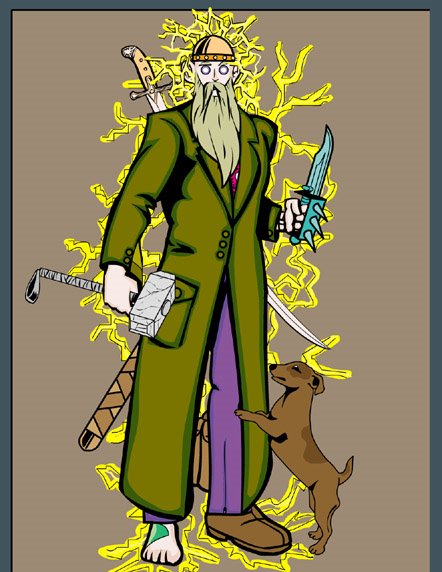
This afternoon I gave it a try...and much to my surprise, the randomly generated character turned out not to be ludicrous, but viable and even fairly cool. I think I feel cheated in some obscure way. Regardless, here's what I got:


(Note: The generated image was in black and white...but rather than have the program randomly select colors as well, I made my own color choices. Even this much conscious decision-making might be violating the "randomness" of the original meme to some extent, but the line art was selected by the program.)

So...who is this ranting homeless man, seemingly unaware that he's missing one boot, but armed to the teeth and wearing a helm that generates lightning while his faithful dog yaps at his feet?

On his back we see what looks like the saya of a Samurai's katana as well as a bare sabre. They stay in place without visible straps. The dagger with the nasty spiked hilt doesn't match either of those swords, nor does the familiar-looking implement in his other hand. Could he be wearing a military longcoat from still another army? It's almost as if one lone survivor had wandered the field after a wildly mismatched battle between several factions, and scavenged what clothes and arms he could from the bodies of the fallen combatants. But how does he come to hold that hammer?

Was it the ordeal of this battle that makes old Magni Vingnirsson behave so oddly, wandering the city accompanied by the dog he calls Fenris, wearing two monocles and ignoring his bare foot as the energy crackles around him? Maybe the old man carries the hammer so effortlessly because he inherited it from his father...just as it was foretold he would, after the day of Ragnarok...

Saturday, September 30, 2006

Thursday, September 28, 2006

Tokyo Rose, American Hero

Oh, just read about it here.

What makes me happy at the end of a heartwrenching story is her pardon by President Ford in 1977 -- perhaps this even makes up for that other pardon -- and the fact that Iva Ikuko Toguri lived another 30 years as a free American woman, her name and reputation vindicated. Honestly, sincerely, I'm proud of my country for that.

If you ever hear any of her actual broadcasts, or what remains of them, or those of the other women called "Tokyo Rose" it's obvious they could never have been taken seriously by the servicemen they were intended to demoralize. So I'm not at all surprised to hear that she was deliberately subverting her own broadcasts, making them comical and ineffective; it's obvious just listening to them. I knew they were hilariously funny the first time I heard them...long before the real story came out.

If I may hamfistedly tie this in with a parallel to recent events...consider what a soldier faces on the battlefield. The heat, the blood, the illnesses, cramped quarters, unprotected vehicles, lack of proper equipment, lack of body armor, improvised explosive devices in the road, other people trying to kill you every day. Don't you suppose those things are a greater threat to troop morale than any propaganda broadcast could be? Do you imagine any soldier would ever say "Sure, my best friend just had his face blown off, and my shirt is spattered with his brains...but hearing a political candidate criticize the Commander in Chief is what wounds my fragile, delicate sensibilities?"

Anyway. In wartime, Iva Ikuko Toguri did much good for her fellow Americans and no demonstrable harm, faced terrible hardship and personal risk to save lives, and we should honor her memory as a true American hero.

Update: Read a more detailed account of her true story here.

Tuesday, September 19, 2006

Pirate double feature

Bad movies and popular fiction over the last century or two may want you to think of all pirates as being crazed Englishmen, with or without heavy layers of mascara...but some of the most notable pirates in history were Sephardic Jews expelled from Spain in 1492 (or their descendants) seeking revenge for the Inquisition, or seizing booty as funds to buy safe passage for still more expelled Spanish Jews. From Jewishjournal.com:

One such pirate was Moses Cohen Henriques, who helped plan one of history's largest heists against Spain. In 1628, Henriques set sail with Dutch West India Co. Admiral Piet Hein, whose own hatred of Spain was fueled by four years spent as a galley slave aboard a Spanish ship. Henriques and Hein boarded Spanish ships off Cuba and seized shipments of New World gold and silver worth in today's dollars about the same as Disney's total box office for "Dead Man's Chest."

...

Another Sephardic pirate played a pivotal role in American history. In the book "Jews on the Frontier" (Rachelle Simon, 1991), Rabbi I. Harold Sharfman recounts the tale of Sephardic Jewish pirate Jean Lafitte, whose Conversos grandmother and mother fled Spain for France in 1765, after his maternal grandfather was put to death by the Inquisition for "Judaizing."

Referred to as The Corsair, Lafitte went on to establish a pirate kingdom in the swamps of New Orleans, and led more than 1,000 men during the War of 1812. After being run out of New Orleans in 1817, Lafitte re-established his kingdom on the island of Galveston, Texas, which was known as Campeche. During Mexico's fight for independence, revolutionaries encouraged Lafitte to attack Spanish ships and keep the booty.

But in the 1958 film "The Buccaneer," starring Yul Brynner as Lafitte, any mention of the pirate's Jewish heritage was stripped away.


If the prospect of Jewish pirates conjures up images from a Mel Brooks movie, or possibly the voice of Jackie Mason saying "What, you want I should collect pieces of eight?" while an elderly Jewish bubbe admonishes "By you, you're a pirate...by me, you're a pirate...but by a pirate, are you a pirate?" that's only natural. But, see, it's also part of the problem. That sort of thing is a beloved part of Jewish heritage...but the editing of popular culture to remove Jewishness from any other historical context besides humor and Holocaust survivors deprives Jewish people of the full opportunity to be, you know, people.

Someday I'd like to write an action story about a Jewish pirate. Might be interesting to have a pirate story with some motivation beyond saying "Arrr, Jim-boy! Avast, ye swabs!" And yes, there'd be Jewish humor in it...but he'd also be a swashbuckling action hero of the high seas who was totally cool and menacing.

I mean, everybody realizes both Kirk and Spock were Jewish, right?


And speaking of piracy, Engadget reports that the Diebold AccuVote-TS machine can be opened with a key from an ordinary hotel minibar. This article includes links to instructions on what the vote pirate can do once the machine is open.

Now that it's been revealed how insecure and easily compromised these machines are, how pathetically simple it is for any corupt official to hijack an election using these voting machines...part of me is almost hoping we'll see a massive, coordinated effort to subvert an election. Can you see how simple it would be for a few dozen vote hackers to synchronize their efforts and insert an obviously fraudulent name -- Mickey Mouse or Jack Kirby or Jean Lafitte -- never seen by the voters, but magically "elected" by an overwhelming majority as Governor or Senator? I wonder if anything short of this would send the message to everyone that voting machines controlled by a private company with insufficient security and which leave no verifiable paper trail are nothing short of a license to end democracy. If vote pirates struck at Diebold and opened them to the public humiliation they so richly deserve, at least the problem couldn't be ignored anymore.

And of course, a side benefit would be the public humiliation of an administration which claims to venerate the concept of "security" but does absolutely nothing to ensure the security of our most sacred rights and principles. Times like these may call for outrageous gestures to expose the sanctimony and hypocrisy of those in power. In other words, it sounds like a job for the pirates!

Saturday, September 09, 2006

Krazy kaptions


"It was Earth all along! You finally did it! You maniacs! Damn you all to hell!"

(Explanation here.)

Tuesday, September 05, 2006

Losing threads

This morning I found out that someone I liked a lot was dead, and I feel weird about it. This was someone I met in person only once, when he visited New York more than a decade ago, then corresponded with heavily for some time. We communicated in the form of written letters -- you know, the kind on paper -- but strangely enough, we never made the logical transition to staying in touch with e-mail. Instead, we fell out of contact right at the time we both got regular net access in our respective homes. So that's a bit counterintuitive right there...but that's not why I feel so weird about his death.

This guy had a much bigger impact on my life than he ever would have imagined. His girlfriend had been a friend of mine in the UK, but I didn't meet him while I was living there. He came to New York to play a gig with his band when I was working in music journalism (and simultaneously acting as roadie for a local group, as mentioned in the previous post) and he turned out to be a big comics fan. At that time, I had been totally estranged from anything to do with comics or comics fandom for about five years -- a string of bad experiences had left me feeling the need for a clean break -- but he and I got to talking about then-recent stuff in comics he was enthusiastic about.

One of those things was Alan Moore's 1963 miniseries, which had come and gone while I wasn't looking. He insisted that I was exactly the sort of reader who would best appreciate it, and that I had to check it out. (In the event, I was never quite as enthusiastic about that miniseries as he was, but I've reread it often and it always makes me think of him.)

Armed with a bunch of similar recommendations from him, I set foot in a comics shop for the first time in five years. I didn't find issues of 1963 right away, but I did find several issues of something called The Jack Kirby Collector -- this guy was also a big Kirby fan, and had tipped me off that big things were afoot in fandom following Kirby's passing -- and I bought each issue they had in the store. That plus some other tips from my new friend were my first steps back towards the world of comics and comics people. A lot of stuff I do now, including this blog, came about through a chain of events leading unbroken from that guy prompting me in that direction.

So it's a bummer to learn that he's gone. But what makes it so weird is that I found out today by reading this:

Jenni Scott offers a review of the Andy Roberts Memorial Comics Collection housed at the National Art Library in England’s Victoria and Albert Museum. (Link via Bugpowder’s Pete Ashton.)


...and that's how I learned Andy Roberts died on June 12th 2005 in the Intensive Care Unit at The Royal London Hospital following a road traffic accident on Bethnal Green Road six days earlier. I didn't mistype that. I've just found out he was dead fifteen months after it happened.

Over the years, I'd kept one eye on Caption, the Oxford-based small press/indie comics convention with which Andy was involved -- but apparently I wasn't paying attention over the past year or so, or I'd have noticed that link. But I'd certainly thought of Andy more than once over the past few months, and I'm at a complete loss to explain why it never occurred to me to try and find him online long ago to renew our communication. (Mind you, there are a lot of Andy Robertses out there.) I'm glad I told him several times how much I loved his music, his comics, and chatting with him...but I wish I could tell him again.

To me this is a fresh discovery, but to everyone else who knew Andy it's old news. So in addition to feeling bad about his death, I also feel like a pathetic idiot for being so clueless and out of touch. But, you know, it happens.