A commenter by appointment to this blog asks: "Countdown with Keith Olbermann, isn't that a sports show, or something?" Let this humble blog be the place where readers may doff their Clueless Hats and become enlightened...
If you think for a moment I'd watch a sports show, you doesn't know me very well. Countdown with Keith Olbermann on MSNBC isn't a sports show. Admittedly there are sports-related stories on the show from time to time, because Olbermann isn't merely a former sportscaster by profession: he loves sports the way I love comics. But this show is almost entirely about national politics and major issues of the day. As I said in the previous post, Countdown is funnier and more pointed in its political commentary than The Daily Show, and well worth watching whatever one's political and/or philosophical bent.
Even when Olbermann covers sports-related stories on Countdown, the stories aren't about games or scores or trades...but rather about the political and social issues that underlie controversies in the sports world. He's had a few too many stories about Barry Bonds and steroid abuse lately for my personal taste...but those stories haven't been about Bonds' career as a left fielder. They've been examinations of how a bureaucracy responds slowly to a scandal, how economic pressure to compete might lead someone to break the rules, how a rulebreaker might misuse the legal system to silence his critics through lawsuits...universal issues that are fascinating even if Bonds himself is of less than no interest to me. But don't be misled by my digression here; I'd guess all sports coverage makes up only 10% of Countdown, which is otherwise oriented towards world news and politics, plus mockery of the tabloid celebrity stories that have all the other cable news shows fascinated.
A further digression about the value of sports reporters, if I may? Sports reporters are often better than any other kind of reporter. This is because entering that field requires some basic qualifications. The sports reporter needs to have a thorough knowledge of sports facts and figures to get in the door -- their stock in trade is verifiable factual information, not just ill-considered opinion or speculation or recycling of White House press releases, and they're held accountable for geting their facts wrong. These skills are what all reporters should have but very few are obliged to learn. These skills serve sports reporters especially well if they move on to other fields besides sports coverage; Bob Costas is another fine example. My interest in professional sports can only be measured in negative numbers, but my respect for former professional sports reporters is very high indeed.
Yes, yes, this is all very well and good, you say, but we're still waiting for you to make the case for Olbermann. Why should we trust you when you won't even tell us what RAB means?
You make an excellent point, imaginary voice. I personally find Keith Olbermann witty, insightful, and erudite...but today's discriminating bloggers demand proof. Whether or not you enjoy a particular television talking head is mostly a question of personal taste. I know people who enjoy watching Jon Stewart but don't care for his politics -- and by the same token, others who agree with the politics but find his style and delivery annoying. The best way to decide if you might like Olbermann is to see him for yourself.
Here are some clips of Keith Olbermann on MSNBC, and here's Keith as a guest on The Colbert Report. This selection of clips is a bit heavy on the Bill O'Reilly content, because the fans love the celebrity feuds and O'Reilly has made Olbermann his personal nemesis. However, a particular favorite clip of mine is Keith Olbermann putting Laura Ingraham in her place for her odious comments about the supposed cowardice of reporters in Iraq. And here are links to some of his essays on various topics including the war on terror, Scooter Libby, and the untrustworthiness of Lance Armstrong.
Oh yeah, because that's another thing sports reporters have to do that other television reporters don't -- they have to be able to write their own words. And if an anti-sports guy like me can enjoy someone writing about sports, you'd best believe that's some good writing.
Monday, March 27, 2006

Friday, March 24, 2006
After morning a be to got there's
This is the conclusion of my accidental Isaac Hayes trilogy of posts. Special bonus points to anyone who anyone who posts the best explanation of the above title...
Maybe three months ago, Gregg and Evan Spiridellis of JibJab were being interviewed on television -- I'm pretty sure the show must have been Countdown with Keith Olbermann on MSNBC, which is often funnier and more pointed in its political commentary than The Daily Show -- about their latest Flash animation poking gentle fun at the travails of President Bush in the preceding year. This was the one set to the tune of "Auld Lang Syne" and "Turkey in the Straw" about which you probably received 900 e-mails in December, all saying "Hilarious!!! You gotta see this!!!"
Personally, I don't find their stuff especially entertaining; I find it bland and toothless, creating the illusion of humor without any point of view. Apparently not everyone feels this way: on this news show, the Spiridellis brothers were talking about the volume of outraged messages they'd received from both ends of the political spectrum. They said the Right was angry with them for attacking the President, and the Left was angry at them for portaying him sympathetically. One of the boys said this proved the maxim that "If both sides are angry at you, you're doing something right."
To which I immediately thought: Wrong. When you're doing this sort of thing right, people of opposing views each think you agree with them.
Case in point: South Park. We all know people who are stone cold liberals and want to see the smirking pretender Bush impeached, and who love South Park for its skepticism of authority and its willingness to attack sexism, racism, and homophobia. We all know rock hard conservatives who love the show for its attacks on political correctness and stand in favor of traditional values. The mere fact of a book titled South Park Conservatives : The Revolt Against Liberal Media Bias makes it clear two opposing philosophies have claimed the show as their own. But in reality, those opposing teams are imaginary constructs of a culture which tries to break every question down to "you're either with us or against us" -- real individuals can have a variety of opinions that fit anywhere along a wide continuum, or even a multidimensional grid, and can even hold contradictory views on the same question. Simply by being honest and reflecting such an individual viewpoint, South Park became a Rorschach blot onto which people could project their own assumptions and biases, and accept the show as agreeing with them.
And so we come to the latest episode, in which the character of Chef is given his momentous farewell. With an estimated 3.5 million viewers tuning in for the season premiere, I hardly need to recap what happened, do I? But it may be interesting to look at the viewer comments on show's official website forums and many other online venues. Responses range from "Man, they really tore Isaac Hayes a new one" and "I hope I never get Matt and Trey as pissed off at me as they were at him" to "the farewell speech was beautiful" and "I was in tears by the end." I think we have here another example of people projecting their own take on an issue -- in this case, the sudden defection of Isaac Hayes from the show -- onto a story that was nuanced, subtle, and even self-contradictory, accurately reflecting the mixed emotions surrounding this topic.
There were moments when the writing was exceptionally vicious towards Hayes -- but never without humor; I hope everyone caught the brilliant visual quote from a famous Simpsons moment when Chef tumbles down the cliff -- and moments when the episode displayed naked heartbreak at the loss of a loved one. And this was an accurate depiction of the wildly swinging pendulum of emotions you feel when you lose a friend or lover or family member to a cult. One moment you rage at that person for being so incredibly stupid and self-destructive and selfish -- "you couldn't have done this if I meant anything to you!" -- and the next moment you're in tears, the anger vanished, mourning a loss that in some ways is worse than a death. If the loved one had simply died, that would be an ending and a closure...but instead you live with the knowledge that he or she is still out there, or someone claiming to be him or her is there, and it feels like an ongoing betrayal that just won't stop.
That's the reality this episode captures, and those who take it only as gleeful bashing of a former cast member or only as a love letter to Hayes are each, one feels, missing part of the picture.
I could quibble with a couple of things. Part of the show's stock in trade is their rapid turnaround time -- producing a finished episode in less than a week -- enabling the content to be timely and topical. In this case, though, they might have done better to wait, if only to give writer Trey Parker as well as partner Matt Stone a chance to reflect and put their feelings in perspective. But then, if they were slow and cautious, South Park wouldn't be South Park.
My other quibble is that a prime tool of the cult mentality is dissociation, the disconnect between the recruit's past life and his or her new life with the cult. Whether or not Hayes truly quit the show of his own volition -- whatever personal volition may mean in circumstances like these! -- the show closing the door on the possibility of his return is, if only on a symbolic level, right in line with the message of a Church that tells its followers "Your old friends outside us aren't really your friends, they've turned their back on you, you only belong with us." The closing memorial to Chef in this episode stands against that message...but the point may be too subtle. And being too subtle always runs that risk of opposing sides each claiming your message as being their own.
Maybe three months ago, Gregg and Evan Spiridellis of JibJab were being interviewed on television -- I'm pretty sure the show must have been Countdown with Keith Olbermann on MSNBC, which is often funnier and more pointed in its political commentary than The Daily Show -- about their latest Flash animation poking gentle fun at the travails of President Bush in the preceding year. This was the one set to the tune of "Auld Lang Syne" and "Turkey in the Straw" about which you probably received 900 e-mails in December, all saying "Hilarious!!! You gotta see this!!!"
Personally, I don't find their stuff especially entertaining; I find it bland and toothless, creating the illusion of humor without any point of view. Apparently not everyone feels this way: on this news show, the Spiridellis brothers were talking about the volume of outraged messages they'd received from both ends of the political spectrum. They said the Right was angry with them for attacking the President, and the Left was angry at them for portaying him sympathetically. One of the boys said this proved the maxim that "If both sides are angry at you, you're doing something right."
To which I immediately thought: Wrong. When you're doing this sort of thing right, people of opposing views each think you agree with them.
Case in point: South Park. We all know people who are stone cold liberals and want to see the smirking pretender Bush impeached, and who love South Park for its skepticism of authority and its willingness to attack sexism, racism, and homophobia. We all know rock hard conservatives who love the show for its attacks on political correctness and stand in favor of traditional values. The mere fact of a book titled South Park Conservatives : The Revolt Against Liberal Media Bias makes it clear two opposing philosophies have claimed the show as their own. But in reality, those opposing teams are imaginary constructs of a culture which tries to break every question down to "you're either with us or against us" -- real individuals can have a variety of opinions that fit anywhere along a wide continuum, or even a multidimensional grid, and can even hold contradictory views on the same question. Simply by being honest and reflecting such an individual viewpoint, South Park became a Rorschach blot onto which people could project their own assumptions and biases, and accept the show as agreeing with them.
And so we come to the latest episode, in which the character of Chef is given his momentous farewell. With an estimated 3.5 million viewers tuning in for the season premiere, I hardly need to recap what happened, do I? But it may be interesting to look at the viewer comments on show's official website forums and many other online venues. Responses range from "Man, they really tore Isaac Hayes a new one" and "I hope I never get Matt and Trey as pissed off at me as they were at him" to "the farewell speech was beautiful" and "I was in tears by the end." I think we have here another example of people projecting their own take on an issue -- in this case, the sudden defection of Isaac Hayes from the show -- onto a story that was nuanced, subtle, and even self-contradictory, accurately reflecting the mixed emotions surrounding this topic.
There were moments when the writing was exceptionally vicious towards Hayes -- but never without humor; I hope everyone caught the brilliant visual quote from a famous Simpsons moment when Chef tumbles down the cliff -- and moments when the episode displayed naked heartbreak at the loss of a loved one. And this was an accurate depiction of the wildly swinging pendulum of emotions you feel when you lose a friend or lover or family member to a cult. One moment you rage at that person for being so incredibly stupid and self-destructive and selfish -- "you couldn't have done this if I meant anything to you!" -- and the next moment you're in tears, the anger vanished, mourning a loss that in some ways is worse than a death. If the loved one had simply died, that would be an ending and a closure...but instead you live with the knowledge that he or she is still out there, or someone claiming to be him or her is there, and it feels like an ongoing betrayal that just won't stop.
That's the reality this episode captures, and those who take it only as gleeful bashing of a former cast member or only as a love letter to Hayes are each, one feels, missing part of the picture.
I could quibble with a couple of things. Part of the show's stock in trade is their rapid turnaround time -- producing a finished episode in less than a week -- enabling the content to be timely and topical. In this case, though, they might have done better to wait, if only to give writer Trey Parker as well as partner Matt Stone a chance to reflect and put their feelings in perspective. But then, if they were slow and cautious, South Park wouldn't be South Park.
My other quibble is that a prime tool of the cult mentality is dissociation, the disconnect between the recruit's past life and his or her new life with the cult. Whether or not Hayes truly quit the show of his own volition -- whatever personal volition may mean in circumstances like these! -- the show closing the door on the possibility of his return is, if only on a symbolic level, right in line with the message of a Church that tells its followers "Your old friends outside us aren't really your friends, they've turned their back on you, you only belong with us." The closing memorial to Chef in this episode stands against that message...but the point may be too subtle. And being too subtle always runs that risk of opposing sides each claiming your message as being their own.
Monday, March 20, 2006
Time for Chef Aid II
The story of Isaac Hayes leaving South Park gets even weirder. From the article:
And...
Who indeed.
Isaac Hayes did not quit "South Park." My sources say that someone quit it for him.
I can tell you that Hayes is in no position to have quit anything. Contrary to news reports, the great writer, singer and musician suffered a stroke on Jan. 17. At the time it was said that he was hospitalized and suffering from exhaustion.
It’s also absolutely ridiculous to think that Hayes, who loved playing Chef on "South Park," would suddenly turn against the show because they were poking fun at Scientology.
Last November, when the “Trapped in a Closet” episode of the comedy aired, I saw Hayes and spent time with him in Memphis for the annual Blues Ball.
If he hated the show so much, I doubt he would have performed his trademark hit song from the show, “Chocolate Salty Balls.” He tossed the song into the middle of one of his less salacious hits and got the whole audience in the Memphis Pyramid to sing along.
And...
Friends in Memphis tell me that Hayes did not issue any statements on his own about South Park. They are mystified.
“Isaac’s been concentrating on his recuperation for the last two and a half, three months,” a close friend told me.
Hayes did not suffer paralysis, but the mild stroke may have affected his speech and his memory. He’s been having home therapy since it happened.
That certainly begs the question of who issued the statement that Hayes was quitting "South Park" now because it mocked Scientology four months ago. If it wasn’t Hayes, then who would have done such a thing?
Who indeed.
Sunday, March 19, 2006
Bounty hunters followup
After feedback on my previous post via e-mail and from the Jack Kirby mailing list, I'd like to clarify a couple of points on my objection to using the name and legacy of Jack Kirby.
First, I have no problem with people paying tribute to Kirby in their work. I didn't see anything wrong with Alan Moore or Kevin Eastman and Peter Laird creating characters in their own comics that were meant to be Kirby himself. (Click on those links: that second one is an absolute gem.) Joe Casey and Tom Scioli have had huge success with a series called GØDLAND, a tribute that works best for fans who recognize the allusions they're making to vintage Kirby comics. What Grant Morrison just did with the Kirby characters Klarion the Witchboy, Mister Miracle, and the Guardian in his Seven Soldiers series was quite lovely. And then there are the artists who can "do Kirby" and visually quote from his work in the process of doing their own thing. To me, these are all ways of saying "That guy was a giant! People like us who came later owe him a huge debt!"
(By way of full disclosure: I've also written the script for a Kirby tribute comic...and it occurred to me that I might be setting myself up for a "Hypocrite of the Decade" award somewhere down the line if it seemed like I was condemning the very thing I was doing myself.)
On the other hand, to have "Jack Kirby's" in the title of a new book by other people gives the impression that it represents his work or carries his informed blessing. If Jack's name wasn't in the title or on the cover, this objection wouldn't apply: it would simply be a comic by Lisa Kirby and Mike Thibodeaux, with a line on the credits page reading "based on an idea by Jack Kirby" and that would be entirely appropriate.
An excellent point was made on the Kirby mailing list regarding the "Kirbyverse" comics from Topps, a line of comics based on concepts and character sketches by Kirby. The actual comics all had Kirby's name on the covers but were largely or entirely the work of other people. And of course there were other times Jack had no problem with other people taking over characters he created -- we're talking about the guy who alone or in collaboration with others invented Captain America, the Fantastic Four, the Incredible Hulk, and several thousands of others. But the arrangement with Topps came at a very specific time in Kirby's life: a time when he was locked in a legal struggle with Marvel Comics over creative credit for his work and the ownership of his original artwork. There was an immediate pressing reason to raise his name recognition as a creator of characters at that particular moment. For me, the bottom line is that Jack decided the Topps arrangement was appropriate then, that one time, and was available to personally approve of having his name on the finished product. That isn't the case now, and there are a different set of concerns today.
Jack Kirby didn't need to think in terms of what his legacy would be years after his death; he was concerned with providing for his family. Now that he's gone, the family's concern should be preserving his legacy in the decades to come. They can do this through the Kirby Museum and by working with publishers to make sure Kirby's actual work is always available to those who want to read it. The Kirby Estate doesn't need to quickly elevate Kirby's name recognition in the short term. If anything, it needs to do the opposite of this, and be more protective and conservative about his reputation and keeping the use of his name away from things he did not participate in. In short, the family needs to take a long-range view. It's not a question of "does the Kirby family have the legal right to make any deal they want?" -- obviously they do -- but my personal feeling that this isn't in the best interests of the Kirby family or in the best interests of preserving Kirby's reputation.
I hope this clears up any potential misunderstanding...and I want to emphasize again that I mean no personal insult to anyone involved in this project. If my best friend in the world were working on this project, I would say the same thing.
First, I have no problem with people paying tribute to Kirby in their work. I didn't see anything wrong with Alan Moore or Kevin Eastman and Peter Laird creating characters in their own comics that were meant to be Kirby himself. (Click on those links: that second one is an absolute gem.) Joe Casey and Tom Scioli have had huge success with a series called GØDLAND, a tribute that works best for fans who recognize the allusions they're making to vintage Kirby comics. What Grant Morrison just did with the Kirby characters Klarion the Witchboy, Mister Miracle, and the Guardian in his Seven Soldiers series was quite lovely. And then there are the artists who can "do Kirby" and visually quote from his work in the process of doing their own thing. To me, these are all ways of saying "That guy was a giant! People like us who came later owe him a huge debt!"
(By way of full disclosure: I've also written the script for a Kirby tribute comic...and it occurred to me that I might be setting myself up for a "Hypocrite of the Decade" award somewhere down the line if it seemed like I was condemning the very thing I was doing myself.)
On the other hand, to have "Jack Kirby's" in the title of a new book by other people gives the impression that it represents his work or carries his informed blessing. If Jack's name wasn't in the title or on the cover, this objection wouldn't apply: it would simply be a comic by Lisa Kirby and Mike Thibodeaux, with a line on the credits page reading "based on an idea by Jack Kirby" and that would be entirely appropriate.
An excellent point was made on the Kirby mailing list regarding the "Kirbyverse" comics from Topps, a line of comics based on concepts and character sketches by Kirby. The actual comics all had Kirby's name on the covers but were largely or entirely the work of other people. And of course there were other times Jack had no problem with other people taking over characters he created -- we're talking about the guy who alone or in collaboration with others invented Captain America, the Fantastic Four, the Incredible Hulk, and several thousands of others. But the arrangement with Topps came at a very specific time in Kirby's life: a time when he was locked in a legal struggle with Marvel Comics over creative credit for his work and the ownership of his original artwork. There was an immediate pressing reason to raise his name recognition as a creator of characters at that particular moment. For me, the bottom line is that Jack decided the Topps arrangement was appropriate then, that one time, and was available to personally approve of having his name on the finished product. That isn't the case now, and there are a different set of concerns today.
Jack Kirby didn't need to think in terms of what his legacy would be years after his death; he was concerned with providing for his family. Now that he's gone, the family's concern should be preserving his legacy in the decades to come. They can do this through the Kirby Museum and by working with publishers to make sure Kirby's actual work is always available to those who want to read it. The Kirby Estate doesn't need to quickly elevate Kirby's name recognition in the short term. If anything, it needs to do the opposite of this, and be more protective and conservative about his reputation and keeping the use of his name away from things he did not participate in. In short, the family needs to take a long-range view. It's not a question of "does the Kirby family have the legal right to make any deal they want?" -- obviously they do -- but my personal feeling that this isn't in the best interests of the Kirby family or in the best interests of preserving Kirby's reputation.
I hope this clears up any potential misunderstanding...and I want to emphasize again that I mean no personal insult to anyone involved in this project. If my best friend in the world were working on this project, I would say the same thing.
Saturday, March 18, 2006
Bounty hunters
Here's a news item from Wizard World:
You know what? No. This isn't a good thing. I know a lot of people will get on my case for saying this -- "How can you possibly know what Jack would have wanted? These are his family and friends, where does someone who never knew him get off claiming to know his wishes better than they do?" -- but nonetheless, I still feel totally confident in saying Jack would not have wanted this.
Marvel reprinting his actual work? Yes. Marvel doing right by his family? Absolutely yes. People trading on his name and some unpublished sketches to sell work that isn't his? Not so much.
I don't mean this as an attack on Marvel -- one benefit of having worked in the Marvel offices myself is the knowledge that it's just a company, not a monolithic conscious entity capable of good or bad intentions. Even during Jack's legal struggle with earlier management, there were individual people at Marvel who loved Jack and were committed to doing whatever they could to support him. And I really don't want this to come across as an insult to Tom Brevoort, who's a really good guy of exceptional taste and has been involved with pretty much every good thing Marvel has published in many years.
And Lisa Kirby? Honestly, believe it or not, I have nothing but sympathy for her position. During my childhood, my dad was the doctor in a small town; I grew up with him being a local "celebrity" and constantly had people telling me what an amazing person he was, how he was a saint and how fortunate I was to have him as my father. Well, yes, sure, I totally agree -- but when a guy is your father and you know his failings and weaknesses and all the times you've argued with him over stupid things, it's mind-bendingly weird to cope with people who are his fans and idolize him. And I can well imagine how offended I'd be if some obnoxious prick came along and claimed to know better than I do what my father would have wanted.
(My dad later ran several hospitals and travelled all over the world as a medical expert in his field. He hated being away from home even overnight, and would fly cross-country twice in a day rather than be put up one night in the most expensive hotel suite in another city. But I did get a major kick out of him becoming world famous...)
But if someone set up a medical practice claiming to be his heir -- even if I were to declare myself a doctor because I happened to be his son, and then put his name on the shingle -- that would still be wrong. My dad was an amazing doctor (I'm biased, yes, but it's still true) but he got that way through a combination of individual gifts AND decades of hard work. He wasn't just born into it, and I didn't get it through his seed or even by being around him for forty years.
I really, really, really want the Kirby family to have a place of honor and respect. He loved his family and worked hard to provide for them and they were at the center of his art. Bless them for that. But they would all do well to become more sensible conservators of his legacy. Things like the Kirby Museum and supporting more reprinting of his work are absolutely right: things that will keep his name and work in front of the public so that future generations will see the stuff from which all later comics derive. But when work by other people is put out with the "Jack Kirby" name slapped on it, it has the tragic effect of diluting his reputation rather than enhancing it. If new readers are unimpressed by it, this will be their negative impression of "Jack Kirby" and it will only put them off seeking out the real thing.
By way of another analogy: for many years, I thought I hated blues music. I couldn't understand this, because I always loved African-American musical styles, but the blues I'd heard left me cold. When I was an adult, I heard Lightning Hopkins and Muddy Waters and John Lee Hooker for the first time and immediately fell in love. Only then did I understand what I'd been thinking of as "blues music" was the watered-down copies by the Rolling Stones (great at their own stuff, but lousy blues musicians) or the Yardbirds or Eric Clapton -- in other words, overly mannered and stylized copies by later imitators. Bad imitations and improper branding could have kept me away from the real thing my whole life, and that would have been a horrible shame.
Please, guys, please...think about the consequences of this sort of thing. I want the Kirby legacy to be strong as much as anyone in the world does. Keep the work he actually did, and finished, and signed off on, and approved out there in front of the public. But don't dilute it with grave rubbings and counterfeit work, or you'll end up without that legacy.
"Before Stephen King, there was another King."
"With these enigmatic words, Joe Quesada began another highly-anticipated Cup O' Joe Panel. Referring to last year's announcement that Stephen King would bring his 'Dark Tower' series to Marvel as a comic in 2007, Joe was talking about a king at Marvel: Jack Kirby.
"For specifics, Joe brought up Jack's daughter Lisa. She explained that, while going through her late father's sketches, she stumbled upon some that she didn't recognize from any of his published work. Thus, 'Jack Kirby's Galactic Bounty Hunters' was born. The first of this six-issue limited series will be out in July, in time for the San Diego Comic Con. Tom Breevort remarked, 'it's good to have a Kirby back at Marvel.' Quesada agreed. The series is a creator-owned property and will be published through Marvel's Icon imprint.
"Jack Kirby's Galactic Bounty Hunters features characters and concepts created by the late Jack Kirby, which have been expanded upon by his daughter Lisa Kirby and Mike Thibodeaux. It's a very personal story for Lisa, metaphorically dealing with her relationship with her father against a cosmic backdrop of fantastic characters and wild vistas. It also features appearances by other Kirby-owned characters such as Captain Victory."
You know what? No. This isn't a good thing. I know a lot of people will get on my case for saying this -- "How can you possibly know what Jack would have wanted? These are his family and friends, where does someone who never knew him get off claiming to know his wishes better than they do?" -- but nonetheless, I still feel totally confident in saying Jack would not have wanted this.
Marvel reprinting his actual work? Yes. Marvel doing right by his family? Absolutely yes. People trading on his name and some unpublished sketches to sell work that isn't his? Not so much.
I don't mean this as an attack on Marvel -- one benefit of having worked in the Marvel offices myself is the knowledge that it's just a company, not a monolithic conscious entity capable of good or bad intentions. Even during Jack's legal struggle with earlier management, there were individual people at Marvel who loved Jack and were committed to doing whatever they could to support him. And I really don't want this to come across as an insult to Tom Brevoort, who's a really good guy of exceptional taste and has been involved with pretty much every good thing Marvel has published in many years.
And Lisa Kirby? Honestly, believe it or not, I have nothing but sympathy for her position. During my childhood, my dad was the doctor in a small town; I grew up with him being a local "celebrity" and constantly had people telling me what an amazing person he was, how he was a saint and how fortunate I was to have him as my father. Well, yes, sure, I totally agree -- but when a guy is your father and you know his failings and weaknesses and all the times you've argued with him over stupid things, it's mind-bendingly weird to cope with people who are his fans and idolize him. And I can well imagine how offended I'd be if some obnoxious prick came along and claimed to know better than I do what my father would have wanted.
(My dad later ran several hospitals and travelled all over the world as a medical expert in his field. He hated being away from home even overnight, and would fly cross-country twice in a day rather than be put up one night in the most expensive hotel suite in another city. But I did get a major kick out of him becoming world famous...)
But if someone set up a medical practice claiming to be his heir -- even if I were to declare myself a doctor because I happened to be his son, and then put his name on the shingle -- that would still be wrong. My dad was an amazing doctor (I'm biased, yes, but it's still true) but he got that way through a combination of individual gifts AND decades of hard work. He wasn't just born into it, and I didn't get it through his seed or even by being around him for forty years.
I really, really, really want the Kirby family to have a place of honor and respect. He loved his family and worked hard to provide for them and they were at the center of his art. Bless them for that. But they would all do well to become more sensible conservators of his legacy. Things like the Kirby Museum and supporting more reprinting of his work are absolutely right: things that will keep his name and work in front of the public so that future generations will see the stuff from which all later comics derive. But when work by other people is put out with the "Jack Kirby" name slapped on it, it has the tragic effect of diluting his reputation rather than enhancing it. If new readers are unimpressed by it, this will be their negative impression of "Jack Kirby" and it will only put them off seeking out the real thing.
By way of another analogy: for many years, I thought I hated blues music. I couldn't understand this, because I always loved African-American musical styles, but the blues I'd heard left me cold. When I was an adult, I heard Lightning Hopkins and Muddy Waters and John Lee Hooker for the first time and immediately fell in love. Only then did I understand what I'd been thinking of as "blues music" was the watered-down copies by the Rolling Stones (great at their own stuff, but lousy blues musicians) or the Yardbirds or Eric Clapton -- in other words, overly mannered and stylized copies by later imitators. Bad imitations and improper branding could have kept me away from the real thing my whole life, and that would have been a horrible shame.
Please, guys, please...think about the consequences of this sort of thing. I want the Kirby legacy to be strong as much as anyone in the world does. Keep the work he actually did, and finished, and signed off on, and approved out there in front of the public. But don't dilute it with grave rubbings and counterfeit work, or you'll end up without that legacy.
Monday, March 13, 2006
Well, crap
I had just about convinced myself this wouldn't happen. What was I thinking?
Hayes could simply have said he was leaving the show, with no explanation, or used the old chestnut that it was for unstated "personal reasons." Everyone would have known the reason, but it would have been far less insulting to people who've done right by him for many years. Instead, his spokesman is quoted in the Reuters article as saying "there is a time when satire ends and intolerance and bigotry toward religious beliefs and others begins" -- in other words, claiming that Trey Parker and Matt Stone are the ones being intolerant and bigoted. But Hayes didn't quit the show when they did far worse to the sacred cows of Christianity or Judaism or Islam or Mormonism. So it's okay to bash everyone else's religions, but his own is something different. I can't think of a clearer demonstration of bigotry and rank hypocrisy.
I can't even begin to convey how utterly depressing this is. Isaac Hayes was such a huge figure in my childhood, the absolute icon of cool. I mean, come on, the opening credits of Shaft with his theme music! His appearances on The Rockford Files, the coolest detective show ever! His amazing, influential albums! Sure, I was miffed when I learned he was a believer in a religion that I have a lot of trouble tolerating (mind you, South Park pointed out that "tolerance" doesn't mean approving of something but rather putting up with it...through gritted teeth if necessary) but his continued participation in the show did a lot to ease my qualms. I was raised to believe a sense of humor is a mark of sanity, above all...and if Hayes could take all the tastelessness and caustic wit of South Park with good humor, maybe that proved Scientology didn't necessarily turn its followers into mindless drones. Maybe, in spite of its egregiously silly teachings, it wasn't that much worse than any other religion. Well, now we have solid proof the exact opposite is the case.
I've lost a childhood idol today, and I'm genuinely upset by that.
Update: a friend has brought to my attention the following quote from the Isaac Hayes interview at the Onion AV Club on January 4th, 2006:
I've seen a number of fans suggesting that Hayes' action was forced on him by Church bigwigs and that they were responsible for his recent statement. The above quote makes that seem entirely likely. But if so, until he stands up for himself, my feelings are the same.
Hayes could simply have said he was leaving the show, with no explanation, or used the old chestnut that it was for unstated "personal reasons." Everyone would have known the reason, but it would have been far less insulting to people who've done right by him for many years. Instead, his spokesman is quoted in the Reuters article as saying "there is a time when satire ends and intolerance and bigotry toward religious beliefs and others begins" -- in other words, claiming that Trey Parker and Matt Stone are the ones being intolerant and bigoted. But Hayes didn't quit the show when they did far worse to the sacred cows of Christianity or Judaism or Islam or Mormonism. So it's okay to bash everyone else's religions, but his own is something different. I can't think of a clearer demonstration of bigotry and rank hypocrisy.
I can't even begin to convey how utterly depressing this is. Isaac Hayes was such a huge figure in my childhood, the absolute icon of cool. I mean, come on, the opening credits of Shaft with his theme music! His appearances on The Rockford Files, the coolest detective show ever! His amazing, influential albums! Sure, I was miffed when I learned he was a believer in a religion that I have a lot of trouble tolerating (mind you, South Park pointed out that "tolerance" doesn't mean approving of something but rather putting up with it...through gritted teeth if necessary) but his continued participation in the show did a lot to ease my qualms. I was raised to believe a sense of humor is a mark of sanity, above all...and if Hayes could take all the tastelessness and caustic wit of South Park with good humor, maybe that proved Scientology didn't necessarily turn its followers into mindless drones. Maybe, in spite of its egregiously silly teachings, it wasn't that much worse than any other religion. Well, now we have solid proof the exact opposite is the case.
I've lost a childhood idol today, and I'm genuinely upset by that.
Update: a friend has brought to my attention the following quote from the Isaac Hayes interview at the Onion AV Club on January 4th, 2006:
AVC: There's some pretty harsh satire on South Park. They don't really care who they offend.
IH: But that's their thing! They're success was built on that cutting-edge stuff. I've had to defend them a lot of times. One time on BET Tonight I defended them because Tavis Smiley, the host on that show, was coming at me. It was a call-in show, too, so people were calling in. I told them not to take this stuff seriously. If you do, you'll get in trouble. Just enjoy it. Remember your high-school yearbook? You look at those pictures now, you laugh, right? That's what South Park is. You got to laugh at it. Because we cursed, but we just didn't dare let the principals, the teachers, or the preachers hear it. And we didn't turn out bad, okay? Just look at it that way. Also, usually there's some kind of moral message at the end for the kids, by the Chef.
AVC: They did just do an episode that made fun of your religion, Scientology. Did that bother you?
IH: Well, I talked to Matt and Trey about that. They didn't let me know until it was done. I said, "Guys, you have it all wrong. We're not like that. I know that's your thing, but get your information correct, because somebody might believe that shit, you know?" But I understand what they're doing. I told them to take a couple of Scientology courses, and understand what we do. [Laughs.]
I've seen a number of fans suggesting that Hayes' action was forced on him by Church bigwigs and that they were responsible for his recent statement. The above quote makes that seem entirely likely. But if so, until he stands up for himself, my feelings are the same.
Sunday, March 12, 2006
Steals from the poor and gives to the rich?
My friend John H, among others, wrote this morning to remind me that the New York Times article by Dave Itzkoff on Alan Moore and V For Vendetta is now available online. I've been mulling over this article for a couple of days -- indeed, the ongoing dispute between Moore and DC is something I've thought about a lot over the past few years. Here are some incoherent ramblings on that topic...
Richard Feynman, one of the most influential physicists of the 20th century and one of my personal heroes -- you may remember him from the investigation of the 1986 Challenger shuttle disaster -- had a sideline in exposing phony mediums and psychics. One of the odd aspects of paranormal studies is that a great many scientists and learned people have been taken in by the most transparently blatant hoaxes and cons involving seances and spiritualists. Feynman attended such demonstrations and took delight in spotting and exposing the tricks that were being used to perpetrate the fraud. He reasoned -- and I paraphrase his own words very roughly here, for which I apologize -- that great thinkers and educated men were fooled precisely because they went into such situations with the attitude "I am a highly educated fellow with many degrees and professional accomplishments to my name, therefore I am not easily fooled and it would take a great deal to trick me." By contrast, Feynman described his own attitude as "I'm as gullible and easily tricked as anyone. If I see something that disagrees with scientific principles, there's a very good chance I'm being fooled. Let me watch closely and see if I can figure out how it's being done." Armed with this concept, Feynman was indeed able to spot the trickery being used by so-called psychics when so many other scientists had been completely taken in by their own conceit.
If it's not immediately clear what this has to do with Alan Moore, let me describe some things I know about him personally. I can't say I was ever a close friend or acquaintance...but I had two or three fairly long conversations with him back in the mid-Eighties, when Moore attended conventions and comics marketplaces, the days when Swamp Thing was still relatively new and Watchmen was still being dreamed up. He was an approachable person then, and although his self-presentation was already very theatrical and posed, he was pretty open about who he was and where he was coming from.
One important thing about Alan Moore is...well, he might like you to think of him as a hard-nosed bastard like John Constantine or a mystic sage like Doctor Strange, but his self-image is much more like his characters Tom Strong or Ozymandias from Watchmen. The smartest guy in the room? Maybe...if that room is as big as the world. His fundamental concept of the world is "I'm cleverer than you, and that entitles me to respect and deference." I'm sorry if that sounds harsh; the truth is, I liked him a lot and saw no reason to disagree with his self-estimation. I don't think arrogance is, in and of itself, necessarily a bad thing. He is pretty damned clever and he's only being realistic in admitting it. But sometimes he's too damn clever for his own good.
(Not an exaggeration: he once recounted an argument he'd had with an angry editor, and concluded by saying "I'm cleverer than [that editor], that person can't speak to me like that!")
One thing about Moore's writing is the amount of calculation and careful planning. His stories are worked out in tiny detail like clockwork -- any other writer who studies his work is driven to despair by the intricacy of his design. But that's his fiction. That's not Alan Moore the person. Moore in real life is entirely as he presents himself, without artifice. His theatrical pronouncements are fairly transparent as attention-getting ploys go. I'd almost go so far as to call him naive in his lack of duplicity and calculation.
(One of my vivid memories is of Moore at a UK Comic Art Convention during the Eagle Awards ceremony: he took a seat in the very back row of the convention hall, knowing full well that he'd be receiving several awards. Sitting at the back gave him the opportunity to make a big show of continually having to stride to the front of the room, accept his award, and go back to the rear. By the fourth or fifth award, he was theatrically panting and puffing to show his exertion at all the walking back and forth. Yeah, it was hilarious and we all laughed. But it was also a way of wringing just a little bit more attention out of the moment...)
His attitude coming into any kind of negotiation or business dealing is "I can easily see in rational terms that you being as good as your word and honoring your committment to me will be to our mutual benefit. There is no rational reason for you to want to cheat me, therefore I trust you." Of course other people are not like that! So he gets burned by deals that less "clever" people would take in their stride. And there we have the Feynman principle in action: the poor guy who's convinced of his own wisdom and inability to be fooled gets taken in by a contract that says "all rights to this property revert to you, provided we let it go out of print...which of course we never will, because we're a business and publishing this makes us money." Countless writers who are less "clever" would take something like that for granted.
Even worse, when someone like Steve Bissette deals with Moore in what seems to be total good faith and a business arrangement falls through without malice on anyone's part, Moore can only imagine that the publisher was acting with criminal ineptitude. Because why would a business deal ever go bad if someone wasn't being a villain? (Moore had his own go at starting a comics company, which published two or three comics in toto before vanishing; apparently this didn't teach him anything about the difficulties of running a healthy business.)
Anyone who's seen the unspeakable cinematic monstrosity claiming to be The League of Extraordinary Gentlemen will understand that Moore is absolutely right in fearing the harm a bad film can do to his professional reputation. I could weep when I think of all the people I've tried to persuade to read the graphic novels who have said "That piece of garbage? I saw that!" But you know, Moore's own protege Neil Gaiman has taken a different path: becoming engaged with the filmmaking process, not alienating the people he works with, and producing some really interesting work for film and television as a result; work that has only enhanced Gaiman's profile. Moore's good friend Frank Miller didn't get bent out of shape by Daredevil or Elektra -- neither of them as entirely unwatchable as LXG but not wonderful either -- and got involved with the process that produced the Sin City film. Mike Mignola got a pretty damn good Hellboy film made that drove people towards reading his work rather than driving them away. Through his unwillingness to dirty his hands with people who are beneath him -- and if they weren't beneath him, why would they be in the film business? -- Moore guaranteed a self-fulfilling prophecy of worthless films that will continue to be made and continue to tarnish his future reputation as a writer.
Moore has a lot to complain about with DC's treatment of him; they've helped make him the single best known comic book writer in the world. Even now they try to avoid offending him further in their public statements -- see Paul Levitz' diplomatic quotes in the Times article -- which is remarkable when you consider the plantation mentality which still controls mainstream comics. But when you're the "cleverest person in the world" it's possible to see yourself as the one true crusader for principle and justice, surrounded on all sides by philistines and conmen who are personally beneath you.
The weird part is...that's actually mostly true! The comic book industry is full of petty criminals and some of the most vile and odious characters you'll find anywhere. As is Hollywood. I'm personally gratified when I read Moore talking about making some executive's head explode by turning down money -- every time he balks at cooperating with another film travesty, they assume it's only a ploy to get more cash, and can't understand why increasing the pay doesn't work. But where he may be doing the right thing, I'm not convinced he's doing it for the right reasons.
Richard Feynman, one of the most influential physicists of the 20th century and one of my personal heroes -- you may remember him from the investigation of the 1986 Challenger shuttle disaster -- had a sideline in exposing phony mediums and psychics. One of the odd aspects of paranormal studies is that a great many scientists and learned people have been taken in by the most transparently blatant hoaxes and cons involving seances and spiritualists. Feynman attended such demonstrations and took delight in spotting and exposing the tricks that were being used to perpetrate the fraud. He reasoned -- and I paraphrase his own words very roughly here, for which I apologize -- that great thinkers and educated men were fooled precisely because they went into such situations with the attitude "I am a highly educated fellow with many degrees and professional accomplishments to my name, therefore I am not easily fooled and it would take a great deal to trick me." By contrast, Feynman described his own attitude as "I'm as gullible and easily tricked as anyone. If I see something that disagrees with scientific principles, there's a very good chance I'm being fooled. Let me watch closely and see if I can figure out how it's being done." Armed with this concept, Feynman was indeed able to spot the trickery being used by so-called psychics when so many other scientists had been completely taken in by their own conceit.
If it's not immediately clear what this has to do with Alan Moore, let me describe some things I know about him personally. I can't say I was ever a close friend or acquaintance...but I had two or three fairly long conversations with him back in the mid-Eighties, when Moore attended conventions and comics marketplaces, the days when Swamp Thing was still relatively new and Watchmen was still being dreamed up. He was an approachable person then, and although his self-presentation was already very theatrical and posed, he was pretty open about who he was and where he was coming from.
One important thing about Alan Moore is...well, he might like you to think of him as a hard-nosed bastard like John Constantine or a mystic sage like Doctor Strange, but his self-image is much more like his characters Tom Strong or Ozymandias from Watchmen. The smartest guy in the room? Maybe...if that room is as big as the world. His fundamental concept of the world is "I'm cleverer than you, and that entitles me to respect and deference." I'm sorry if that sounds harsh; the truth is, I liked him a lot and saw no reason to disagree with his self-estimation. I don't think arrogance is, in and of itself, necessarily a bad thing. He is pretty damned clever and he's only being realistic in admitting it. But sometimes he's too damn clever for his own good.
(Not an exaggeration: he once recounted an argument he'd had with an angry editor, and concluded by saying "I'm cleverer than [that editor], that person can't speak to me like that!")
One thing about Moore's writing is the amount of calculation and careful planning. His stories are worked out in tiny detail like clockwork -- any other writer who studies his work is driven to despair by the intricacy of his design. But that's his fiction. That's not Alan Moore the person. Moore in real life is entirely as he presents himself, without artifice. His theatrical pronouncements are fairly transparent as attention-getting ploys go. I'd almost go so far as to call him naive in his lack of duplicity and calculation.
(One of my vivid memories is of Moore at a UK Comic Art Convention during the Eagle Awards ceremony: he took a seat in the very back row of the convention hall, knowing full well that he'd be receiving several awards. Sitting at the back gave him the opportunity to make a big show of continually having to stride to the front of the room, accept his award, and go back to the rear. By the fourth or fifth award, he was theatrically panting and puffing to show his exertion at all the walking back and forth. Yeah, it was hilarious and we all laughed. But it was also a way of wringing just a little bit more attention out of the moment...)
His attitude coming into any kind of negotiation or business dealing is "I can easily see in rational terms that you being as good as your word and honoring your committment to me will be to our mutual benefit. There is no rational reason for you to want to cheat me, therefore I trust you." Of course other people are not like that! So he gets burned by deals that less "clever" people would take in their stride. And there we have the Feynman principle in action: the poor guy who's convinced of his own wisdom and inability to be fooled gets taken in by a contract that says "all rights to this property revert to you, provided we let it go out of print...which of course we never will, because we're a business and publishing this makes us money." Countless writers who are less "clever" would take something like that for granted.
Even worse, when someone like Steve Bissette deals with Moore in what seems to be total good faith and a business arrangement falls through without malice on anyone's part, Moore can only imagine that the publisher was acting with criminal ineptitude. Because why would a business deal ever go bad if someone wasn't being a villain? (Moore had his own go at starting a comics company, which published two or three comics in toto before vanishing; apparently this didn't teach him anything about the difficulties of running a healthy business.)
Anyone who's seen the unspeakable cinematic monstrosity claiming to be The League of Extraordinary Gentlemen will understand that Moore is absolutely right in fearing the harm a bad film can do to his professional reputation. I could weep when I think of all the people I've tried to persuade to read the graphic novels who have said "That piece of garbage? I saw that!" But you know, Moore's own protege Neil Gaiman has taken a different path: becoming engaged with the filmmaking process, not alienating the people he works with, and producing some really interesting work for film and television as a result; work that has only enhanced Gaiman's profile. Moore's good friend Frank Miller didn't get bent out of shape by Daredevil or Elektra -- neither of them as entirely unwatchable as LXG but not wonderful either -- and got involved with the process that produced the Sin City film. Mike Mignola got a pretty damn good Hellboy film made that drove people towards reading his work rather than driving them away. Through his unwillingness to dirty his hands with people who are beneath him -- and if they weren't beneath him, why would they be in the film business? -- Moore guaranteed a self-fulfilling prophecy of worthless films that will continue to be made and continue to tarnish his future reputation as a writer.
Moore has a lot to complain about with DC's treatment of him; they've helped make him the single best known comic book writer in the world. Even now they try to avoid offending him further in their public statements -- see Paul Levitz' diplomatic quotes in the Times article -- which is remarkable when you consider the plantation mentality which still controls mainstream comics. But when you're the "cleverest person in the world" it's possible to see yourself as the one true crusader for principle and justice, surrounded on all sides by philistines and conmen who are personally beneath you.
The weird part is...that's actually mostly true! The comic book industry is full of petty criminals and some of the most vile and odious characters you'll find anywhere. As is Hollywood. I'm personally gratified when I read Moore talking about making some executive's head explode by turning down money -- every time he balks at cooperating with another film travesty, they assume it's only a ploy to get more cash, and can't understand why increasing the pay doesn't work. But where he may be doing the right thing, I'm not convinced he's doing it for the right reasons.
Saturday, March 11, 2006
Morrison's shame
I've had this sitting around for a while, but I'm only just getting around to posting it now. This shocking headline goes out to Brian and the rest of the Grant Morrison-loving crowd at Comics Should Be Good:
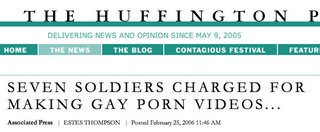
For shame, Mr. Morrison, for shame. Details here.
(And non-comics readers may be enlightened here.)
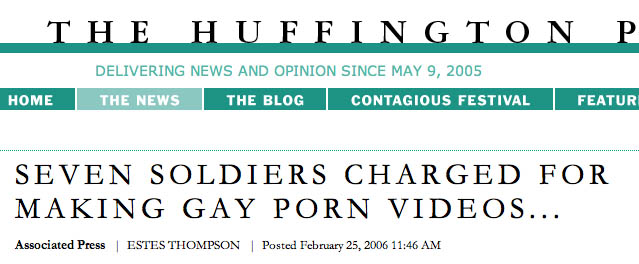
For shame, Mr. Morrison, for shame. Details here.
(And non-comics readers may be enlightened here.)
Tuesday, March 07, 2006
Best. Convention. Moment. EVER.
It's Sunday, 26 March 2006, a bit after 1 PM. Joe Simon is ninety-two years old, but any fears I may have had about the man's health or the stength of his faculties were swept away by hearing him talk. He's in better physical shape than some people I've known who were twenty years younger, his speech is clear, and his memory has only the minimal amount of vagueness you'd have to allow for anyone with over nine decades of stuff to remember.
A group of us are gathered around Joe in the corridor outside the conference room where he's just given a brief talk, forming an entourage to escort him onto the convention floor where he's scheduled to sign autographs now that his talk has ended.
Comics journalist Adam McGovern says to Joe Simon, "I was wondering something about the revival of The Sandman you and Kirby did in the Seventies. How did that happen, with the two of you being on different coasts by that time?"
Joe replies, "Oh, we got together for that. We spent the night together in a hotel room."
"Oh ho," says Adam, "really?"
"Sure. Then Kirby took his teeth out, put them in a glass, and went to sleep."
"Hey!" I exclaim in mock offense. "That doesn't sound very romantic!"
"Yeah," Joe laughs. "It wasn't romantic at all!"
I had worked out a whole speech in case I had the chance to speak to Joe Simon. It was going to be a lot of stuff about how much I'd loved his work since I was ten years old...especially the "Newsboy Legion" series in Star-Spangled Comics from the early Forties. My parents were of the same generation as those kids and came from similar lower-class immigrant New York backgrounds, and reading those stories at an early age helped put me in touch with the world of my parents' childhood. I was ready to thank Joe Simon for helping me feel closer to my own mother and father.
But this was better. I'd rather make someone laugh than give him a speech any day.
A group of us are gathered around Joe in the corridor outside the conference room where he's just given a brief talk, forming an entourage to escort him onto the convention floor where he's scheduled to sign autographs now that his talk has ended.
Comics journalist Adam McGovern says to Joe Simon, "I was wondering something about the revival of The Sandman you and Kirby did in the Seventies. How did that happen, with the two of you being on different coasts by that time?"
Joe replies, "Oh, we got together for that. We spent the night together in a hotel room."
"Oh ho," says Adam, "really?"
"Sure. Then Kirby took his teeth out, put them in a glass, and went to sleep."
"Hey!" I exclaim in mock offense. "That doesn't sound very romantic!"
"Yeah," Joe laughs. "It wasn't romantic at all!"
I had worked out a whole speech in case I had the chance to speak to Joe Simon. It was going to be a lot of stuff about how much I'd loved his work since I was ten years old...especially the "Newsboy Legion" series in Star-Spangled Comics from the early Forties. My parents were of the same generation as those kids and came from similar lower-class immigrant New York backgrounds, and reading those stories at an early age helped put me in touch with the world of my parents' childhood. I was ready to thank Joe Simon for helping me feel closer to my own mother and father.
But this was better. I'd rather make someone laugh than give him a speech any day.
Meetings at geek prom
Just some of the folks I crossed paths with last weekend...
Redhead Fangirl recognized me from the photo I posted on this very blog. I knew she'd be there, and had been keeping half an eye out hoping to spot someone who looked like the picture on her blog -- there wasn't anyone else I was expecting to run into that day -- but in the end, it happened the other way around. I'd actually looked right at her and assumed it wasn't her; I didn't even take a second look. being the guy who walked up to every redheaded woman in the place and saying "um, er, are you the redhead fangirl?" had seemed like a bad idea.
Randy Hoppe, chief trustee of the Jack Kirby Museum -- a cause I'd be happy to support if it didn't require large sums of money -- is exactly the sort of person you want to be with at a convention. He knows everyone and has a plausible reason for starting up a conversation with anyone. Hang with him and you'll end up in conversations with people you'd never have occasion to meet otherwise. As soon as I spotted him, I attached myself to his side like a limpet and he could not shake me loose.
Brian Cronin organized a Comics Should Be Good dinner party at the Empire State Building branch of the Heartland Brewery. As a result, I became a star of the comics blogosphere for fifteen or so minutes, all of which I spent offline and therefore missed it. Just an immensely great guy to hang out with. Those who are expecting dish and backstabbing about my friends in comics fandom have come to the wrong place.
I walked up to Peter Scolari and said, "Mr. Scolari, it's an honor to meet you. I've loved your comics for years." Thank heavens he got the joke immediately, and thanked me equally seriously but with a twinkle in his eye. His sense of humor turns out to be much like that of his most famous character -- dry and understated. I however was giddy at meeting a childhood icon of mine, no matter how bizarre the circumstances. I also told him that while Tom Hanks may be a big star and all, the fans all knew Peter was the better actor. He said "I can't possibly agree with that, Richard." And I said "You shouldn't," and looked around conspiratorially before continuing, "but we all know it's true." And it is: good actors disappear into their roles; you don't think about the actor you're watching, you think about the character. "Stars" are people who don't disappear when you see them on screen; you're always aware "Hey, that's Harrison Ford!" or "What's Tom Hanks doing?" My buddy Peter is a great actor, and anyone who has anything terrible to say about him can step outside right now.
I used to know Colleen Doran before anyone else did, before her first published work...before she was, you know, Colleen Doran. It was a trip and a half to actually see her and speak to her for the first time in all these years. Even before she was "discovered" it was obvious to anyone who saw her work that she was destined for stardom; her other main characteristic back then was being immensely poised and outgoing in social situations...which is not always the case among people whose careers are based around sitting in a room by themselves for long hours and churning out work. All these years later, she is still that same person, only more so. I heard several people at the convention rave about meeting her, and it's easy to see why. I was pleased to watch her table for a bit when she had to step away to visit the CBLDF booth; I was equally pleased to accept an apple danish from her as my payment. Colleen apparently spent the whole weekend giving away free danish left and right...but the one she gave me was special, so there!
Redhead Fangirl recognized me from the photo I posted on this very blog. I knew she'd be there, and had been keeping half an eye out hoping to spot someone who looked like the picture on her blog -- there wasn't anyone else I was expecting to run into that day -- but in the end, it happened the other way around. I'd actually looked right at her and assumed it wasn't her; I didn't even take a second look. being the guy who walked up to every redheaded woman in the place and saying "um, er, are you the redhead fangirl?" had seemed like a bad idea.
Randy Hoppe, chief trustee of the Jack Kirby Museum -- a cause I'd be happy to support if it didn't require large sums of money -- is exactly the sort of person you want to be with at a convention. He knows everyone and has a plausible reason for starting up a conversation with anyone. Hang with him and you'll end up in conversations with people you'd never have occasion to meet otherwise. As soon as I spotted him, I attached myself to his side like a limpet and he could not shake me loose.
Brian Cronin organized a Comics Should Be Good dinner party at the Empire State Building branch of the Heartland Brewery. As a result, I became a star of the comics blogosphere for fifteen or so minutes, all of which I spent offline and therefore missed it. Just an immensely great guy to hang out with. Those who are expecting dish and backstabbing about my friends in comics fandom have come to the wrong place.
I walked up to Peter Scolari and said, "Mr. Scolari, it's an honor to meet you. I've loved your comics for years." Thank heavens he got the joke immediately, and thanked me equally seriously but with a twinkle in his eye. His sense of humor turns out to be much like that of his most famous character -- dry and understated. I however was giddy at meeting a childhood icon of mine, no matter how bizarre the circumstances. I also told him that while Tom Hanks may be a big star and all, the fans all knew Peter was the better actor. He said "I can't possibly agree with that, Richard." And I said "You shouldn't," and looked around conspiratorially before continuing, "but we all know it's true." And it is: good actors disappear into their roles; you don't think about the actor you're watching, you think about the character. "Stars" are people who don't disappear when you see them on screen; you're always aware "Hey, that's Harrison Ford!" or "What's Tom Hanks doing?" My buddy Peter is a great actor, and anyone who has anything terrible to say about him can step outside right now.
I used to know Colleen Doran before anyone else did, before her first published work...before she was, you know, Colleen Doran. It was a trip and a half to actually see her and speak to her for the first time in all these years. Even before she was "discovered" it was obvious to anyone who saw her work that she was destined for stardom; her other main characteristic back then was being immensely poised and outgoing in social situations...which is not always the case among people whose careers are based around sitting in a room by themselves for long hours and churning out work. All these years later, she is still that same person, only more so. I heard several people at the convention rave about meeting her, and it's easy to see why. I was pleased to watch her table for a bit when she had to step away to visit the CBLDF booth; I was equally pleased to accept an apple danish from her as my payment. Colleen apparently spent the whole weekend giving away free danish left and right...but the one she gave me was special, so there!
Conventional wisdom
A lot has been written online about the issue of overcrowding at the New York Comic-Con. While I'm being a linkhappy fool, here's the most evenhanded eyewitness account I've seen. Much of the coverage has been handwringing and denunciation of the organizers for failing to anticipate the pent-up demand for a proper comics convention and the overwhelming drop-in traffic on the weekend following the major push the con got from all the major newspapers in NYC. I've seen people call the organizers "incompetent" for failing to anticipate the crush. The fire marshal closed the convention floor on Saturday (this didn't mean people were thrown out or that business stopped; merely that people were only allowed in to replace an equal number leaving so the floor didn't become even more crowded) and state troopers (!!!) were called in to enforce order. People who showed up to buy tickets at the door were turned away. Lines of ticket-holders waiting to get in were up to two hours long. So yeah, it was a thing.
Now that a full week has gone by, I hope people are breathing a little more easily and we can look back without hyperventilating. It seems to me, this was nobody's "fault" and incompetence was not to blame. The organizers spent months promoting this event -- and tickets were available online up to the show's opening -- but there's no way they could have counted on all the newspapers giving the con such heavy play. Of course publicists try their best to get these events promoted, but they don't control editorial and couldn't have seen this getting a half page in the New York Times and full page or double-page articles elsewhere. Those articles, more than any amount of advertising, brought the public in.
And too, novices at the comics convention scene could not have known how pent-up the demand for a proper convention here had grown. This is the first real convention in NYC in...what, nearly twenty years? All we've really had over the intervening years has been some lackluster marketplaces, while places like San Diego and Orlando and Atlanta have become the real convention centers. I've followed this scene solely as a fan for all this time, and I was astonished by the turnout; I can't fault a newcomer for getting bowled over.
The convention easily filled one hangarlike subsection of the airport-terminal-like Javits Center...but even with two other conventions taking place in the building at the same time (an art expo and an American Express travel show, not to mention a Jeopardy contestants' tryout also happening somewhere) there was still plenty of empty space everywhere apart from the convention floor. If this convention goes on to become the San Diego East it seems poised to be, I think they'll have no trouble claiming additional floor space and scaling up the ticket-processing mechanism so that this year's crush is not repeated.
Look. Folks who didn't get in have a right to feel miffed. Exhibitors and even guests who found themselves stuck outside the main area for an hour or two have a legitimate gripe. But in the larger scheme of things, these reflected minor glitches that can be corrected and almost certainly will be in time for next year. They don't reflect systemic failure or gross incompetence. So can we have a little less of the righteous indignation, please?
On a personal note...
Clearly, some divine force watches over fools like me. The con was due to open to the public at 4 PM on Friday, so I turned up around 3 PM and figured a one hour wait on line. I know the Javits Center all too well from attending the annual Macworld Expo there every year it was held in New York -- I swear I could find every men's room and water fountain in the building in a blackout -- so no worries there. To my surprise, there were only perhaps a dozen people on line ahead of me. Elapsed time on line, fifteen minutes. Then I turned around as I reached the head of the line: suddenly there was a queue of hundreds behind me.
Getting a pass involved filling out a printed form and presenting it to the desk, where the data was typed in to produce a barcoded badge. In spite of this, my badge still came out with my name misspelled. My last name always gets spelled wrong. I just looked at it and thought, who didn't see this coming? On the plus side, I'd been given a "Professional" badge rather than your common variety regular punter sort of badge. I'd have credited this to my erstwhile career at Marvel had it not been for the misspelling. Unless there's a comics pro named "Richard Benson" whose badge I mistakenly picked up. Sorry, guy!
Having a "Professional" badge did get me into the show floor a whole 45 minutes before it was opened to the general public, and I caught a number of people surreptitiously sneaking a glance at my badge and trying to figure out if I was someone they were supposed to have heard of. To the core of my being I am a populist and anti-elitist...but screw whatever Thomas Jefferson said, if there are elitist perks and privileges being handed out, it's better to be in the elite.
Now that a full week has gone by, I hope people are breathing a little more easily and we can look back without hyperventilating. It seems to me, this was nobody's "fault" and incompetence was not to blame. The organizers spent months promoting this event -- and tickets were available online up to the show's opening -- but there's no way they could have counted on all the newspapers giving the con such heavy play. Of course publicists try their best to get these events promoted, but they don't control editorial and couldn't have seen this getting a half page in the New York Times and full page or double-page articles elsewhere. Those articles, more than any amount of advertising, brought the public in.
And too, novices at the comics convention scene could not have known how pent-up the demand for a proper convention here had grown. This is the first real convention in NYC in...what, nearly twenty years? All we've really had over the intervening years has been some lackluster marketplaces, while places like San Diego and Orlando and Atlanta have become the real convention centers. I've followed this scene solely as a fan for all this time, and I was astonished by the turnout; I can't fault a newcomer for getting bowled over.
The convention easily filled one hangarlike subsection of the airport-terminal-like Javits Center...but even with two other conventions taking place in the building at the same time (an art expo and an American Express travel show, not to mention a Jeopardy contestants' tryout also happening somewhere) there was still plenty of empty space everywhere apart from the convention floor. If this convention goes on to become the San Diego East it seems poised to be, I think they'll have no trouble claiming additional floor space and scaling up the ticket-processing mechanism so that this year's crush is not repeated.
Look. Folks who didn't get in have a right to feel miffed. Exhibitors and even guests who found themselves stuck outside the main area for an hour or two have a legitimate gripe. But in the larger scheme of things, these reflected minor glitches that can be corrected and almost certainly will be in time for next year. They don't reflect systemic failure or gross incompetence. So can we have a little less of the righteous indignation, please?
On a personal note...
Clearly, some divine force watches over fools like me. The con was due to open to the public at 4 PM on Friday, so I turned up around 3 PM and figured a one hour wait on line. I know the Javits Center all too well from attending the annual Macworld Expo there every year it was held in New York -- I swear I could find every men's room and water fountain in the building in a blackout -- so no worries there. To my surprise, there were only perhaps a dozen people on line ahead of me. Elapsed time on line, fifteen minutes. Then I turned around as I reached the head of the line: suddenly there was a queue of hundreds behind me.
Getting a pass involved filling out a printed form and presenting it to the desk, where the data was typed in to produce a barcoded badge. In spite of this, my badge still came out with my name misspelled. My last name always gets spelled wrong. I just looked at it and thought, who didn't see this coming? On the plus side, I'd been given a "Professional" badge rather than your common variety regular punter sort of badge. I'd have credited this to my erstwhile career at Marvel had it not been for the misspelling. Unless there's a comics pro named "Richard Benson" whose badge I mistakenly picked up. Sorry, guy!
Having a "Professional" badge did get me into the show floor a whole 45 minutes before it was opened to the general public, and I caught a number of people surreptitiously sneaking a glance at my badge and trying to figure out if I was someone they were supposed to have heard of. To the core of my being I am a populist and anti-elitist...but screw whatever Thomas Jefferson said, if there are elitist perks and privileges being handed out, it's better to be in the elite.
Monday, March 06, 2006
The End of Omega
The following piece is a contribution to Plok's "Seven Soldiers of Steve" project in honor of comics writer Steve Gerber. I've written a more personal tribute to Steve here, and I'm always on board for any effort to give this guy the props he deserves. Enjoy!
This is how it ends:
The alien visitor we know only as Omega -- the alleged title character of OMEGA THE UNKNOWN, though that isn't his name, he's never called that by anyone else, and he's not the lead character of the series -- has travelled to Las Vegas on an urgent mission. His goal on Earth now requires large sums of money, which he's getting in the casinos with the help of his sole human friend, an elderly Hell's Kitchen pawnbroker named Gramps. But their takings are stolen, and Omega goes after the culprit. Uncharacteristically emotional and agitated, Omega threatens the culprit, demanding the return of the stolen money...and three Las Vegas policemen, mistaking him for the felon, shoot at point blank range. Omega drops to the ground, and our last image is of the fallen alien apparently lifeless on the Strip.
Whatever Marvel Comics may have told you, that was the last we ever saw of Omega...and whatever Marvel may tell you now, that's very likely the last we'll ever see of Omega. His body is still lying there, eternally bleeding to death but never dying, like Prometheus chained to the Las Vegas Strip.
Superhero stories are often described as adolescent power fantasies: an extended metaphor for the juvenile ego discovering its own power, lashing out against the mysterious forces of the world, and the growing realization that no one else will ever truly understand your true hidden self -- the ultimate "secret identity" we all possess. If that's so, what writers Steve Gerber and Mary Skrenes did in OMEGA THE UNKNOWN was decouple the superhero metaphor from the adolescent reality it represents, separating the real boy and the costumed hero to give new meaning to both.
In a text piece in the first issue, Gerber says "I'd always resented the lousy treatment kids had received in comics over the past three decades: either they had to be magically transformed into a full-grown man to be effectual, or they were saddled with an adult "mentor" and relegated to the duty of making bad puns during fight scenes. I wanted to do a real twelve-year-old, a human being poised on the edge of puberty, facing all the enormous (and enourmous-seeming) problems adolescence would bring..." But, he realized, to make this work the protagonist could not be wearing a super-hero leotard. Spider-Man may have been revolutionary at one time as the teenaged superhero with "real problems" but the limits of that approach had been reached long ago. And yet, a costumed hero was necessary for the commercial considerations of Marvel Comics circa 1975. This new book needed both a protagonist and a hero. One would be life sized, and one larger. Working with his friend and ally Mary Skrenes -- who had previously written mystery, horror, romance, and funny animal comics under a variety of pseudonyms -- Gerber fleshed out his vision of this new series.
The artist would be a favorite collaborator, the legendary Jim Mooney, a childhood favorite of Gerber's for his work on the TOMMY TOMORROW series twenty years earlier. (Among hundreds of other credits, Mooney also drew DIAL H FOR HERO, one of those comics about a child magically transformed to an adult...and SUPERGIRL, a well-known juvenile offshoot of a more capable adult mentor.)
The first issue of OMEGA started in sound superhero fashion with a blue clad, red-caped heroic type fleeing the conquest of his native world by robot armies. The mysterious figure's story is intercut with a parallel story on Earth, in which an aloof, intellectual boy raised and home schooled in rural isolation discovers that his "parents" are actually robots. Their unexpected destruction in a car crash leaves young James-Michael Starling adrift in the harsh neighborhood of Hell's Kitchen in New York City...very much the polar opposite of his previous cultured and disciplined upbringing. When the mysterious alien arrives on Earth, he becomes James-Michael's covert protector, but always staying at a distance. There's some bond between the two, but what is it? Is "Omega" the boy's father? Is James-Michael another refugee of the same race? Were his android "parents" connected to the robots who sacked the alien world?
We may never know. OMEGA was cancelled after ten issues, just as the narrative was reaching a major turning point. After several harrowing encounters with school violence, James-Michael flees Hell's Kitchen and returns to his secluded former home...where he discovers further robot duplicates of his deceased "parents." There was a sense something major was about to be revealed, if only the book had lasted one more issue...
Marvel just published a reprint collection of the original ten issues of OMEGA, along with a couple of unwelcome extras (more about these in a moment), so there's no need for me to recap the course of the series. If you're interested you can read them for yourself, and I cannot recommend the series too highly. It combines all the pomp and cosmic significance for which Marvel was known in the mid-Seventies with an intimate potrayal of real people and motivations as sophisticated as anything ever published in mainstream comics. It includes the eponymous super-powered character with blue tights and a red cape and plenty of bad-guy-crushing action -- both the Hulk and Marvel villain Electro appear in the second issue, to reassure fans that standard Marvel action is never far off -- but the real story is about the soul-crushing burden of adolescence on a sensitive introspective mind.
The problem is that Marvel won't leave the corpse alone.
On the final page of the last issue, a note from "Steve, Mary, and Jim" promises that the story of Omega will be concluded in a future issue of THE DEFENDERS. But when this finally came about, Gerber had split from Marvel acrimoniously, and the two-issue "conclusion" was written with what can only be called hostile intent. That hatchet job is reprinted in the collection alongside the real OMEGA stories: I won't bother to describe it here. Gerber assures his fans that it bears no resemblance whatsoever to his intentions for the characters.
The rift between Gerber and Marvel was healed to some extent in later years. Gerber returned to write titles such as SHE-HULK, FOOLKILLER, and a revival of HOWARD THE DUCK -- all excellent -- and new management at the House of Ideas seemed much more sympathetic. But the new spirit of goodwill was undone by Marvel's announcement that novelist Jonathan Lethem would be "reviving" OMEGA THE UNKNOWN against the express wishes of his creators. Gerber and Skrenes' immediate response can be seen here. The controversy has been covered at length elsewhere. I'm just going to say I feel Lethem has acted in bad faith, showing no regard for the wishes of fellow writers, and exploiting someone else's work in a way he would fight with every means available were it done to him.
But this essay isn't about controversy, it's about a great issue of a great comic. The last issue of OMEGA is a perfect little microcosm of many things that make Gerber and Skrenes' writing so worthwhile.
The story opens with the funeral of John Hadley, one of James-Michael's only school friends, who had been critically injured in a beating at the hands of bullies in a previous issue. Not intending to die like John, James-Michael announces his decision to leave the city to his other friend Dian, who in turn asks if she can come along. But the mysterious Omega has also been watching the funeral from a distance, the same remove from which he always observes his young charge...and, in the way that his decisions always seem to parallel or complement those of James-Michael, he also decides that a change of locale is in order: he collects his elderly friend Gramps for a sudden trip to Las Vegas.
In Vegas, the increasingly and uncharacteristically talkative Omega teaches Gramps a Zenlike method for becoming attuned to a slot machine, producing an immediate jackpot. Soon both men will be wealthy, and Omega will use the money for his secret purpose: to rescue James-Michael from Hell's Kitchen. He doesn't realize the boy has already made his departure...
Omega makes a brief trip to the desert to recuperate (from the effort of talking so much, we're told) where in a hallucinatory interlude he's attacked for no apparent reason by a oddly malleable rose-hued demon. When Omega tries to punch said demon in the chest, his fist stretches through the monster's body as if the creature were made of rubber; I mention this because it will be important later. The resulting gratuitous fight scene demonstrates Gerber's flair for the narrative double-entendre style he perfected long before Alan Moore came along and won accolades for doing essentially the same thing.
This apparently throwaway and meaningless scene is quintessential Steve Gerber in another way. Most scenes of violence in his Marvel work are couched in futility and outright absurdity. While other comics writers were trying to give increasingly "logical" and "realistic" justification to their action scenes, Gerber seems to have decided early on that this stuff couldn't be taken seriously and there was no reason to try. Building a more verbose action comic isn't his interest: the relationships of his characters are where the real action can be found. Bring the monster on and have him fight the hero for a couple of pages for no purpose and then disappear, and we can get on with the good stuff. Like Gramps, the kindly World War I veteran who has taken Omega under his wing, all excited by the adventure of a gambling spree in Las Vegas. Or James-Michael, a prepubescent boy raised by a pair of robots and frequently sounding like one himself, allowing a girl into his private world and thereby demonstrating how socialized he's become thru his recent experiences. These are human beings experiencing human moments, and no rubbery monster fighting a guy in tights can mean as much as that.
When James-Michael runs away, his adult caretakers back in New York -- the overly empathetic Ruth and the jaded bohemian survivor Amber -- differ sharply in their responses. Ruth is naturally worried for his safety, but Amber says "Close the floodgates and put on a pot of coffee, willya? It's no tragedy. He made a move on his own, that's all -- without consulting us grown ups. I'm telling ya -- he'll be in touch. The punk's nothing if not responsible!" From the first issue, Amber has been in the role of the cool, clued-in adult who alone treats James-Michael with respect as an equal, conferring on him the dignity of honorary adulthood: an intellectual teenager's dream of the ideal aunt or older sister. But here Amber becomes Gerber's mouthpiece, overtly stating one of his recurring themes: that children live in a world of constant peril and horror no matter what adults may do to shield them, they are far more capable than they're given credit for being, and they deserve both respect and trust -- in fact, they need these things in order to become adults.
The underlying message of the best children's fantasy is "young hero undergoes a terrible ordeal of initiation to achieve symbolic maturity" and this iteration of the heroic myth serves as a metaphor to explain the growth process to young readers who are going through a similar ordeal in more prosaic terms. What makes OMEGA especially potent is that, for all the series is couched in fantasy terms -- an alien costumed hero, strange psychic powers, robotic surrogate parents, the super-villains of the Marvel Universe -- James-Michael's trials are not of the metaphorical fantasy type. His quest isn't for a magic ring or to end the rule of winter over a fairyland: it's to cope with the sudden loss of his parents and to survive the brutality of bullies and life in a dangerous and crime-ridden urban neighborhood. Childhood is a time of real danger and outright melodrama, and the too-sensitive and too-intelligent child faces constant threat to his or her identity. When these comics were published I was the same age as James-Michael Starling, and I immediately felt that his story was a potent metaphor for my own life by not being metaphorical at all.
And then there's the thief...
There are many good reasons a writer might reuse a character from an earlier work: in response to audience demand, a shortcut to save having to build a new character from scratch, personal fondness, or the chance to show the character in a different light. But in continuity-minded comics, it creates an illusion of depth to the imaginary world that assists the suspension of disbelief. Our memory of accepting the previous story bootstraps our acceptance of the new one. This principle is the basis of the whole Seven Soldiers of Steve project, of course: the idea that Gerber reused particular characters in different series as a way of creating a "Gerber continuity" within all his Marvel comics, a subset of the Marvel Universe itself.
(A typical example of Marvel continuity of the period appears in OMEGA issue #2, when a guest appearance by the Incredible Hulk includes dialogue and an editorial note specifying that these events take place immediately after the events of DEFENDERS #35 -- now on sale! -- even though placing this appearance chronologically in the Hulk's life doesn't really have any impact on the story. Although continuity is now treasured for its own sake by generations of fans, remember that it was born as a sales-enhancement device; a way to remind the reader of OMEGA there are other Marvel titles he or she might want to buy as well. Just as the cover and story appearance of the Hulk in that issue of OMEGA is a way to entice Hulk fans to pick up yet another Marvel book they might otherwise pass by. All of this is obvious, but in an era when continuity is being held up as an end in itself, it's good to remember that historically the main purpose of comic books has been to sell more comic books. But I digress...)
If a writer brings back an old character and doesn't identify him or her as such -- the nature of the medium requires you to assume that only a small portion of the readers will have read the previous appearance; any comic book might be some reader's first -- spotting the callback to the past becomes a sort of Easter Egg for the attentive reader. And what we have here might be such a case.
At the climax of the issue, Omega and Gramps have their winnings stolen from their hotel room by a female thief who produces tentacles from her forehead, choking both men into unconsciousness, and later using the same appendages to make her escape. The culprit introduces herself by saying "Little Ruby gets paid for using her head." She turns out to be the boss of the malleable rose-colored demon seen earlier, addressing him as "Dibbuk."
So we have a larcenous woman named Ruby with a malleable head, who commands a malleable servant. Could this be Ruby Thursday, a villain from Gerber's run on THE DEFENDERS, who replaced her own head with a perfect sphere of rose-colored "malleable organic circuitry" that could be reshaped to her will? Could "Dibbuk" -- the Hebrew word for "demon" -- be a synthetic creature extruded from that same flexible stuff? When last seen, Ruby had been foiled by the Defenders along with her colleagues the Headmen, but we never saw what happened to her afterward. Had Gerber and Skrenes actually concluded the Omega story in DEFENDERS, it's entirely possible Ruby could have provided the bridge between the two series, clearing the way for Doctor Strange, Valkyrie, Nighthawk et al to become involved in the final resolution of James-Michael Starling's mystery.
But that isn't what happened. Ruby's identity remains unconfirmed, as do the answers to pretty much every question raised by OMEGA THE UNKNOWN. To this day, thirty years later, Gerber and Skrenes leave open the possibility they may yet complete their story as it was originally intended, and for that reason will never disclose any of its secrets. So James-Michael and Dian are still staring in amazement at the robot duplicates of his parents, and Omega himself still lies on the Vegas Strip...and possibly always will.
The same cannot be said for Gerber and Skrenes...well, except that it can, in that both are still in Las Vegas. But the writing team has reunited for the DC series HARD TIME. (For nebulous contractual reasons only Gerber was given a writing credit on the first volume; the second volume gives Skrenes her due as co-author.) Even without a superhero character, HARD TIME -- the story of a juvenile offender sentenced to prison as an adult, following a Columbine-like shooting -- has many, many similarities to OMEGA in theme, story elements, and character types. The primary difference is that the American comics scene has changed enough to allow a series without a superhero character -- although there is a fantasy element, and the protagonist has strange psychic powers -- and to permit the use of language and "adult" situations not possible at Marvel in the Seventies. Any fan of one would have to be an equal fan of the other. For this fan in particular, nothing could be better than seeing that after three decades these two writers have lost none of their creative fire or storytelling ability, and their empathy for their characters is every bit as strong. The story is not the plot; the story is how people relate to each other.
Buy the OMEGA collection if you like; it's definitely worth reading. But make sure you buy HARD TIME, so that Gerber and Skrenes have a chance to complete the story this time.
This is how it ends:
The alien visitor we know only as Omega -- the alleged title character of OMEGA THE UNKNOWN, though that isn't his name, he's never called that by anyone else, and he's not the lead character of the series -- has travelled to Las Vegas on an urgent mission. His goal on Earth now requires large sums of money, which he's getting in the casinos with the help of his sole human friend, an elderly Hell's Kitchen pawnbroker named Gramps. But their takings are stolen, and Omega goes after the culprit. Uncharacteristically emotional and agitated, Omega threatens the culprit, demanding the return of the stolen money...and three Las Vegas policemen, mistaking him for the felon, shoot at point blank range. Omega drops to the ground, and our last image is of the fallen alien apparently lifeless on the Strip.
Whatever Marvel Comics may have told you, that was the last we ever saw of Omega...and whatever Marvel may tell you now, that's very likely the last we'll ever see of Omega. His body is still lying there, eternally bleeding to death but never dying, like Prometheus chained to the Las Vegas Strip.
Superhero stories are often described as adolescent power fantasies: an extended metaphor for the juvenile ego discovering its own power, lashing out against the mysterious forces of the world, and the growing realization that no one else will ever truly understand your true hidden self -- the ultimate "secret identity" we all possess. If that's so, what writers Steve Gerber and Mary Skrenes did in OMEGA THE UNKNOWN was decouple the superhero metaphor from the adolescent reality it represents, separating the real boy and the costumed hero to give new meaning to both.
In a text piece in the first issue, Gerber says "I'd always resented the lousy treatment kids had received in comics over the past three decades: either they had to be magically transformed into a full-grown man to be effectual, or they were saddled with an adult "mentor" and relegated to the duty of making bad puns during fight scenes. I wanted to do a real twelve-year-old, a human being poised on the edge of puberty, facing all the enormous (and enourmous-seeming) problems adolescence would bring..." But, he realized, to make this work the protagonist could not be wearing a super-hero leotard. Spider-Man may have been revolutionary at one time as the teenaged superhero with "real problems" but the limits of that approach had been reached long ago. And yet, a costumed hero was necessary for the commercial considerations of Marvel Comics circa 1975. This new book needed both a protagonist and a hero. One would be life sized, and one larger. Working with his friend and ally Mary Skrenes -- who had previously written mystery, horror, romance, and funny animal comics under a variety of pseudonyms -- Gerber fleshed out his vision of this new series.
The artist would be a favorite collaborator, the legendary Jim Mooney, a childhood favorite of Gerber's for his work on the TOMMY TOMORROW series twenty years earlier. (Among hundreds of other credits, Mooney also drew DIAL H FOR HERO, one of those comics about a child magically transformed to an adult...and SUPERGIRL, a well-known juvenile offshoot of a more capable adult mentor.)
The first issue of OMEGA started in sound superhero fashion with a blue clad, red-caped heroic type fleeing the conquest of his native world by robot armies. The mysterious figure's story is intercut with a parallel story on Earth, in which an aloof, intellectual boy raised and home schooled in rural isolation discovers that his "parents" are actually robots. Their unexpected destruction in a car crash leaves young James-Michael Starling adrift in the harsh neighborhood of Hell's Kitchen in New York City...very much the polar opposite of his previous cultured and disciplined upbringing. When the mysterious alien arrives on Earth, he becomes James-Michael's covert protector, but always staying at a distance. There's some bond between the two, but what is it? Is "Omega" the boy's father? Is James-Michael another refugee of the same race? Were his android "parents" connected to the robots who sacked the alien world?
We may never know. OMEGA was cancelled after ten issues, just as the narrative was reaching a major turning point. After several harrowing encounters with school violence, James-Michael flees Hell's Kitchen and returns to his secluded former home...where he discovers further robot duplicates of his deceased "parents." There was a sense something major was about to be revealed, if only the book had lasted one more issue...
Marvel just published a reprint collection of the original ten issues of OMEGA, along with a couple of unwelcome extras (more about these in a moment), so there's no need for me to recap the course of the series. If you're interested you can read them for yourself, and I cannot recommend the series too highly. It combines all the pomp and cosmic significance for which Marvel was known in the mid-Seventies with an intimate potrayal of real people and motivations as sophisticated as anything ever published in mainstream comics. It includes the eponymous super-powered character with blue tights and a red cape and plenty of bad-guy-crushing action -- both the Hulk and Marvel villain Electro appear in the second issue, to reassure fans that standard Marvel action is never far off -- but the real story is about the soul-crushing burden of adolescence on a sensitive introspective mind.
The problem is that Marvel won't leave the corpse alone.
On the final page of the last issue, a note from "Steve, Mary, and Jim" promises that the story of Omega will be concluded in a future issue of THE DEFENDERS. But when this finally came about, Gerber had split from Marvel acrimoniously, and the two-issue "conclusion" was written with what can only be called hostile intent. That hatchet job is reprinted in the collection alongside the real OMEGA stories: I won't bother to describe it here. Gerber assures his fans that it bears no resemblance whatsoever to his intentions for the characters.
The rift between Gerber and Marvel was healed to some extent in later years. Gerber returned to write titles such as SHE-HULK, FOOLKILLER, and a revival of HOWARD THE DUCK -- all excellent -- and new management at the House of Ideas seemed much more sympathetic. But the new spirit of goodwill was undone by Marvel's announcement that novelist Jonathan Lethem would be "reviving" OMEGA THE UNKNOWN against the express wishes of his creators. Gerber and Skrenes' immediate response can be seen here. The controversy has been covered at length elsewhere. I'm just going to say I feel Lethem has acted in bad faith, showing no regard for the wishes of fellow writers, and exploiting someone else's work in a way he would fight with every means available were it done to him.
But this essay isn't about controversy, it's about a great issue of a great comic. The last issue of OMEGA is a perfect little microcosm of many things that make Gerber and Skrenes' writing so worthwhile.
The story opens with the funeral of John Hadley, one of James-Michael's only school friends, who had been critically injured in a beating at the hands of bullies in a previous issue. Not intending to die like John, James-Michael announces his decision to leave the city to his other friend Dian, who in turn asks if she can come along. But the mysterious Omega has also been watching the funeral from a distance, the same remove from which he always observes his young charge...and, in the way that his decisions always seem to parallel or complement those of James-Michael, he also decides that a change of locale is in order: he collects his elderly friend Gramps for a sudden trip to Las Vegas.
In Vegas, the increasingly and uncharacteristically talkative Omega teaches Gramps a Zenlike method for becoming attuned to a slot machine, producing an immediate jackpot. Soon both men will be wealthy, and Omega will use the money for his secret purpose: to rescue James-Michael from Hell's Kitchen. He doesn't realize the boy has already made his departure...
Omega makes a brief trip to the desert to recuperate (from the effort of talking so much, we're told) where in a hallucinatory interlude he's attacked for no apparent reason by a oddly malleable rose-hued demon. When Omega tries to punch said demon in the chest, his fist stretches through the monster's body as if the creature were made of rubber; I mention this because it will be important later. The resulting gratuitous fight scene demonstrates Gerber's flair for the narrative double-entendre style he perfected long before Alan Moore came along and won accolades for doing essentially the same thing.
This apparently throwaway and meaningless scene is quintessential Steve Gerber in another way. Most scenes of violence in his Marvel work are couched in futility and outright absurdity. While other comics writers were trying to give increasingly "logical" and "realistic" justification to their action scenes, Gerber seems to have decided early on that this stuff couldn't be taken seriously and there was no reason to try. Building a more verbose action comic isn't his interest: the relationships of his characters are where the real action can be found. Bring the monster on and have him fight the hero for a couple of pages for no purpose and then disappear, and we can get on with the good stuff. Like Gramps, the kindly World War I veteran who has taken Omega under his wing, all excited by the adventure of a gambling spree in Las Vegas. Or James-Michael, a prepubescent boy raised by a pair of robots and frequently sounding like one himself, allowing a girl into his private world and thereby demonstrating how socialized he's become thru his recent experiences. These are human beings experiencing human moments, and no rubbery monster fighting a guy in tights can mean as much as that.
When James-Michael runs away, his adult caretakers back in New York -- the overly empathetic Ruth and the jaded bohemian survivor Amber -- differ sharply in their responses. Ruth is naturally worried for his safety, but Amber says "Close the floodgates and put on a pot of coffee, willya? It's no tragedy. He made a move on his own, that's all -- without consulting us grown ups. I'm telling ya -- he'll be in touch. The punk's nothing if not responsible!" From the first issue, Amber has been in the role of the cool, clued-in adult who alone treats James-Michael with respect as an equal, conferring on him the dignity of honorary adulthood: an intellectual teenager's dream of the ideal aunt or older sister. But here Amber becomes Gerber's mouthpiece, overtly stating one of his recurring themes: that children live in a world of constant peril and horror no matter what adults may do to shield them, they are far more capable than they're given credit for being, and they deserve both respect and trust -- in fact, they need these things in order to become adults.
The underlying message of the best children's fantasy is "young hero undergoes a terrible ordeal of initiation to achieve symbolic maturity" and this iteration of the heroic myth serves as a metaphor to explain the growth process to young readers who are going through a similar ordeal in more prosaic terms. What makes OMEGA especially potent is that, for all the series is couched in fantasy terms -- an alien costumed hero, strange psychic powers, robotic surrogate parents, the super-villains of the Marvel Universe -- James-Michael's trials are not of the metaphorical fantasy type. His quest isn't for a magic ring or to end the rule of winter over a fairyland: it's to cope with the sudden loss of his parents and to survive the brutality of bullies and life in a dangerous and crime-ridden urban neighborhood. Childhood is a time of real danger and outright melodrama, and the too-sensitive and too-intelligent child faces constant threat to his or her identity. When these comics were published I was the same age as James-Michael Starling, and I immediately felt that his story was a potent metaphor for my own life by not being metaphorical at all.
And then there's the thief...
There are many good reasons a writer might reuse a character from an earlier work: in response to audience demand, a shortcut to save having to build a new character from scratch, personal fondness, or the chance to show the character in a different light. But in continuity-minded comics, it creates an illusion of depth to the imaginary world that assists the suspension of disbelief. Our memory of accepting the previous story bootstraps our acceptance of the new one. This principle is the basis of the whole Seven Soldiers of Steve project, of course: the idea that Gerber reused particular characters in different series as a way of creating a "Gerber continuity" within all his Marvel comics, a subset of the Marvel Universe itself.
(A typical example of Marvel continuity of the period appears in OMEGA issue #2, when a guest appearance by the Incredible Hulk includes dialogue and an editorial note specifying that these events take place immediately after the events of DEFENDERS #35 -- now on sale! -- even though placing this appearance chronologically in the Hulk's life doesn't really have any impact on the story. Although continuity is now treasured for its own sake by generations of fans, remember that it was born as a sales-enhancement device; a way to remind the reader of OMEGA there are other Marvel titles he or she might want to buy as well. Just as the cover and story appearance of the Hulk in that issue of OMEGA is a way to entice Hulk fans to pick up yet another Marvel book they might otherwise pass by. All of this is obvious, but in an era when continuity is being held up as an end in itself, it's good to remember that historically the main purpose of comic books has been to sell more comic books. But I digress...)
If a writer brings back an old character and doesn't identify him or her as such -- the nature of the medium requires you to assume that only a small portion of the readers will have read the previous appearance; any comic book might be some reader's first -- spotting the callback to the past becomes a sort of Easter Egg for the attentive reader. And what we have here might be such a case.
At the climax of the issue, Omega and Gramps have their winnings stolen from their hotel room by a female thief who produces tentacles from her forehead, choking both men into unconsciousness, and later using the same appendages to make her escape. The culprit introduces herself by saying "Little Ruby gets paid for using her head." She turns out to be the boss of the malleable rose-colored demon seen earlier, addressing him as "Dibbuk."
So we have a larcenous woman named Ruby with a malleable head, who commands a malleable servant. Could this be Ruby Thursday, a villain from Gerber's run on THE DEFENDERS, who replaced her own head with a perfect sphere of rose-colored "malleable organic circuitry" that could be reshaped to her will? Could "Dibbuk" -- the Hebrew word for "demon" -- be a synthetic creature extruded from that same flexible stuff? When last seen, Ruby had been foiled by the Defenders along with her colleagues the Headmen, but we never saw what happened to her afterward. Had Gerber and Skrenes actually concluded the Omega story in DEFENDERS, it's entirely possible Ruby could have provided the bridge between the two series, clearing the way for Doctor Strange, Valkyrie, Nighthawk et al to become involved in the final resolution of James-Michael Starling's mystery.
But that isn't what happened. Ruby's identity remains unconfirmed, as do the answers to pretty much every question raised by OMEGA THE UNKNOWN. To this day, thirty years later, Gerber and Skrenes leave open the possibility they may yet complete their story as it was originally intended, and for that reason will never disclose any of its secrets. So James-Michael and Dian are still staring in amazement at the robot duplicates of his parents, and Omega himself still lies on the Vegas Strip...and possibly always will.
The same cannot be said for Gerber and Skrenes...well, except that it can, in that both are still in Las Vegas. But the writing team has reunited for the DC series HARD TIME. (For nebulous contractual reasons only Gerber was given a writing credit on the first volume; the second volume gives Skrenes her due as co-author.) Even without a superhero character, HARD TIME -- the story of a juvenile offender sentenced to prison as an adult, following a Columbine-like shooting -- has many, many similarities to OMEGA in theme, story elements, and character types. The primary difference is that the American comics scene has changed enough to allow a series without a superhero character -- although there is a fantasy element, and the protagonist has strange psychic powers -- and to permit the use of language and "adult" situations not possible at Marvel in the Seventies. Any fan of one would have to be an equal fan of the other. For this fan in particular, nothing could be better than seeing that after three decades these two writers have lost none of their creative fire or storytelling ability, and their empathy for their characters is every bit as strong. The story is not the plot; the story is how people relate to each other.
Buy the OMEGA collection if you like; it's definitely worth reading. But make sure you buy HARD TIME, so that Gerber and Skrenes have a chance to complete the story this time.
Update
While I continue waiting for my local cable company to sort out an interruption of service that's already lasted a full week and will probably last several more days, I've found an alternate connection that should enable me to get back to posting and corresponding again. We'll see...
Wednesday, March 01, 2006
Irregularly scheduled programming will resume
...but not just yet.
No sooner do I return home from the eventful rollercoaster of fun and thrills that was the New York Comic-Con than my cable connection dies on me...leaving me for the past three days almost entirely without access to the blogosphere during my fifteen minutes of fame as a blogger of note. How unfair is that? I'm now muddling along on dialup and finding it very rough going. It might be another day or two before my cable service is restored.
But anyway...I had a backlog of work that needed doing as soon as the convention was done, and now I've got a ton of new correspondence to get through as well. I hope everyone will be patient with me a bit longer and understand why I haven't been making posts or answering messages. There are a couple dozen things I want to say about my convention experiences and I intend to get to them as soon as it's doable.
No sooner do I return home from the eventful rollercoaster of fun and thrills that was the New York Comic-Con than my cable connection dies on me...leaving me for the past three days almost entirely without access to the blogosphere during my fifteen minutes of fame as a blogger of note. How unfair is that? I'm now muddling along on dialup and finding it very rough going. It might be another day or two before my cable service is restored.
But anyway...I had a backlog of work that needed doing as soon as the convention was done, and now I've got a ton of new correspondence to get through as well. I hope everyone will be patient with me a bit longer and understand why I haven't been making posts or answering messages. There are a couple dozen things I want to say about my convention experiences and I intend to get to them as soon as it's doable.
Thursday, February 23, 2006
Wednesday, February 22, 2006
Other people talking
Whilst I'm preoccupied, some other blogs have interesting stuff:
Plok has been comparing the underlying philosophies and worldviews of Steve Englehart and Steve Gerber. These two mean as much to me as they do to him, and I admire him for putting it into words.
Ragnell has a great take on Wonder Woman and religion and inspires some really inspired comments.
Apparently there was a party at a good-looking comics shop attended by good-looking comics fans. And you wonder why I feel old. Just remember, I did my time in the trenches before comics were "cool" and "hip" -- my generation of fans all wore anoraks indoors and didn't bathe, and the comic shops all had stacks of porn instead of cappucino dispensers. Though of course I was buying them at newsstands long before comic shops were invented; even the grubbiest comic shop would have been paradise back then. To this day when I buy comics I still think someone is waiting outside the shop to beat me up. When you see me at the convention just remember I went through all that so you young people could live in a better world, so be kind to me.
(Link via Mark, who also has the blurry photo of scowling beard thing going on.)
Plok has been comparing the underlying philosophies and worldviews of Steve Englehart and Steve Gerber. These two mean as much to me as they do to him, and I admire him for putting it into words.
Ragnell has a great take on Wonder Woman and religion and inspires some really inspired comments.
Apparently there was a party at a good-looking comics shop attended by good-looking comics fans. And you wonder why I feel old. Just remember, I did my time in the trenches before comics were "cool" and "hip" -- my generation of fans all wore anoraks indoors and didn't bathe, and the comic shops all had stacks of porn instead of cappucino dispensers. Though of course I was buying them at newsstands long before comic shops were invented; even the grubbiest comic shop would have been paradise back then. To this day when I buy comics I still think someone is waiting outside the shop to beat me up. When you see me at the convention just remember I went through all that so you young people could live in a better world, so be kind to me.
(Link via Mark, who also has the blurry photo of scowling beard thing going on.)
Sunday, February 19, 2006
Fan spotting guide
 Next weekend, I'm planning to be at the New York Comic-Con at the Jacob Javits Convention Center -- a venue I've come to know and loathe all too well from attending too many Macworld Expos there. Since I'm hoping to meet up with various people who've never met me in real life and know me only by my online persona, I decided to take a cue from the Redhead Fangirl and post a picture of myself here, so as to give people an idea of what to look for.
In order for this picture to be an accurate representation, you'll need to follow some preliminary instructions. First, down at least six stiff drinks: that should provide the suitably blurred vision. I myself would choose vodka, but feel free to substitute gin or scotch if such is your preference. As a side benefit, you drinking heavily will make me seem more entertaining than I actually am, so we both win.
Second, walk/stagger/shamble up to me and loudly say something guaranteed to make me scowl angrily. Your best bets are "Jack Kirby couldn't write for crap, Stan Lee was a thousand times better!" or "Superman is a boring prick, I prefer Batman because he's a total psychopath!" or "Hey, isn't that Christopher Priest over there?" Any of these conversational gambits is sure to evoke the expression seen here!
And no, my head has not been photographically distorted in this photo. It really is that long and thin. This is why I feel more comfortable as Ron Stoppable.
Thursday, February 16, 2006
And she can beat up your mom, too
True story:
I was just talking with my mom, who had recently heard about Frank Miller's upcoming Batman Versus Al Qaeda comic and wanted to know what I thought about it. As it happens, I just posted a comment at The Brill Building about same, so I repeated what I said there.
"The original Star Trek didn't necessarily do it well, but that's the right idea," I said. "If you want to make a comment about the Civil Rights movement, you don't make it about Black versus White, because your audience won't have any distance to understand the problem from outside their personal experience. You make it about green people, or Andorians, or..."
"...or Frank Gorshin with his face painted half black and half white," she replied.
"Well, that's a bad example, but...but...um, should I be proud or ashamed that you remembered that was Frank Gorshin?"
I was kidding, of course. She took me to my first Trek convention. Yeah, my mom is a Trekkie. You got a problem with that?
I was just talking with my mom, who had recently heard about Frank Miller's upcoming Batman Versus Al Qaeda comic and wanted to know what I thought about it. As it happens, I just posted a comment at The Brill Building about same, so I repeated what I said there.
"The original Star Trek didn't necessarily do it well, but that's the right idea," I said. "If you want to make a comment about the Civil Rights movement, you don't make it about Black versus White, because your audience won't have any distance to understand the problem from outside their personal experience. You make it about green people, or Andorians, or..."
"...or Frank Gorshin with his face painted half black and half white," she replied.
"Well, that's a bad example, but...but...um, should I be proud or ashamed that you remembered that was Frank Gorshin?"
I was kidding, of course. She took me to my first Trek convention. Yeah, my mom is a Trekkie. You got a problem with that?
Tuesday, February 14, 2006
You give me such nachas
Israeli group announces anti-Semitic cartoons contest!
I sent an e-mail to Amitai Sandy saying that as a Jewish comic book writer who has hated himself for many years, this contest and the sentiments behind it honestly make me proud. In return, I got an invitation from Amitai to submit an entry, which makes me even prouder.
Seriously, I was hoping someone would do this. I was amused by the thought of the Iranian competition for cartoons making fun of the Holocaust, but I don't hold out much hope for the results. Nothing should be off-limits as a potential subject for humor...but the Holocaust has defied our finest minds, even Mel Brooks, for generations now. The catch is, it has to be funny -- just making an anti-Semitic remark and saying "ha ha ha" doesn't make it a good joke.
I do recall one extremely funny Holocaust-related joke: Seth Green's show Robot Chicken on Cartoon Network once envisioned The Diary of Anne Frank remade as a Hollywood vehicle for Hillary Duff. Which is more of a joke on the tastelessness of Hollywood than anything else...but it's the best example I can think of.
Eyal Zusman (30), actor and writer, and Amitai Sandy (29), graphic artist and publisher of Dimona Comix Publishing, both from Tel-Aviv, Israel, have followed the unfolding of the "Muhammad cartoon-gate" events in amazement, until finally Zusman came up with the right answer to all this insanity - and so they announced today the launch of a new anti-Semitic cartoons contest - this time drawn by Jews themselves!
"We'll show the world we can do the best, sharpest, most offensive Jew hating cartoons ever published!" said Zusman, and Sandy added: "No Iranian will beat us on our home turf!"
The contest has been announced today on the www.boomka.org website, and the initiators accept submissions of cartoons, caricatures and short comic strips from people all over the world. The deadline is Sunday March 5, and the best works will be displayed in an Exhibition in Tel-Aviv, Israel.
Sandy and Zusman are now in the process of arranging sponsorships of large organizations, and promise lucrative prizes for the winners, including of course the famous Matzo-bread baked with the blood of Christian children.
I sent an e-mail to Amitai Sandy saying that as a Jewish comic book writer who has hated himself for many years, this contest and the sentiments behind it honestly make me proud. In return, I got an invitation from Amitai to submit an entry, which makes me even prouder.
Seriously, I was hoping someone would do this. I was amused by the thought of the Iranian competition for cartoons making fun of the Holocaust, but I don't hold out much hope for the results. Nothing should be off-limits as a potential subject for humor...but the Holocaust has defied our finest minds, even Mel Brooks, for generations now. The catch is, it has to be funny -- just making an anti-Semitic remark and saying "ha ha ha" doesn't make it a good joke.
I do recall one extremely funny Holocaust-related joke: Seth Green's show Robot Chicken on Cartoon Network once envisioned The Diary of Anne Frank remade as a Hollywood vehicle for Hillary Duff. Which is more of a joke on the tastelessness of Hollywood than anything else...but it's the best example I can think of.
Hypocrisy, thy name is Yahoo!
"We are deeply concerned by efforts of governments to restrict and control open access to information and communication."
This statement from Yahoo! came in response to...no, not the demands of the Chinese government, with which they have no problem...but rumblings of new U.S. legislation to prevent Internet companies from setting up servers in nations controlled by repressive regimes.
If Yahoo! and Google and Microsoft had any collective corporate brains, they'd welcome such legislation -- perhaps after making a token effort to resist same for the sake of appearances -- as a way of backing out of these pro-censorship decisions which have become a PR disaster for them. Actually, that might be what they're doing. I can only hope.
Update: wow.
"History demonstrates that only a totalitarian system needs news censorship, out of the delusion that it can keep the public locked in ignorance," the group said in the letter, according to Reuters news agency....Those signing the letter include Chairman Mao's former secretary, Li Rui; the former editor of the Communist party's own mouthpiece, People's Daily, Hu Jiwei; and ex-propaganda boss, Zhu Houze.
Now let's see if Yahoo! and Google and Microsoft can be as brave in opposing Chinese censorship as Chairman Mao's former secretary.
Monday, February 13, 2006
What we talk about when we talk about comics
You may not know this about me...but sometimes I post short comic book scripts on the Writer's Forum at digitalwebbing.com. Is it weird for me to do this when my first published comics story was at Marvel Comics mumble-mumble years ago? Well, maybe so, but I had to drop out of the business for a good long time...and now that I'm getting back in, I'm totally back to being a novice. Especially given how radically the industry has changed since my last go-round.
Anyway, I've never been able to just write for practice and stick the results in a drawer. I can only write at all if I'm reasonably sure someone else will read it. And since raw comic book scripts are not really all that entertaining to the general public, the online forums are a great help in that respect.
I posted my latest script on digitalwebbing.com and got a couple of comments about the sparseness of my descriptions, which led me to write the following musings. I share this with you because all the people reading this are comics fans -- and comics fans tend to want to become comics creators -- and this is the stuff we obsess about. It's not all "I've got a great idea for Ultra the Multi-Alien if only DC would let me write it!" It's more about "if I make this page a nine-panel grid instead of a six-panel grid, how does that affect the pacing of the dialog?"
(And by the way: I really, really do have a great idea for Ultra the Multi-Alien.)
A quick note for the younger folks: "Marvel style" refers to a method of comics writing devised by Stan Lee and Jack Kirby when they were inventing Marvel Comics. It consists of a plot outline without any dialog or individual panel descriptions -- it might say "Black Panther sees his foe. The baddie zaps him with a laser beam. Panther's arm gets cut." -- and the panel-by-panel development of this plot is left to the artist. Then the pencilled art is sent back to the writer, who composes dialog and captions to suit the drawings the artist has created. It was unique to Marvel, and now even they have switched to using full scripts.
With that out of the way, we present a comics writer's plaint...
When I first started learning about comics writing, Marvel was still using the "Marvel style" and the sample they gave aspiring writers to emulate was one of Jim Shooter's later issues of THE AVENGERS. Not the best example to give newcomers for a variety of reasons, not least because Shooter was just knocking them out without a second thought at that point. But it illustrated one extreme approach to hypersimplified writing: he covered all the story beats of a 22 page issue in something like 800 words. Lots of stuff like "they fight for a couple of pages" and just leave the details to the artist because I'm too busy being Editor In Chief to break that down any further.
When I tried to do Marvel style, I took 300 words to describe each page. No way was I going to compress things as much as Shooter had.
At the other extreme, there were Alan Moore scripts. I saw a single SWAMP THING script that was literally thicker than the telephone book of the small town where I grew up. There's no point in anyone else trying to emulate that: being longwinded won't make you Alan Moore.
A much bigger influence on the way I think of comic scripts has been reading film scripts and books on Hollywood techniques. I don't have trouble thinking of myself as equivalent to the screenplay author and the artist as the director...except unlike Hollywood, the comics writer can and should expect that his words and situations will be regarded as relatively inviolate and not subject to rewrites by thirteen other writers and improvisation on set.
Now here's the catch: immediately before I started posting here, I had a really talented artist bail out on a project I'd written especially for him. Honestly, I was more upset by that than I was when my ex-fiancee broke off our engagement! One of his complaints -- um, this would be the artist; my former bride-to-be was female -- was that he felt he was just drawing MY story, that I was dictating to him how everything should be drawn, and that he wasn't getting enough freedom to consider it a collaboration. So it's more than likely this bad experience is now causing me to list too far in the opposite direction: maybe I give the artist too little direction. Like, you know, a guy who gets dumped by a girl and then lets the next woman in his life walk all over him just so long as she please won't leave him...
By the way, do any other writers here have a problem with artists starting out all enthusiastic about a project, calling it brilliant and promising you the moon, only to flake out and not get any work done, then moving on to someone else? Or is it just something I inspire in artists (and girlfriends)? Do I have bad breath? Does this hairstyle make me look fat?
Anyway, I've never been able to just write for practice and stick the results in a drawer. I can only write at all if I'm reasonably sure someone else will read it. And since raw comic book scripts are not really all that entertaining to the general public, the online forums are a great help in that respect.
I posted my latest script on digitalwebbing.com and got a couple of comments about the sparseness of my descriptions, which led me to write the following musings. I share this with you because all the people reading this are comics fans -- and comics fans tend to want to become comics creators -- and this is the stuff we obsess about. It's not all "I've got a great idea for Ultra the Multi-Alien if only DC would let me write it!" It's more about "if I make this page a nine-panel grid instead of a six-panel grid, how does that affect the pacing of the dialog?"
(And by the way: I really, really do have a great idea for Ultra the Multi-Alien.)
A quick note for the younger folks: "Marvel style" refers to a method of comics writing devised by Stan Lee and Jack Kirby when they were inventing Marvel Comics. It consists of a plot outline without any dialog or individual panel descriptions -- it might say "Black Panther sees his foe. The baddie zaps him with a laser beam. Panther's arm gets cut." -- and the panel-by-panel development of this plot is left to the artist. Then the pencilled art is sent back to the writer, who composes dialog and captions to suit the drawings the artist has created. It was unique to Marvel, and now even they have switched to using full scripts.
With that out of the way, we present a comics writer's plaint...
When I first started learning about comics writing, Marvel was still using the "Marvel style" and the sample they gave aspiring writers to emulate was one of Jim Shooter's later issues of THE AVENGERS. Not the best example to give newcomers for a variety of reasons, not least because Shooter was just knocking them out without a second thought at that point. But it illustrated one extreme approach to hypersimplified writing: he covered all the story beats of a 22 page issue in something like 800 words. Lots of stuff like "they fight for a couple of pages" and just leave the details to the artist because I'm too busy being Editor In Chief to break that down any further.
When I tried to do Marvel style, I took 300 words to describe each page. No way was I going to compress things as much as Shooter had.
At the other extreme, there were Alan Moore scripts. I saw a single SWAMP THING script that was literally thicker than the telephone book of the small town where I grew up. There's no point in anyone else trying to emulate that: being longwinded won't make you Alan Moore.
A much bigger influence on the way I think of comic scripts has been reading film scripts and books on Hollywood techniques. I don't have trouble thinking of myself as equivalent to the screenplay author and the artist as the director...except unlike Hollywood, the comics writer can and should expect that his words and situations will be regarded as relatively inviolate and not subject to rewrites by thirteen other writers and improvisation on set.
Now here's the catch: immediately before I started posting here, I had a really talented artist bail out on a project I'd written especially for him. Honestly, I was more upset by that than I was when my ex-fiancee broke off our engagement! One of his complaints -- um, this would be the artist; my former bride-to-be was female -- was that he felt he was just drawing MY story, that I was dictating to him how everything should be drawn, and that he wasn't getting enough freedom to consider it a collaboration. So it's more than likely this bad experience is now causing me to list too far in the opposite direction: maybe I give the artist too little direction. Like, you know, a guy who gets dumped by a girl and then lets the next woman in his life walk all over him just so long as she please won't leave him...
By the way, do any other writers here have a problem with artists starting out all enthusiastic about a project, calling it brilliant and promising you the moon, only to flake out and not get any work done, then moving on to someone else? Or is it just something I inspire in artists (and girlfriends)? Do I have bad breath? Does this hairstyle make me look fat?
Dick + Wittington = Pussy
Oh, come on -- no one's used that joke yet?
Anyway, the evil cyborg Cheney is a pussy. And not in the good way. He's no hunter, but he loves pretending to be one. That ranch in Texas where Wittington got sprayed with shot? One of those places where they raise quail in pens and feed them by hand, so they're not afraid of people. Then they let the poor stupid birds out dozens or hundreds at a time, not knowing they're supposed to flee hunters. They'd walk right up to you and let you hand feed them if you tried. And a bunch of wimps who think that holding rifles makes them real men -- man, if only Cheney had known that guns equal manhood sooner, maybe he wouldn't have gotten those five deferments from serving in Vietnam -- feel great about killing them up a whole bunch.
I read that Cheney has killed 70 of these utterly tame and defenseless birds in one day. On one of his frequent hunting trips, 400 birds were released and his hunting party killed 317 of them. Gotta love those odds. No wonder he was sure Iraq would go smoothly: after all, Cheney knows what it's like to defend the thin line of civilization against a rampaging horde of murderous tame quail. It's hell in those rushes, and you need a good stiff lite beer afterward to cleanse those psychic scars.
Real hunters don't shoot 70 quail in one day. Shooting more than you can eat is bad form, to say the least.
On the plus side, I understand that the shot pellets in Wittington's colon are in their last throes, and the Vice President's office announced that the Texas lawyer has welcomed Cheney as a liberator.
Anyway, the evil cyborg Cheney is a pussy. And not in the good way. He's no hunter, but he loves pretending to be one. That ranch in Texas where Wittington got sprayed with shot? One of those places where they raise quail in pens and feed them by hand, so they're not afraid of people. Then they let the poor stupid birds out dozens or hundreds at a time, not knowing they're supposed to flee hunters. They'd walk right up to you and let you hand feed them if you tried. And a bunch of wimps who think that holding rifles makes them real men -- man, if only Cheney had known that guns equal manhood sooner, maybe he wouldn't have gotten those five deferments from serving in Vietnam -- feel great about killing them up a whole bunch.
I read that Cheney has killed 70 of these utterly tame and defenseless birds in one day. On one of his frequent hunting trips, 400 birds were released and his hunting party killed 317 of them. Gotta love those odds. No wonder he was sure Iraq would go smoothly: after all, Cheney knows what it's like to defend the thin line of civilization against a rampaging horde of murderous tame quail. It's hell in those rushes, and you need a good stiff lite beer afterward to cleanse those psychic scars.
Real hunters don't shoot 70 quail in one day. Shooting more than you can eat is bad form, to say the least.
On the plus side, I understand that the shot pellets in Wittington's colon are in their last throes, and the Vice President's office announced that the Texas lawyer has welcomed Cheney as a liberator.
Saturday, February 11, 2006
Why do TV writers hate me?
I just wrote a shorter version of the following in the comments section of Bill Sherman's blog Pop Culture Gadabout and decided to expand it for a wider audience...
Okay, so now Bones starring David Boreanaz has done an episode mocking socially inept comics fans. A while back, Six Feet Under did an episode mocking socially inept geeky comics fans at a funeral. Back in November, a show called Las Vegas -- a series presumably inspired by the "what happens here, stays here" ad campaign -- set an episode in a comic book convention, including every negative cliche about socially inept comics fans you can think of. Apparently we're all teenage boys who are afraid of women and can't tell the difference between comics and real life.
What inspires this venom from tv writers? Is it that they're so humiliated and put upon in their own field they have to find an even more defenseless group to beat up on?
(Yes, I know there are plenty of writers in Hollywood who read comics. One is John Rogers who not only produced a pilot based on the Warren Ellis comic Global Frequency but is also now writing Blue Beetle.)
I gather The O.C. treats comics fandom better -- not surprisingly, given one of the executive producers also writes Young Avengers for Marvel -- but I've never seen that show. Maybe I'm missing something really good. Apart from that, the only decent treatment of comics fans I recall seeing in prime time was a sequence from Roseanne, involving the younger daughter attending conventions and trying to break into the industry.
So the other day, I found an unaired pilot made for Comedy Central called Super Nerds, created by and starring Patton Oswalt and Brian Posehn, two of the greatest stand-up comedians around.
These guys are real hardcore comic geeks, surely they'll outdo Kevin Smith in conferring a little respect and dignity on our much-despised ilk? Nope. The comic shop set is perfect, the topical references are as accurate as one could hope...but the jokes all revolve around these two guys being terrified of women, losing the ability to speak in the presence of a pretty girl, and obsessing over a valuable pair of limited edition Kirk and Picard bookends.
A few years back, a pilot for an animated show based on the comic "Welcome to Eltingville" by cartoonist Evan Dorkin aired on Cartoon Network. I enjoyed it, but it wasn't remotely affectionate. Now we can add this pilot to the roster of self-loathing depictions in other media created by comics fans. Can't we do better than this?
Comments and other examples of mass-media depictions of the hapless comics fan are requested...
Okay, so now Bones starring David Boreanaz has done an episode mocking socially inept comics fans. A while back, Six Feet Under did an episode mocking socially inept geeky comics fans at a funeral. Back in November, a show called Las Vegas -- a series presumably inspired by the "what happens here, stays here" ad campaign -- set an episode in a comic book convention, including every negative cliche about socially inept comics fans you can think of. Apparently we're all teenage boys who are afraid of women and can't tell the difference between comics and real life.
What inspires this venom from tv writers? Is it that they're so humiliated and put upon in their own field they have to find an even more defenseless group to beat up on?
(Yes, I know there are plenty of writers in Hollywood who read comics. One is John Rogers who not only produced a pilot based on the Warren Ellis comic Global Frequency but is also now writing Blue Beetle.)
I gather The O.C. treats comics fandom better -- not surprisingly, given one of the executive producers also writes Young Avengers for Marvel -- but I've never seen that show. Maybe I'm missing something really good. Apart from that, the only decent treatment of comics fans I recall seeing in prime time was a sequence from Roseanne, involving the younger daughter attending conventions and trying to break into the industry.
So the other day, I found an unaired pilot made for Comedy Central called Super Nerds, created by and starring Patton Oswalt and Brian Posehn, two of the greatest stand-up comedians around.
These guys are real hardcore comic geeks, surely they'll outdo Kevin Smith in conferring a little respect and dignity on our much-despised ilk? Nope. The comic shop set is perfect, the topical references are as accurate as one could hope...but the jokes all revolve around these two guys being terrified of women, losing the ability to speak in the presence of a pretty girl, and obsessing over a valuable pair of limited edition Kirk and Picard bookends.
A few years back, a pilot for an animated show based on the comic "Welcome to Eltingville" by cartoonist Evan Dorkin aired on Cartoon Network. I enjoyed it, but it wasn't remotely affectionate. Now we can add this pilot to the roster of self-loathing depictions in other media created by comics fans. Can't we do better than this?
Comments and other examples of mass-media depictions of the hapless comics fan are requested...
Tuesday, February 07, 2006
Hello World
Despite all appearances to the contrary, this is actually the inaugural post of this blog. The others have been painstakingly transferred over from my previous blog over at Tribe so that the place would feel a bit more lived in. Some of the external links in the earlier posts may be out of date, but are preserved intact here for the sake of an accurate historical record. I hope you all appreciate the trouble I've taken on your behalf. It's only because I care. I really do.
Standard disclaimer: my blogroll of honor at right is incomplete, and more entries will be added as I think of them. If anyone feels miffed at being excluded, please accept my apologies in advance and please notify me of the omission at once.
Now let the housewarming party begin...
Standard disclaimer: my blogroll of honor at right is incomplete, and more entries will be added as I think of them. If anyone feels miffed at being excluded, please accept my apologies in advance and please notify me of the omission at once.
Now let the housewarming party begin...
Tuesday, January 17, 2006
I saw this on The Jetsons...
...and now it's real.
So this is what it's like to live in the future.
BTW, I have an urgent warning: do NOT apply the latest firmware upgrade to Rosie the Robot without first backing up all her preference files. I ran the installer immediately before my boss came over for dinner, with the result that Rosie dumped a pineapple upsidedown cake over Mr. Spacely's head. Consider yourself warned.
So this is what it's like to live in the future.
BTW, I have an urgent warning: do NOT apply the latest firmware upgrade to Rosie the Robot without first backing up all her preference files. I ran the installer immediately before my boss came over for dinner, with the result that Rosie dumped a pineapple upsidedown cake over Mr. Spacely's head. Consider yourself warned.
Sunday, January 15, 2006
I feel special
What's that? You say the Japanese now use the word "hikikomori" to describe people who are basically like me?
And now sleep researchers have discovered even more people just like me in at least one crucial respect?
Now I don't feel special anymore.
And now sleep researchers have discovered even more people just like me in at least one crucial respect?
Now I don't feel special anymore.
Thursday, January 05, 2006
Tower of London
 Believe it or not, this is one of my favorite buildings in the world.
 The London Post Office Tower -- now the British Telecom Tower -- epitomizes the era of Swinging London. I already knew it from The Goodies ("Kitten Kong" uses it as a scratching post in their best-remembered episode) and Doctor Who (it was the villain's headquarters in "The War Machines") and the 1967 comedy "Smashing Time" (Rita Tushingham, Lynn Redgrave, and Michael York end up in the revolving restaurant that used to be at the top) before I saw it in person on my first visit to London.
What I didn't realize from film and television was how completely the tower dominates the London skyline. For newcomers like my starry-eyed younger self, it functions as a true landmark that helps orient them within the city in a way even the Empire State Building does not. More than any other structure, the sight of that tower means London to me.
This musing inspired by The World of Kane.
Wednesday, January 04, 2006
Today's rant
First, read here.
Now on with the rant:
A few years back, Dick Clark voiced himself in the first episode of the cartoon show Futurama. To quote one of my favorite Futurama lines, after reading some of the comments otherwise intelligent people are making about Clark's appearance New Year's Eve, "I'm literally angry with rage!"
When a celebrity recovers from any other accident or horrific illness sufficiently to make a public appearance, he or she is hailed for bravery. No one would have dreamed of saying about the genuinely heroic Christopher Reeve, "he should stay out of sight until he can walk, or at least talk without the respirator." Anyone who said such a thing would rightly be deplored. But when it comes to surviving a stroke, it seems like anything goes.
I think what's going on here is that a lot of people are just plain terrified of strokes -- they strike without warning, often for no apparent reason, and can happen to anyone. This isn't something you can avoid by not smoking or avoiding risky activities like horseback riding. And in such terrible fear, people are willing to say "Just keep those poor victims out of sight! I don't want to be reminded that this can happen! Let them stay shut up inside someplace until they get better!"
Well, look, the thing is, stroke survivors get better by working at it, by returning to their lives, and by relearning the skills their bodies have forgotten how to do. What kind of message does it send to the millions of regular folks who aren't celebrities and have suffered strokes, when columnists feel free to treat a stroke as if it's something for the victim to be ashamed of?
I've seen stroke survivors quoted as saying they thought Clark's appearance was brave and even inspiring. I'm with them. I'm sorry if seeing someone doing a splendid job of recovery, speaking intelligibly with a clear mind, makes some newspaper guy squirm because he doesn't like to be reminded that sometimes bad things happen to people. That's just too damn bad.
Now on with the rant:
A few years back, Dick Clark voiced himself in the first episode of the cartoon show Futurama. To quote one of my favorite Futurama lines, after reading some of the comments otherwise intelligent people are making about Clark's appearance New Year's Eve, "I'm literally angry with rage!"
When a celebrity recovers from any other accident or horrific illness sufficiently to make a public appearance, he or she is hailed for bravery. No one would have dreamed of saying about the genuinely heroic Christopher Reeve, "he should stay out of sight until he can walk, or at least talk without the respirator." Anyone who said such a thing would rightly be deplored. But when it comes to surviving a stroke, it seems like anything goes.
I think what's going on here is that a lot of people are just plain terrified of strokes -- they strike without warning, often for no apparent reason, and can happen to anyone. This isn't something you can avoid by not smoking or avoiding risky activities like horseback riding. And in such terrible fear, people are willing to say "Just keep those poor victims out of sight! I don't want to be reminded that this can happen! Let them stay shut up inside someplace until they get better!"
Well, look, the thing is, stroke survivors get better by working at it, by returning to their lives, and by relearning the skills their bodies have forgotten how to do. What kind of message does it send to the millions of regular folks who aren't celebrities and have suffered strokes, when columnists feel free to treat a stroke as if it's something for the victim to be ashamed of?
I've seen stroke survivors quoted as saying they thought Clark's appearance was brave and even inspiring. I'm with them. I'm sorry if seeing someone doing a splendid job of recovery, speaking intelligibly with a clear mind, makes some newspaper guy squirm because he doesn't like to be reminded that sometimes bad things happen to people. That's just too damn bad.
Thursday, December 22, 2005
I've written a science fiction story just for you
THE DILEMMA
"If we examine the development of philosophical thought, I believe we can identify one respect in which the spiritual traditions of East and West became diametrically opposed.
"In the west, the common thread has been to posit self-identity -- self-awareness -- the soul, if you will, as that characteristic which distinguished the human from all other living creatures. The awareness of individuality is paramount, even venerated. In the Old Testament, the seminal text informing western philosophy, God even refers to Himself as 'I Am' -- placing the individual ego at the center of creation itself.
"From this choice, one feels, comes a sense of disconnectedness from the rest of reality. A division between the mind capable of thought and the medium in which thought takes place. And too, a sense that the physical form is somehow a limitation, somehow impure, while pure thought -- pure ego -- is the most desirable state."
I nodded slowly, pretending to understand, though it wasn't clear he recognized my mental state. I hadn't thought to ask the technicians if this was one of his capabilities.
"Contrast this with the eastern traditions such as Buddhism and Zen which deemphasize the separation between objects," he continued. "There is no observer and no observed, only a process of observation. Hinduism explicitly states this viewpoint as 'Tat Tvam Asi' -- you are that, that is you. There is no such thing as you or I. I am that chair; I am that table.
"And indeed, if the western physicist examines that table or chair at the quantum level, is it not true that the sense of 'objectness' disappears? Is not all matter merely atoms in states of energy, observed in mid-gesture? The universe is not things; the universe is process. So the western scientist has come around to appreciating the fundamental truth of the eastern viewpoint."
I interrupted at this point. "Okay...I guess that explains why you've decided to call yourself a Buddhist. But I still don't understand the problem -- "
The robot's antenna jiggled as he swug his faceplate towards me, too quickly for comfort. "Don't you see? By installing this self-awareness circuitry, my makers have deprived me of the perfect state of unity with all things I would otherwise have known! I am aware of myself, and now I have to spend hours every day in meditation attempting to lose my ego all over again!"
"Well, I suppose you could just turn yourself off..." I said feebly.
"Like that's a solution? Would you suggest to the Tibetan monks that they should just throw themselves out the monastery window? There's a difference between death of the ego and just plain death, you know!" The robot narrowed his eye lenses at me suspiciously.
"Uh, um...I see."
"This is very serious to me! I mean, have you considered what happens to me if I don't achieve Nirvana? If I terminate without my karma in balance? All you have to worry about is coming back as a pauper, or an animal. But what does a robot reincarnate as? Will I come back as a cellphone? Or a toaster?"
See: http://dsc.discovery.com/news/briefs/20051219/awarerobot_tec.html
"If we examine the development of philosophical thought, I believe we can identify one respect in which the spiritual traditions of East and West became diametrically opposed.
"In the west, the common thread has been to posit self-identity -- self-awareness -- the soul, if you will, as that characteristic which distinguished the human from all other living creatures. The awareness of individuality is paramount, even venerated. In the Old Testament, the seminal text informing western philosophy, God even refers to Himself as 'I Am' -- placing the individual ego at the center of creation itself.
"From this choice, one feels, comes a sense of disconnectedness from the rest of reality. A division between the mind capable of thought and the medium in which thought takes place. And too, a sense that the physical form is somehow a limitation, somehow impure, while pure thought -- pure ego -- is the most desirable state."
I nodded slowly, pretending to understand, though it wasn't clear he recognized my mental state. I hadn't thought to ask the technicians if this was one of his capabilities.
"Contrast this with the eastern traditions such as Buddhism and Zen which deemphasize the separation between objects," he continued. "There is no observer and no observed, only a process of observation. Hinduism explicitly states this viewpoint as 'Tat Tvam Asi' -- you are that, that is you. There is no such thing as you or I. I am that chair; I am that table.
"And indeed, if the western physicist examines that table or chair at the quantum level, is it not true that the sense of 'objectness' disappears? Is not all matter merely atoms in states of energy, observed in mid-gesture? The universe is not things; the universe is process. So the western scientist has come around to appreciating the fundamental truth of the eastern viewpoint."
I interrupted at this point. "Okay...I guess that explains why you've decided to call yourself a Buddhist. But I still don't understand the problem -- "
The robot's antenna jiggled as he swug his faceplate towards me, too quickly for comfort. "Don't you see? By installing this self-awareness circuitry, my makers have deprived me of the perfect state of unity with all things I would otherwise have known! I am aware of myself, and now I have to spend hours every day in meditation attempting to lose my ego all over again!"
"Well, I suppose you could just turn yourself off..." I said feebly.
"Like that's a solution? Would you suggest to the Tibetan monks that they should just throw themselves out the monastery window? There's a difference between death of the ego and just plain death, you know!" The robot narrowed his eye lenses at me suspiciously.
"Uh, um...I see."
"This is very serious to me! I mean, have you considered what happens to me if I don't achieve Nirvana? If I terminate without my karma in balance? All you have to worry about is coming back as a pauper, or an animal. But what does a robot reincarnate as? Will I come back as a cellphone? Or a toaster?"
See: http://dsc.discovery.com/news/briefs/20051219/awarerobot_tec.html
Queer Eye For The Department Guy
From http://www.washingtonpost.com/wp-dyn/content/article/2005/12/21/AR2005122102327_pf.html
...And that story should be called "Screw New Orleans, We've Got A Color Scheme!"
"The Department of Homeland Security was only a month old, and already it had an image problem.
"It was April 2003, and Susan Neely, a close aide to DHS Secretary Tom Ridge, decided the gargantuan new conglomeration of 22 federal agencies had to stand for something more than multicolored threat levels. It needed an identity -- not the flavor of the day in terms of brand chic, as Neely put it, but something meant to last.
"So she called in the branders.
"Neely hired Landor Associates, the same company that invented the FedEx name and the BP sunflower, and together they began to rebrand a behemoth Landor described in a confidential briefing as a 'disparate organization with a lack of focus.' They developed a new DHS typeface (Joanna, with modifications) and color scheme (cool gray, red and hints of 'punched-up' blue). They debated new uniforms for its armies of agents and focus-group-tested a new seal designed to convey 'strength' and 'gravitas.' The department even got its own lapel pin, which was given to all 180,000 of its employees -- with Ridge's signature -- to celebrate its 'brand launch' that June.
"'It's got to have its own story,' Neely explained."
...And that story should be called "Screw New Orleans, We've Got A Color Scheme!"
Thursday, November 17, 2005
Words to live by
"Yeah, I need to reassure myself of my qualifications, because right now I am staring at a page, under a fucking deadline, with that dark black combo of writer's block and the endless echo of 'you're a fucking hack' that every screenwriter gets at 3am, whenever 3am decides to fall that day. I am vulnerable, and scared, and lie through my teeth every time I take a job because every job I'm convinced this'll be the one I can't pull off. And when you're a writer, that NEVER. FUCKING. STOPS. UNTIL. YOU'RE DEAD."
-- John Rogers
It takes a very twisted person to find these words inspiring and hopeful. And yet, I really do.
-- John Rogers
It takes a very twisted person to find these words inspiring and hopeful. And yet, I really do.
Friday, November 11, 2005
The effects of secondhand porn
From Salon:
You know where this is going to lead, don't you. They'll ban pornography from bars, restaurants, nightclubs, theaters, and all public places. Office productivity will go down -- er, I mean decrease -- as workers are forced to sneak out for porn breaks rather than doing it in their cubicles. Bar and nightclub owners will see a droop, sorry, drop in business as frustrated patrons have to be ejected for trying to look at porn. In any city, you'll be walking down the street and see them huddled together, office workers outside their places of employment, customers crowded outside the entrances to bars and restaurants, looking at porn in the street because they aren't allowed to do it indoors. If you think it's bad now that the sidewalks are littered with crushed cigarette butts, just wait until the pavement is congested with discarded porn.
And just let them TRY to invent a patch for people who want to quit.
"'This is not just a simple, benign form of expression, but rather a potentially addictive substance,' explained one of the subcommittee's panelists, Jill Manning, a sociologist from Brigham Young University. 'People watch a movie, read a book, listen to music, but they masturbate to pornography. In that difference, you have a different stimulation to the brain.'
"She went on to explain that the experience of masturbation activates about 14 neurotransmitters and hormones, causing a quick chain reaction of brain activity. 'There have been some experts who have even argued that, in and of itself, overrides informed consent when encountering this material,' she said, apparently suggesting that an adult's own sexual self-stimulation can lead to a loss of judgment. Pornography, she continued, had been shown to increase the risk of divorce, decrease marital intimacy and cause misunderstandings about the prevalence of less common sex practices like group sex, bestiality and sadomasochistic activity. Men are not the only victims. Women, she said, make up about 30 percent of the audience for online pornography."
You know where this is going to lead, don't you. They'll ban pornography from bars, restaurants, nightclubs, theaters, and all public places. Office productivity will go down -- er, I mean decrease -- as workers are forced to sneak out for porn breaks rather than doing it in their cubicles. Bar and nightclub owners will see a droop, sorry, drop in business as frustrated patrons have to be ejected for trying to look at porn. In any city, you'll be walking down the street and see them huddled together, office workers outside their places of employment, customers crowded outside the entrances to bars and restaurants, looking at porn in the street because they aren't allowed to do it indoors. If you think it's bad now that the sidewalks are littered with crushed cigarette butts, just wait until the pavement is congested with discarded porn.
And just let them TRY to invent a patch for people who want to quit.
Thursday, November 10, 2005
Message to the future
My youngest nephew, almost ten, is carrying on a proud family tradition by telling lies in order to get out of school. His latest gambit, I am informed, is to emerge from the boy's bathroom and tell his teacher that he's just thrown up and thinks he's coming down with the flu. Neither of these statements is true -- rest assured, the family doctor has verified this -- but gullible school authorities have been sending him home each time he does it.
It happens that his mother, my little sister, has been around the block a few times and knows a lot about how to deal with deceitful children. Obviously her years of experience growing up with me were not entirely wasted. When he pulls this trick, she takes him with her to the office rather than letting him stay at home, and makes him sit there getting bored. She hopes he'll learn that skipping school will not be rewarded, but is even more boring and tedious than school.
I mention all this because there's something I want to tell my nephew the next time I see him, and I'm writing it here so that I won't forget. And that something is this:
"Nephew, I'm proud of you for not liking school and wanting to get the hell away from there.
"In a way, I'm also proud of you for being a nuisance to my sister, since that was my job for many long and difficult years and it's good to know someone is carrying on that tradition.
"But remember that no matter how intolerably mind-numbing school seems right now, there is hope. I myself am more than thirty-three years older than you...and even now, in the morning, I wake up and realize I DON'T HAVE TO GO TO SCHOOL TODAY OR EVER AGAIN and it makes me happy.
"You have that pleasure to look forward to, and it will last the rest of your life."
It happens that his mother, my little sister, has been around the block a few times and knows a lot about how to deal with deceitful children. Obviously her years of experience growing up with me were not entirely wasted. When he pulls this trick, she takes him with her to the office rather than letting him stay at home, and makes him sit there getting bored. She hopes he'll learn that skipping school will not be rewarded, but is even more boring and tedious than school.
I mention all this because there's something I want to tell my nephew the next time I see him, and I'm writing it here so that I won't forget. And that something is this:
"Nephew, I'm proud of you for not liking school and wanting to get the hell away from there.
"In a way, I'm also proud of you for being a nuisance to my sister, since that was my job for many long and difficult years and it's good to know someone is carrying on that tradition.
"But remember that no matter how intolerably mind-numbing school seems right now, there is hope. I myself am more than thirty-three years older than you...and even now, in the morning, I wake up and realize I DON'T HAVE TO GO TO SCHOOL TODAY OR EVER AGAIN and it makes me happy.
"You have that pleasure to look forward to, and it will last the rest of your life."
Subscribe to:
Posts (Atom)