Joe Quesada, well-known Editor in Chief of Marvel Comics, appeared on The Colbert Report to discuss Civil War, and he summed up the central dilemma of the series with the following question:
"What's more important -- your civil liberties or your personal freedom?"
These subtle moral and political questions are really tough. I can't decide between the two!
Update: a clip of the appearance (with some annoying extra clicks on the soundtrack) can be found here. An article on the segement (with original Joe Quesada pencils for a mock cover featuring Stephen) is here.
Friday, July 28, 2006

Wednesday, July 26, 2006
Do a favor?
Read this and please consider signing this petition. I don't believe petitions ever amount to much in changing bad decisions...but it would be a nice thing to show some support for Melanie Martinez in the face of abject stupidity and cowardice on the part of her former employers.
I've never seen the PBS Kids Sprout network and I've never seen this thing called The Good Night Show. For that matter, I've never seen the "Technical Virgin" parody videos that got her into trouble, if you'll pardon the unintended pun. But I know this much: when George Carlin, or Ringo Starr, or Alec Baldwin, or Sharon Stone are all perfectly acceptable to PBS but this lady suddenly isn't, on the basis of acting in one comedy project seven years ago, that means someone is arbitrarily making new standards on a personal whim. And when any person in authority has the power to suddenly invent new rules -- if there are no objective standards or even written guides as to what is acceptable and what isn't -- that's a necessary precursor to an atmosphere of complete intimidation. It is absolutely chilling in any workplace, and if that workplace happens to be Public Television -- currently desperate to avoid doing anything which might offend the religious right -- an atmosphere of terror is the next step towards outright censorship.
Whoever made this call had just better hope that he or she has never, ever done anything in his or her entire life that someone, somewhere might conceivably find offensive. Oh, wait, he or she already has.
Update:Just for fun, here's the contact info:
PBS KIDS Sprout
PO Box 59269
Philadelphia, PA 19102-9997
215.320.5891
info@sproutletsgrow.com
I've never seen the PBS Kids Sprout network and I've never seen this thing called The Good Night Show. For that matter, I've never seen the "Technical Virgin" parody videos that got her into trouble, if you'll pardon the unintended pun. But I know this much: when George Carlin, or Ringo Starr, or Alec Baldwin, or Sharon Stone are all perfectly acceptable to PBS but this lady suddenly isn't, on the basis of acting in one comedy project seven years ago, that means someone is arbitrarily making new standards on a personal whim. And when any person in authority has the power to suddenly invent new rules -- if there are no objective standards or even written guides as to what is acceptable and what isn't -- that's a necessary precursor to an atmosphere of complete intimidation. It is absolutely chilling in any workplace, and if that workplace happens to be Public Television -- currently desperate to avoid doing anything which might offend the religious right -- an atmosphere of terror is the next step towards outright censorship.
Whoever made this call had just better hope that he or she has never, ever done anything in his or her entire life that someone, somewhere might conceivably find offensive. Oh, wait, he or she already has.
Update:Just for fun, here's the contact info:
PBS KIDS Sprout
PO Box 59269
Philadelphia, PA 19102-9997
215.320.5891
info@sproutletsgrow.com
Tuesday, July 18, 2006
Cooked nines
I haven't been able to post or write much lately because this weather is stupidifying me.
Remember the Carl Reiner/Steve Martin film The Man With Two Brains? Martin plays Dr. Michael Hfuhruhurr, a neurosurgeon who discovers he can hear the thoughts of Anne Uumellmahaye, a disembodied brain in a jar, much to the irritation of his unfeeling and money-hungry new bride Dolores. At one point, Dolores puts the brain of her disembodied rival in an oven and tries to bake it. Dr. Hfuhruhurr grabs the brain out of the oven and tries to cool it off in the sink.
Anne Uumellmahaye: I… I think I'm alright.
Dr. Hfuhruhurr: Count to ten!
Anne Uumellmahaye: 1… 2… 3… 4… 5… 6… 7… 8… 10.
(Dr. Hfuhruhurr turns to Dolores in a rage.)
Dr. Hfuhruhurr: You cooked her nines!
That's pretty much how I'm feeling. I'm a very bad soldier when it comes to warm weather, as the world discovered when I collapsed from heat prostration during a family trip to Monticello when I was nine years old. (To this day, mentioning Thomas Jefferson makes me break out in a sweat.) A few years back I made a spectacularly ill-advised trip to Florida in December and it was almost more than I could handle. (This is, I must admit, not the only reason that whenever a hurricane strikes Florida I root for the hurricane to level the whole place, and long for the day when some tropical disaster eradicates it from the map. It's just one of the reasons.) A former employer of mine once offered to pay my way to attend DragonCon held in Atlanta in the summer. I asked him why he wanted to kill me.
The above should demonstrate that I have a great deal of trouble focusing and being coherent this time of year, and this year in particular. I mean, look, "stupidifying" isn't even a word! That's how bad it is!
Remember the Carl Reiner/Steve Martin film The Man With Two Brains? Martin plays Dr. Michael Hfuhruhurr, a neurosurgeon who discovers he can hear the thoughts of Anne Uumellmahaye, a disembodied brain in a jar, much to the irritation of his unfeeling and money-hungry new bride Dolores. At one point, Dolores puts the brain of her disembodied rival in an oven and tries to bake it. Dr. Hfuhruhurr grabs the brain out of the oven and tries to cool it off in the sink.
Anne Uumellmahaye: I… I think I'm alright.
Dr. Hfuhruhurr: Count to ten!
Anne Uumellmahaye: 1… 2… 3… 4… 5… 6… 7… 8… 10.
(Dr. Hfuhruhurr turns to Dolores in a rage.)
Dr. Hfuhruhurr: You cooked her nines!
That's pretty much how I'm feeling. I'm a very bad soldier when it comes to warm weather, as the world discovered when I collapsed from heat prostration during a family trip to Monticello when I was nine years old. (To this day, mentioning Thomas Jefferson makes me break out in a sweat.) A few years back I made a spectacularly ill-advised trip to Florida in December and it was almost more than I could handle. (This is, I must admit, not the only reason that whenever a hurricane strikes Florida I root for the hurricane to level the whole place, and long for the day when some tropical disaster eradicates it from the map. It's just one of the reasons.) A former employer of mine once offered to pay my way to attend DragonCon held in Atlanta in the summer. I asked him why he wanted to kill me.
The above should demonstrate that I have a great deal of trouble focusing and being coherent this time of year, and this year in particular. I mean, look, "stupidifying" isn't even a word! That's how bad it is!
Sunday, July 16, 2006
Found character
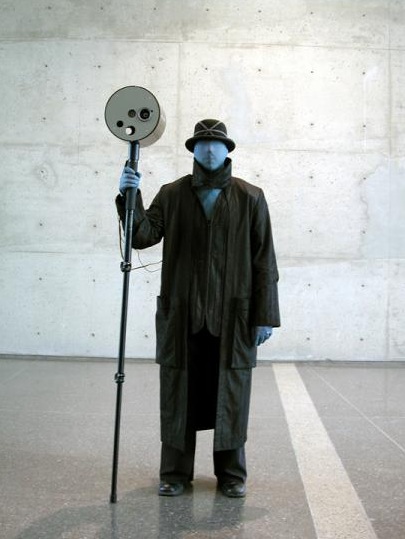
This faceless individual looks like a character out of some story by Bilal or Moebius or Ditko...but it's actually a real life concept created by an advertising agency for "nomadic media" presentations. Can you imagine walking down the street and running into this guy? I don't think the response will be as pleasant or benign as the inventors suppose.
This particular fellow is described as "The Projector" -- sounds even more like a Ditko character, don't you think? -- but the company's trade is sending people out into the streets wearing backpack-mounted LCD screens. Intellectually, I realize this is nothing more than a logical high-tech extension of the standard "guy wearing a sandwich board handing out flyers to passersby"...but emotionally, it strikes me as creepy on a dozen different levels. Imagine taking a job as a mobile TV stand. Or imagine stepping outside for some air and not being able to escape walking TV sets heading toward you.
The image comes from here but I found it thanks to a post here.
Tuesday, July 11, 2006
If You Go, Don't Be Slow

In an interview a few years back, David Bowie remarked that "it doesn't matter who did it first; what matters is who did it second!" This aphorism could have a lot of different applications. It might refer to a purely commercial sense, meaning "The true innovator doesn't reap the commercial rewards of his or her new invention; all the wealth and fame goes to someone else who steals or borrows the innovation and puts it to use in a more accessible form." Or it might be a less cynical comment on the artistic process, suggesting that "Innovations may come about by accident or necessity; the real credit is deserved by those who recognize the innate value of the new thing on its own merits and strive to apply it to their own work. Without them it would be a fluke, not an innovation." Whichever interpretation you prefer doesn't matter; what matters is that Syd Barrett was one of the ones who did it first.
Other people will mention the Floyd's single "See Emily Play" as one of the seminal groundbreaking moments of late-Sixties psychedelia -- and it is everything people say it is -- or talk about how Barrett's mental decline formed the emotional core of later Pink Floyd albums like Dark Side of the Moon and especially Wish You Were Here. Barrett released two solo albums which are treasured by anyone since who's written songs with a guitar in hand...but not widely known to the general public who thinks of Pink Floyd as that band of elderly geezers who did "Comfortably Numb" or "Another Brick In The Wall."
But for me, the name Syd Barrett is synonymous with the impossibly clear and powerful crashing widescreen Cinerama guitar chord that opens "Astronomy Domine" -- the first song on their debut album Piper At The Gates of Dawn. The song was recorded at Abbey Road Studios in April 1967 -- pretty much the same time the Beatles started living there full time. The pleasant British nostalgia of Sgt. Pepper is what caught the world's attention...but that power chord slide from E to Eb was a raw challenge of pure defiance that hasn't been equalled in the punk, or postpunk, or metal of subsequent years. It's a thunderclap that for a little while sounded like it might break the world open.
A lot -- too much -- has been written about Barrett's mental illness and withdrawal from the public eye. Clearly, there were problems which may have been the result of an existing schizophrenic tendancy exacerbated by indulgence in psychedelic drugs. (I wonder how many cases of drug burnout might actually be situations where someone with preexisting mental issues fell into using LSD or the like as an accidental form of self-medication rather than getting the early treatment they needed?) But at the same time, anyone withdrawing from fame and attention is defying what's practically become the modern religion of fame at all costs. Witness the venom and bile spewed at Dave Chappelle for a more recent example. I've seen him condemned with the unspoken subtext of How dare he walk away from the thing we're all supposed to want?
So, yeah, Syd became a bit of a nutter, lost his hair, gained weight -- though when you get right down to it, he didn't look any worse than any of the surviving members of Pink Floyd do -- but I'd like to think that on some level living quietly in Cambridge, painting and gardening, really was the right choice for him and that he was happy in these final years. He was owed that much.
Thursday, June 29, 2006
The Superman page Grant Morrison wishes he wrote
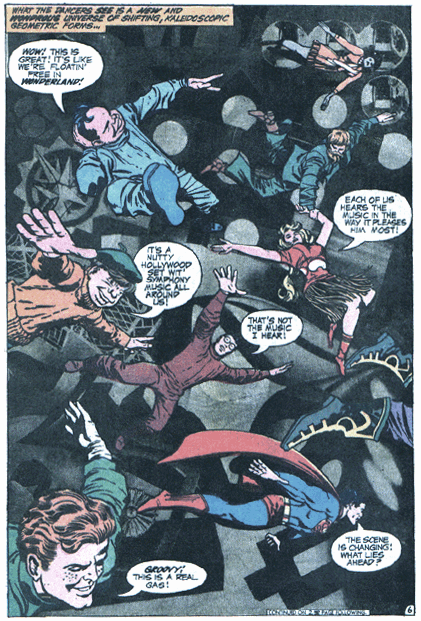
Okay, maybe All-Star Superman #4 is the best Superman comic to be published in nearly twenty years...but well before that, Jimmy and his best pal were exploring tripped-out psychedelic landscapes alongside the Hairies and the Newsboy Legion, courtesy of Jack Kirby:

(From Superman's Pal Jimmy Olsen #137, one of my favorite comics of all time.)
You'll definitely want to check out more about this here.
(From Superman's Pal Jimmy Olsen #137, one of my favorite comics of all time.)
You'll definitely want to check out more about this here.
Tuesday, June 27, 2006
Every time a bell rings, an angel gets his...oh, never mind
Apparently, back in the old days of Hollywood, they knew how to conduct a proper job interview. Like this:
None of my job interviews went like that.
I wonder if this was the inspiration for The Cheyenne Social Club? Nah, probably not.
Movie great JAMES STEWART was forced to prove he wasn't gay by bedding two hookers, according to an explosive new biography. Movie mogul LOUIS B MAYER reportedly instructed the IT'S A WONDERFUL LIFE star to prove to him he wasn't a homosexual before offering him a film deal, sending the actor off to find a couple of prostitutes. The shocking claim is made by MARC ELIOT in his new tome JIMMY STEWART - A BIOGRAPHY, which is set to hit bookshelves this autumn. Eliot claims Meyer demanded Stewart prove he wasn't gay by visiting a Hollywood brothel and bedding "at least two of those broads".
None of my job interviews went like that.
I wonder if this was the inspiration for The Cheyenne Social Club? Nah, probably not.
Monday, June 26, 2006
Friday, June 23, 2006
That's it, I'm taking your comics away
From the New York Times:
You'll all get your comic books back when you can promise me you'll behave. But first I want you people to think about what you've done. Your mother and I are both very disappointed in you.
CARTOON SUPERMAN never amounted to more than that for most people. But for a select group, early encounters with the Man of Steel wearing a molded bodysuit, knee boots and a shiny cape helped set the course of an erotic life. "Batman and Robin and Superman were all really exciting," said John Weis, the chairman of the Folsom Street East street fair, an annual event that kicked off Gay Pride Week in New York on Sunday. "Batman was always tied up or in some peril, and I thought that was really great."
You'll all get your comic books back when you can promise me you'll behave. But first I want you people to think about what you've done. Your mother and I are both very disappointed in you.
Sunday, June 04, 2006
Broken wings
A rant, in which I respectfully disagree with Kalinara on a topic that is of no personal significance to me whatsoever, but that touches on matters I think about a lot.
Most of the time I talk about comics on this blog...but I know some of you aren't actually comics readers, so first a quick summary to bring everyone up to speed. DC Comics has a character named Nightwing, more about whom shortly. Also, DC Comics recently published a godawful series called Infinite Crisis in which the very foundations of the DC superhero universe were shaken and the continuity of their books rearranged to make them new and exciting again. If that wasn't enough excitement, Infinite Crisis was preceded by a bunch of mini-series all leading into the main event, and its aftermath involves all the DC titles jumping forward in time to "One Year Later" -- in which time dramatic changes have come to various characters, for example: Green Arrow is now the mayor of Star City! But how did this come about? -- and a year long weekly comic series called 52 which discloses the events of the "missing year" during which Superman, Batman, and Wonder Woman all took a simultaneous twelve month sabbatical. All clear? Okay. You don't need to remember any of that.
Now, at the Wizard World convention in Philadephia, DC Vice President and Executive Editor Dan Didio revealed that one of his hopes for Infinite Crisis had been killing off the character Nightwing...who is none other than Dick Grayson, formerly Batman's sidekick Robin. However, Nightwing got a reprieve from higher up, and is still alive.
Robin/Nightwing has a considerable fan following, and a lot of that fandom feels that his comic totally blows. Kalinara, a very astute reader whose opinions I always enjoy, opines that the character is irredeemably broken due to writer mishandling, and that killing him off would have been the best choice. She makes a strong case based on the significance his death would have had in the continuity, and how other characters would respond. Very sensible stuff...and yet, I disagree.
Virtually every reference I've seen to what's wrong with Nightwing, or killing off Dick Grayson as a good or bad thing, or how much a segment of fans liked him in Teen Titans, has been based on hardcore fan reference points and continuity debates...and totally missing a larger aspect in the real world outside of comics.
I've never read an issue of any Nightwing solo comic. I read maybe the first six or seven issues of the Teen Titans comic by Marv Wolfman and George Perez, and none since then. I don't know a damn thing about the character or his development over the years. But I do know that an astonishingly large percentage of the world's population knows who Batman and Robin are, and that a considerable subgroup of same knows that they're Bruce Wayne and Dick Grayson. If you said to these people "Robin grew up to work on his own, apart from Batman, and now calls himself Nightwing" that premise is totally accessible and immediately understandable. Any comic publisher that wanted to hook an audience -- instead of servicing the continuity-based minutiae known only to an ever-diminishing of insiders -- would be complete and utter fools to throw away something with that level of audience recognition.
If there were a Nightwing movie or television show, all the reviews and listings would have to say is "the adventures of Batman's former partner Robin, now grown up and on his own," and boom! -- everyone would be on the same page. Do comics fans really not see how valuable that is? To say "Oh, but the character is broken, we have no way to tell a good story about him anymore" is completely missing how the act of writing fiction works.
As I say, I have only the astute comments of folks like Kalinara and Vince Murphy to indicate the ways in which Nightwing has been poorly handled; I assume these are accurate descriptions. But all that's needed to remedy these faults is a proper writer, one who can say: "What's the premise of this character? Oh yeah, the whole grown-up Robin thing. Right, so he was a boy acrobat whose parents were killed, trained by the World's Greatest Detective in crime fighting. But he's different from Batman, because he had a mentor instead of being alone since boyhood. So he's as tough and competent as Batman, but with a warmer human side. And he's known all the other heroes since he was a kid. They don't hold any mystique for him; he's seen it all...and anyway, Batman's the best. So what happens when..."
And suddenly, you're telling stories. See how that works? Writers who are obsessed with continuity points at the expense of telling stories have their heads, and there's no other way of saying this, shoved into their own asses.
Now here's the question that's been driving me nuts. If Nightwing was doing so poorly that the Vice President and Executive Editor of DC Comics wanted to kill him off...why is DC still publishing a Nightwing comic? You don't have to kill off the character, just stop publishing the damn comic and give him a rest. But if the comic is selling well enough to keep going...why the hell was this guy trying to have him killed off?
If you can wrap your head around this...if you can answer those questions...you understand the world of comics better than I do.
Most of the time I talk about comics on this blog...but I know some of you aren't actually comics readers, so first a quick summary to bring everyone up to speed. DC Comics has a character named Nightwing, more about whom shortly. Also, DC Comics recently published a godawful series called Infinite Crisis in which the very foundations of the DC superhero universe were shaken and the continuity of their books rearranged to make them new and exciting again. If that wasn't enough excitement, Infinite Crisis was preceded by a bunch of mini-series all leading into the main event, and its aftermath involves all the DC titles jumping forward in time to "One Year Later" -- in which time dramatic changes have come to various characters, for example: Green Arrow is now the mayor of Star City! But how did this come about? -- and a year long weekly comic series called 52 which discloses the events of the "missing year" during which Superman, Batman, and Wonder Woman all took a simultaneous twelve month sabbatical. All clear? Okay. You don't need to remember any of that.
Now, at the Wizard World convention in Philadephia, DC Vice President and Executive Editor Dan Didio revealed that one of his hopes for Infinite Crisis had been killing off the character Nightwing...who is none other than Dick Grayson, formerly Batman's sidekick Robin. However, Nightwing got a reprieve from higher up, and is still alive.
Robin/Nightwing has a considerable fan following, and a lot of that fandom feels that his comic totally blows. Kalinara, a very astute reader whose opinions I always enjoy, opines that the character is irredeemably broken due to writer mishandling, and that killing him off would have been the best choice. She makes a strong case based on the significance his death would have had in the continuity, and how other characters would respond. Very sensible stuff...and yet, I disagree.
Virtually every reference I've seen to what's wrong with Nightwing, or killing off Dick Grayson as a good or bad thing, or how much a segment of fans liked him in Teen Titans, has been based on hardcore fan reference points and continuity debates...and totally missing a larger aspect in the real world outside of comics.
I've never read an issue of any Nightwing solo comic. I read maybe the first six or seven issues of the Teen Titans comic by Marv Wolfman and George Perez, and none since then. I don't know a damn thing about the character or his development over the years. But I do know that an astonishingly large percentage of the world's population knows who Batman and Robin are, and that a considerable subgroup of same knows that they're Bruce Wayne and Dick Grayson. If you said to these people "Robin grew up to work on his own, apart from Batman, and now calls himself Nightwing" that premise is totally accessible and immediately understandable. Any comic publisher that wanted to hook an audience -- instead of servicing the continuity-based minutiae known only to an ever-diminishing of insiders -- would be complete and utter fools to throw away something with that level of audience recognition.
If there were a Nightwing movie or television show, all the reviews and listings would have to say is "the adventures of Batman's former partner Robin, now grown up and on his own," and boom! -- everyone would be on the same page. Do comics fans really not see how valuable that is? To say "Oh, but the character is broken, we have no way to tell a good story about him anymore" is completely missing how the act of writing fiction works.
As I say, I have only the astute comments of folks like Kalinara and Vince Murphy to indicate the ways in which Nightwing has been poorly handled; I assume these are accurate descriptions. But all that's needed to remedy these faults is a proper writer, one who can say: "What's the premise of this character? Oh yeah, the whole grown-up Robin thing. Right, so he was a boy acrobat whose parents were killed, trained by the World's Greatest Detective in crime fighting. But he's different from Batman, because he had a mentor instead of being alone since boyhood. So he's as tough and competent as Batman, but with a warmer human side. And he's known all the other heroes since he was a kid. They don't hold any mystique for him; he's seen it all...and anyway, Batman's the best. So what happens when..."
And suddenly, you're telling stories. See how that works? Writers who are obsessed with continuity points at the expense of telling stories have their heads, and there's no other way of saying this, shoved into their own asses.
Now here's the question that's been driving me nuts. If Nightwing was doing so poorly that the Vice President and Executive Editor of DC Comics wanted to kill him off...why is DC still publishing a Nightwing comic? You don't have to kill off the character, just stop publishing the damn comic and give him a rest. But if the comic is selling well enough to keep going...why the hell was this guy trying to have him killed off?
If you can wrap your head around this...if you can answer those questions...you understand the world of comics better than I do.
Thursday, June 01, 2006
Nerd news
I hope we'll have no more complaints about this:
NY COMIC-CON ANNOUNCES EXPANDED VENUE FOR 2007
So I've got karaoke this weekend and a convention next February. I'll try to fill in the nine months between the two as best I can.
NY COMIC-CON ANNOUNCES EXPANDED VENUE FOR 2007
Organizers note that the upstairs location can accommodate twice as many exhibitors and many of the aisles will also be twice as wide which will afford easy access for the many attendees. The lobby, which also houses the registration area, will be five times bigger than the lobby in ’06 and there will be twice as many registration counters. There will also be longer show hours, two entrances to the show floor, and separate registration lines for pre-registration and on-site ticket purchases. In addition, exhibitor and professional badges will be mailed in advance this year eliminating an estimated 8,000 badge “pick ups” in the registration area just before the show.
So I've got karaoke this weekend and a convention next February. I'll try to fill in the nine months between the two as best I can.
Thursday, May 25, 2006
We broke them, I tell you
About five years ago, many thousands of television viewers told the Sci-Fi Channel, "No, don't cancel Farscape! Farscape is the best thing you have! If you cancel it, you're going down a bad road! Who knows where it will lead?" But they didn't listen to the fans, and Farscape was cancelled.
And now Bonnie Hammer, president of Sci-Fi Channel then as now, is trying to rationalize the Sci-Fi Channel airing WWE wrestling shows.
That's in addition to the channel already showing the soap opera Passions (!) and reruns of Law and Order: SVU (!!!).
We tried to warn them, but they didn't listen. Now they're broken. Cartoon Network, you're next.
And now Bonnie Hammer, president of Sci-Fi Channel then as now, is trying to rationalize the Sci-Fi Channel airing WWE wrestling shows.
That's in addition to the channel already showing the soap opera Passions (!) and reruns of Law and Order: SVU (!!!).
We tried to warn them, but they didn't listen. Now they're broken. Cartoon Network, you're next.
Tuesday, May 16, 2006
Blast from the past
I'm sorry, but other than a surprisingly decent Superboy, these guys look terrible. I assume they were trying to capture some of that rakish Teen Titans quasi-anime mojo but instead they took a left turn and veered off into Ugly Town.
For that matter, you have to wonder how the cartoon will get away with featuring Superboy so prominently, in the wake of the recent court ruling that the television series Smallville may infringe on the copyright held by his creator's wife and daughter...and that show doesn't even refer to the character as "Superboy." So wouldn't the same concerns over possible copyright infringement apply here? DC only just got finished getting rid of the two remaining characters they had named Superboy, and the current Legion comic now features Supergirl.
Personally, I don't understand why the different divisions at Warner can't coordinate their activities a little better: either have a "Legion of Super-Heroes" cartoon without a Superboy or Supergirl...or, better still, make the cartoon "Supergirl and the Legion of Super-Heroes" for greater consonance and cross-promotional possibilities with the print version, not to mention a girl-positive lead character.
(And if you say a teenage girl cannot be the lead action hero in a cartoon series that appeals to boys, I shall have to ask you to step outside.)
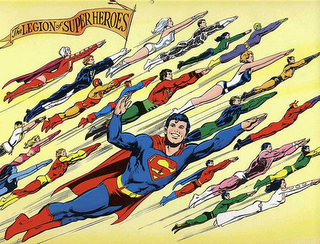
Ah well. As a reward for putting up with my fevered rantings, here's something nice to look at, courtesy of Robby Reed at Dial B for Blog:
For that matter, you have to wonder how the cartoon will get away with featuring Superboy so prominently, in the wake of the recent court ruling that the television series Smallville may infringe on the copyright held by his creator's wife and daughter...and that show doesn't even refer to the character as "Superboy." So wouldn't the same concerns over possible copyright infringement apply here? DC only just got finished getting rid of the two remaining characters they had named Superboy, and the current Legion comic now features Supergirl.
Personally, I don't understand why the different divisions at Warner can't coordinate their activities a little better: either have a "Legion of Super-Heroes" cartoon without a Superboy or Supergirl...or, better still, make the cartoon "Supergirl and the Legion of Super-Heroes" for greater consonance and cross-promotional possibilities with the print version, not to mention a girl-positive lead character.
(And if you say a teenage girl cannot be the lead action hero in a cartoon series that appeals to boys, I shall have to ask you to step outside.)
Ah well. As a reward for putting up with my fevered rantings, here's something nice to look at, courtesy of Robby Reed at Dial B for Blog:

Sunday, May 14, 2006
Atom heart mother
I wasn't planning to write anything special for Mother's Day, but this post by Ragnell inspired me to make a quasi-political statement about my mom.
My mother turned seventy-one nearly a month ago. The most recent comic book she read was the latest issue of All-Star Superman. She liked Watchmen a lot. (I've told her League of Extraordinary Gentlemen is much superior among Alan Moore's work...but adult-onset diabetes has messed with her vision and she needs to get new corrective lenses before she's ready to tackle any more text-intensive Moore comics.) She was a fan of The Tick before I'd ever even heard of it. Sure, these days I recommend comics to her that I think she'd enjoy...but I didn't introduce her to comics. She was reading them back in the Forties, and was a big fan of Captain Marvel. When DC first revived the character in the Seventies, I read the copies she bought, not the other way around.
I should add that she bought them so my dad could read them too. Before he became a surgeon, he had wanted to be a cartoonist, and avidly read comic books and comic strips. In subsequent years he did all the illustrations for his own medical papers. Neither parent discouraged me from reading comics, any more than they discouraged me from reading their collection of Kurt Vonnegut novels when I was nine years old, or any other books I wanted to read. Both parents borrowed my comics.
So, that's my mom: geneticist, cell biologist, medical school teacher, left-wing political activist, science fiction geek, fan of Farscape and Doctor Who and Deep Space Nine, Usenet addict...and superhero comic reader. Erik Larsen will just have to deal with it.
My mother turned seventy-one nearly a month ago. The most recent comic book she read was the latest issue of All-Star Superman. She liked Watchmen a lot. (I've told her League of Extraordinary Gentlemen is much superior among Alan Moore's work...but adult-onset diabetes has messed with her vision and she needs to get new corrective lenses before she's ready to tackle any more text-intensive Moore comics.) She was a fan of The Tick before I'd ever even heard of it. Sure, these days I recommend comics to her that I think she'd enjoy...but I didn't introduce her to comics. She was reading them back in the Forties, and was a big fan of Captain Marvel. When DC first revived the character in the Seventies, I read the copies she bought, not the other way around.
I should add that she bought them so my dad could read them too. Before he became a surgeon, he had wanted to be a cartoonist, and avidly read comic books and comic strips. In subsequent years he did all the illustrations for his own medical papers. Neither parent discouraged me from reading comics, any more than they discouraged me from reading their collection of Kurt Vonnegut novels when I was nine years old, or any other books I wanted to read. Both parents borrowed my comics.
So, that's my mom: geneticist, cell biologist, medical school teacher, left-wing political activist, science fiction geek, fan of Farscape and Doctor Who and Deep Space Nine, Usenet addict...and superhero comic reader. Erik Larsen will just have to deal with it.
Friday, May 12, 2006
On self publishing
I haven't had a lot of time for blogging lately, but somehow I had the time to get involved with this discussion thread at digitalwebbing.com, a combination sounding board/workshop/support group for aspiring comics creators. If you're one of those people who thinks you'd like to work in comics someday -- statistics show that 99% of comic book readers want to become comic book professionals, and I can vouch for that figure personally because I just made it up -- you could do a hell of a lot worse than checking out this site. I only wish it had existed twenty years ago...but back then I wouldn't have been able to process and accept the information it offers.
Anyway, this particular discussion thread led me to make some lengthy comments, and I'd like to repost them here for the benefit of anyone in the wider audience who might be interested. What follows is an edited jumble of comments from the thread; if you'd like to read the whole thing in context, follow the above link.
The thread is about seeking tips and advice on the best way for aspiring comics creators to approach editors and publishers at conventions. The non-comics person may need to be told here that unlike prose writers or Hollywood screenwriters, creative talent in comics do not have agents representing them. Being the lowest of the low end in periodical publications, comics operate on the basis of creators making pitches directly to editors...and most publishers have become -- or are in the process of becoming -- closed, invitation-only clubs. You don't even get to pitch to Marvel or DC; they invite you to pitch, and then only on the basis of a proven track record or an existing social relationship.
This is why comic conventions have become so vitally important for aspiring writers and artists, and why they've become such fraught experiences for editors. It's one of the few ways potential creators can possibly develop a face-to-face social relationship with prospective editors. But feel for the poor editor who has to deal with one hundred earnest young people who each have a 22 page comic book script they each want him to read and make thoughtful comments upon right there on the spot! (I hope you didn't have anything else planned for that weekend.)
The original poster on the thread cited a literary agent who determines whether or not a writer has something to offer simply by reading the first paragraph. Surely comic book editors can do the same? Well, sure, I understand that perspective. It's the American Idol effect: people's innate capacity for self-delusion can be truly staggering, and it doesn't take more than a couple of flat notes for Simon Cowell to work out who might be a promising contender and who has no business even singing in the shower. We can leave out anyone who writes in crayon, or has major spelling or grammatical errors on the first page, or doesn't know how to format a readable script and it doesn't change the fundamental point I'm about to make.
Here's the thing about writing: loads of people can write a killer paragraph. Especially if they're novices with no deadlines to meet and with years and years to hone and refine that killer paragraph. Only a small percentage of the people who are talented with words have the tenacity and determination to write every day, even when no inspiration strikes, to keep going in the face of every setback and discoragement...to actually be steadily working writers.
Talent has very little to do with the capacity to do that work. In fact, talent can be an imediment -- if it means that writing comes so easily to you that you never had to learn how to work at it when it doesn't come easily.
The catch is, only the people who are capable of sticking it out and getting the work done regularly and consistently are worth an agent's or editor's time. They've got deadlines to meet and books that have to be delivered and (at least in the prose world) advances that have to be justified. So many people come along and seem promising and talented yet who fold under pressure or flake out and don't deliver the finished work. In books, that means not only this book, but the next one and the one after that. In comics, that means not only the script you've finished, but next month's script and the month after that. These people are investing in your future output and they have to take a gamble on your ability to perform...and they still get burned time and time again.
This is why self-publication has become a big feature of the comics landscape and will only become bigger in the future, especially for the aspiring newcomer.
An aspiring writer handing an editor a finished, printed comic book at least says "I'm determined enough to make it in this business that I did all the extra work besides writing necessary to make it happen, I pulled it together and could coordinate with at least one other person -- the artist; possibly more than one if there was an inker and letterer -- and I nagged them about deadlines and kept after them and still made them want to work with me. And here's the proof right in your hands." This goes a long way to showing an editor that you're someone who can and will do the work of being a writer.
It also helps show them that what you want to do is make comics, not "be a comics author" or whatever. The person who does comics because he or she has to -- who does the work for the sake of doing it and getting it seen by others -- is a MUCH better gamble for a publisher than someone who's only interested in doing it if certain conditions are met. A finished printed comic says "I did whatever it took for people to see this story, because I had to. If you don't publish me, people are still going to see my stuff."
If I were an editor, that's who I'd want to work with.
But there are so many aspiring writers and artists! There are more working writers out there, already published, than the industry can support as it is. And why bother when even the most successful comics writers could probably be making better money, working under better conditions, writing copy at an ad agency?
If you compare writing comics to writing copy at an ad agency, then yes, the supply outstrips the demand for the former, and the latter is far more lucrative. But you could say the exact same thing about being a painter and painting signs. There are far more painters in the world today than are needed, strictly speaking in terms of the number of paintings that anyone can look at in a lifetime. The guaranteed income of a regularly working sign painter may be much more useful in supporting a family than that of a starving painter in a garret. Novelists? No one can get through the smallest fraction of novels published each year. Musicians? It's even worse. We can say the same about film and television.
So, in ANY field of art, a person had better be doing it for sheer love of doing it. In that sense, there's no more reason to discourage someone from creating comics than there is to discourage people from writing novels, painting paintings, making music. They're all equally "fruitless" in terms of strict supply and demand.
But art doesn't work in terms of supply and demand, either. Good art creates its audience. An artist is not filling an existing demand for something that doesn't exist; the artist gives the audience something they didn't know they wanted until they saw it.
(My thanks to comics fan extraordinaire Tim Bateman for that turn of phrase.)
If there were no Grant Morrison (one of my favorites, but you can substitute your favorite writer or artist here) my comic book purchases wouldn't simply transfer to someone else. I buy a new Morrison book if I see it; if there isn't one, that's one less comic book I buy. And this is the reason why editors are looking for new creators at all: not because they have an opening on their schedule, but because they hope to find another Grant Morrison who will create a new audience they otherwise wouldn't have.
Note also that Grant's first published comics work was in 1977. It can take a while for a career to happen. I don't think anyone would argue that Grant should have given up much sooner?
We are competing, in the Darwinian sense of so many new comics wanting to catch the eyeballs of a potential audience. Breaking through that is hard. Doing something that justifies getting this attention is hard too. But a Grant Morrison or a Brian Bendis or whoever is not our competitor. They created an audience. We have to create one too. My goal is not to take away one of Grant's readers, but to work and struggle and pray for that day when someone tells me "I bought two comics today -- yours and his."
Anyway, this particular discussion thread led me to make some lengthy comments, and I'd like to repost them here for the benefit of anyone in the wider audience who might be interested. What follows is an edited jumble of comments from the thread; if you'd like to read the whole thing in context, follow the above link.
The thread is about seeking tips and advice on the best way for aspiring comics creators to approach editors and publishers at conventions. The non-comics person may need to be told here that unlike prose writers or Hollywood screenwriters, creative talent in comics do not have agents representing them. Being the lowest of the low end in periodical publications, comics operate on the basis of creators making pitches directly to editors...and most publishers have become -- or are in the process of becoming -- closed, invitation-only clubs. You don't even get to pitch to Marvel or DC; they invite you to pitch, and then only on the basis of a proven track record or an existing social relationship.
This is why comic conventions have become so vitally important for aspiring writers and artists, and why they've become such fraught experiences for editors. It's one of the few ways potential creators can possibly develop a face-to-face social relationship with prospective editors. But feel for the poor editor who has to deal with one hundred earnest young people who each have a 22 page comic book script they each want him to read and make thoughtful comments upon right there on the spot! (I hope you didn't have anything else planned for that weekend.)
The original poster on the thread cited a literary agent who determines whether or not a writer has something to offer simply by reading the first paragraph. Surely comic book editors can do the same? Well, sure, I understand that perspective. It's the American Idol effect: people's innate capacity for self-delusion can be truly staggering, and it doesn't take more than a couple of flat notes for Simon Cowell to work out who might be a promising contender and who has no business even singing in the shower. We can leave out anyone who writes in crayon, or has major spelling or grammatical errors on the first page, or doesn't know how to format a readable script and it doesn't change the fundamental point I'm about to make.
Here's the thing about writing: loads of people can write a killer paragraph. Especially if they're novices with no deadlines to meet and with years and years to hone and refine that killer paragraph. Only a small percentage of the people who are talented with words have the tenacity and determination to write every day, even when no inspiration strikes, to keep going in the face of every setback and discoragement...to actually be steadily working writers.
Talent has very little to do with the capacity to do that work. In fact, talent can be an imediment -- if it means that writing comes so easily to you that you never had to learn how to work at it when it doesn't come easily.
The catch is, only the people who are capable of sticking it out and getting the work done regularly and consistently are worth an agent's or editor's time. They've got deadlines to meet and books that have to be delivered and (at least in the prose world) advances that have to be justified. So many people come along and seem promising and talented yet who fold under pressure or flake out and don't deliver the finished work. In books, that means not only this book, but the next one and the one after that. In comics, that means not only the script you've finished, but next month's script and the month after that. These people are investing in your future output and they have to take a gamble on your ability to perform...and they still get burned time and time again.
This is why self-publication has become a big feature of the comics landscape and will only become bigger in the future, especially for the aspiring newcomer.
An aspiring writer handing an editor a finished, printed comic book at least says "I'm determined enough to make it in this business that I did all the extra work besides writing necessary to make it happen, I pulled it together and could coordinate with at least one other person -- the artist; possibly more than one if there was an inker and letterer -- and I nagged them about deadlines and kept after them and still made them want to work with me. And here's the proof right in your hands." This goes a long way to showing an editor that you're someone who can and will do the work of being a writer.
It also helps show them that what you want to do is make comics, not "be a comics author" or whatever. The person who does comics because he or she has to -- who does the work for the sake of doing it and getting it seen by others -- is a MUCH better gamble for a publisher than someone who's only interested in doing it if certain conditions are met. A finished printed comic says "I did whatever it took for people to see this story, because I had to. If you don't publish me, people are still going to see my stuff."
If I were an editor, that's who I'd want to work with.
But there are so many aspiring writers and artists! There are more working writers out there, already published, than the industry can support as it is. And why bother when even the most successful comics writers could probably be making better money, working under better conditions, writing copy at an ad agency?
If you compare writing comics to writing copy at an ad agency, then yes, the supply outstrips the demand for the former, and the latter is far more lucrative. But you could say the exact same thing about being a painter and painting signs. There are far more painters in the world today than are needed, strictly speaking in terms of the number of paintings that anyone can look at in a lifetime. The guaranteed income of a regularly working sign painter may be much more useful in supporting a family than that of a starving painter in a garret. Novelists? No one can get through the smallest fraction of novels published each year. Musicians? It's even worse. We can say the same about film and television.
So, in ANY field of art, a person had better be doing it for sheer love of doing it. In that sense, there's no more reason to discourage someone from creating comics than there is to discourage people from writing novels, painting paintings, making music. They're all equally "fruitless" in terms of strict supply and demand.
But art doesn't work in terms of supply and demand, either. Good art creates its audience. An artist is not filling an existing demand for something that doesn't exist; the artist gives the audience something they didn't know they wanted until they saw it.
(My thanks to comics fan extraordinaire Tim Bateman for that turn of phrase.)
If there were no Grant Morrison (one of my favorites, but you can substitute your favorite writer or artist here) my comic book purchases wouldn't simply transfer to someone else. I buy a new Morrison book if I see it; if there isn't one, that's one less comic book I buy. And this is the reason why editors are looking for new creators at all: not because they have an opening on their schedule, but because they hope to find another Grant Morrison who will create a new audience they otherwise wouldn't have.
Note also that Grant's first published comics work was in 1977. It can take a while for a career to happen. I don't think anyone would argue that Grant should have given up much sooner?
We are competing, in the Darwinian sense of so many new comics wanting to catch the eyeballs of a potential audience. Breaking through that is hard. Doing something that justifies getting this attention is hard too. But a Grant Morrison or a Brian Bendis or whoever is not our competitor. They created an audience. We have to create one too. My goal is not to take away one of Grant's readers, but to work and struggle and pray for that day when someone tells me "I bought two comics today -- yours and his."
Wednesday, May 03, 2006
The butter in my pocket is melting
In the movie An Inconvenient Truth Al Gore uses a clip from Futurama to illustrate global warming.
That man is my President.
That man is my President.
Tuesday, May 02, 2006
Links of note
I've been busy lately doing preliminary research for a new writing project. That's always the best part, when I can indulge myself learning a ton of stuff about the history of railroads, diagnostic indicators of cerebral hemorrhage, trees native to Pennsylvania, and the Ramayana...and saying to myself "I'm not goofing off, it's research." Then comes the other good part, which is staring off into space and letting it all swirl around in my head...and saying to myself "I'm not goofing off, I'm developing a story." And then comes the part about typing it all out, cursing myself for having no talent, waking up at 4 AM and deciding to quit writing...the usual. But at times like these, the blogging gets shortchanged. It's unavoidable. It doesn't mean I don't love you.
Now, if you're anything like me...first of all, please seek help immediately. Even though I make it sound fun and glamorous and exciting, it will only end in tears. But I digress. If you're anything like me, you've spent the last few days reading endless commentary and analysis of Steven Colbert's appearance at the White House Correspondents Dinner on Saturday. It's become an obsession with me. I was jazzed to see the real thing live on television, but the aftershocks have become overwhelming. All the commentary after the fact can be summed up in this simple formula: If he was talking about you, you didn't think it was funny.
Fortunately, one person has provided a comprehensive, sensible, and well-informed analysis of the event and subsequent reactions to same on his blog. And no, I don't mean Johnny Triangles. I refer to stand-up comedian, physicist, screenwriter, and comic book author John Rogers, who writes about Colbert's performance here and here. Anything I could say on the topic has already been said in those two posts and in the comments section for each.
Besides, anyone who knows why the words "Vaughn Meader" were once the funniest joke ever told has my respect.
Now, if you're anything like me...first of all, please seek help immediately. Even though I make it sound fun and glamorous and exciting, it will only end in tears. But I digress. If you're anything like me, you've spent the last few days reading endless commentary and analysis of Steven Colbert's appearance at the White House Correspondents Dinner on Saturday. It's become an obsession with me. I was jazzed to see the real thing live on television, but the aftershocks have become overwhelming. All the commentary after the fact can be summed up in this simple formula: If he was talking about you, you didn't think it was funny.
Fortunately, one person has provided a comprehensive, sensible, and well-informed analysis of the event and subsequent reactions to same on his blog. And no, I don't mean Johnny Triangles. I refer to stand-up comedian, physicist, screenwriter, and comic book author John Rogers, who writes about Colbert's performance here and here. Anything I could say on the topic has already been said in those two posts and in the comments section for each.
Besides, anyone who knows why the words "Vaughn Meader" were once the funniest joke ever told has my respect.
Monday, April 24, 2006
Have you got any ice cream without so much spam in it?

Vermonty Python is described as "coffee liqueur ice cream with a chocolate cookie crumb swirl & fudge cows." This doesn't sound very appealing to me; worse, it sounds as if someone just thought up the name and decided to slap it on the next random combination of flavors that came along, rather than trying to devise a variety of flavor that would be appropriate for the name.
Surely with "Vermonty" in the name, the obvious choice would be a maple syrup flavor. It would be perfect for that special someone who became a barber to overcome his crippling fear of hair, when all he really wanted to be was...a lumberjack! Or a strawberry tart flavor, without so much rat in it. Maybe three rats...rather a lot, really. No, the perfect flavor to go with this theme would be ice cream mixed with chocolate-dipped crunchy frogs!
And woe betide the Ben & Jerry's customer who orders a pint of Vermonty Python and complains about the dirty spoon...
Okay, that's enough. I invite anyone who's interested to post their own Python-derived jokes on this theme in the comments section. I have serious misgivings about one of the most precious things from my childhood being turned into a string of licensing opportunities and mass marketed to the point of inanity, but that's just me.
Wednesday, April 19, 2006
Local news
I can't believe this cretin got off, you should pardon the expression, with a mere two years probation.
More than once, this jerk (hmm, another bad choice of words on my part) has said things similar to the quote provided in the above article: "she may like me and want to go home with me...it's her call." He made similar comments in an article published in New York magazine. To me, that spells future stalker and/or sex offender. Loads of rapists say things afterwards like "I could tell she was enjoying it" or other filth from the depths of their self-delusion.
And when he gets arrested for doing something even worse -- like stalking or assaulting someone -- you just know what the authorities will say:
"No one could possibly have foreseen that his levees would burst."
More than once, this jerk (hmm, another bad choice of words on my part) has said things similar to the quote provided in the above article: "she may like me and want to go home with me...it's her call." He made similar comments in an article published in New York magazine. To me, that spells future stalker and/or sex offender. Loads of rapists say things afterwards like "I could tell she was enjoying it" or other filth from the depths of their self-delusion.
And when he gets arrested for doing something even worse -- like stalking or assaulting someone -- you just know what the authorities will say:
"No one could possibly have foreseen that his levees would burst."
Tuesday, April 18, 2006
Up against the WSJ
The Wall Street Journal has an article about the nascent trend of paid product placement in comic books.
The whole idea seems dubious to me on more than one level. Leaving aside my hippy-dippy crunchy granola sentiments about the ubiquity of paid advertising and endorsement deals and the implicit message they carry that everyone and everything can be bought and owned and even our fantasies can be colonized by corporations...as I say, leaving aside that whole train of thought, it raises a lot of questions for me on a purely pragmatic and materialistic level. Does it make a lot of sense for corporate advertisers to move into comics now...when the audience size for comics is in decline?
Given that the diminishing market is moving towards trade paperbacks and graphic novels -- which don't carry ad pages -- one can see the logic of advertisers wanting to get their content into the story pages instead, which will end up in those collections. But in the best case scenario, those stealth ads and product placements will stay on the shelves for years -- do these companies really wants years- or decades-old products still being advertised? I suppose the answer is the same as with outdated product placement in movies and tv shows on DVD: the corporations don't really care if their advertising detritus hangs around for the rest of time.
And what about the money? It won't go towards offsetting production costs or lowering the cover prices of new comics. Does any of it make its way into the pockets of the writers and artists? If so, are they getting the same amount that a professional copywriter or illustrator would get at an ad agency for doing the same work, or is this a way for an advertiser to save some moolah?
And then there's this quote:
"They trust us." We're tame. We certainly won't do anything to threaten this cozy relationship, so they don't need to constantly look over our shoulders. You won't see any stories that implicitly question the corporate behavior of Dodge or Pontiac in refusing to strengthen emission standards, or embrace alternative technologies, or outsourcing their manufacturing facilities. Or any stories that skewer Nike for the corrosive social effects of fetishizing sportswear, or their sweatshops in Indonesia or Mexico or East Asia. (Oops, I said I wouldn't go all sandal-wearing and tree-hugging on you. My bad.) Well, there wouldn't have been that kind of story in those comics anyway, so no harm done...
I suppose this new trend won't really make any difference...which is kind of sad, don't you think?
But look, one good thing: there's a quote in the article from someone we know! I don't disapprove of the article itself...and I note with much approval that when it came time to get quotes from the fan perspective, both fans the author chose to quote were women. Holy stereotype shattering, Batman!
The whole idea seems dubious to me on more than one level. Leaving aside my hippy-dippy crunchy granola sentiments about the ubiquity of paid advertising and endorsement deals and the implicit message they carry that everyone and everything can be bought and owned and even our fantasies can be colonized by corporations...as I say, leaving aside that whole train of thought, it raises a lot of questions for me on a purely pragmatic and materialistic level. Does it make a lot of sense for corporate advertisers to move into comics now...when the audience size for comics is in decline?
Given that the diminishing market is moving towards trade paperbacks and graphic novels -- which don't carry ad pages -- one can see the logic of advertisers wanting to get their content into the story pages instead, which will end up in those collections. But in the best case scenario, those stealth ads and product placements will stay on the shelves for years -- do these companies really wants years- or decades-old products still being advertised? I suppose the answer is the same as with outdated product placement in movies and tv shows on DVD: the corporations don't really care if their advertising detritus hangs around for the rest of time.
And what about the money? It won't go towards offsetting production costs or lowering the cover prices of new comics. Does any of it make its way into the pockets of the writers and artists? If so, are they getting the same amount that a professional copywriter or illustrator would get at an ad agency for doing the same work, or is this a way for an advertiser to save some moolah?
And then there's this quote:
DC's Mr. McKillips says Pontiac will not have direct editorial oversight of the comic and its main character. "We're not seeking their approval on everything, and they trust us," he says. A Pontiac spokesman says the company is not involved in the creative process.
"They trust us." We're tame. We certainly won't do anything to threaten this cozy relationship, so they don't need to constantly look over our shoulders. You won't see any stories that implicitly question the corporate behavior of Dodge or Pontiac in refusing to strengthen emission standards, or embrace alternative technologies, or outsourcing their manufacturing facilities. Or any stories that skewer Nike for the corrosive social effects of fetishizing sportswear, or their sweatshops in Indonesia or Mexico or East Asia. (Oops, I said I wouldn't go all sandal-wearing and tree-hugging on you. My bad.) Well, there wouldn't have been that kind of story in those comics anyway, so no harm done...
I suppose this new trend won't really make any difference...which is kind of sad, don't you think?
But look, one good thing: there's a quote in the article from someone we know! I don't disapprove of the article itself...and I note with much approval that when it came time to get quotes from the fan perspective, both fans the author chose to quote were women. Holy stereotype shattering, Batman!
Subscribe to:
Posts (Atom)