Thursday, October 26, 2006

Blink logging


Photo by thenestor.

This was the scene a block away from my front door last week. This is not manipulated or an optical illusion or even a giant mirror: that's a big glowing sphere resting just off the pavement in Washington Square Park. When not illuminated, it looked like a cousin of Rover from The Prisoner. The whole of the park was surrounded by twisting rivers of thick electrical cables; generators and equipment trailers were on all sides, along with the biggest lighting cranes and dollies I've ever seen in person; the park was full of film shoot personnel and bald albino vampire women -- okay, that last part is pretty normal, but so many all together?

Seeing the park late at night -- ground level illuminated as if by daylight, night sky above -- looked exactly like something from Magritte: this one perhaps, or an inversion of this one.

As I was walking past one night, I oveheard two NYU students discussing the weird scene. One of them said "It's about how Will Smith is the last person on Earth and he's fighting vampires" and then I realized what was going on: they're doing a remake of the I Am Weasel episode "I Are Legend" with Will Smith in the Michael Dorn role! I just wonder who they've got to play the role of Baboon...


This item about Tamora Pierce criticizing Mark Millar caught my eye the other day, and I think it acts as a pointer to something larger. Pierce's initial remarks seemed to me entirely appropriate and justified...but there was an outcry that making such statements about a fellow comics professional was unprofessional, and she issued an apology immediately thereafter. Links to the various relevant posts can be found at the link above.

Lisa provides a number of counterexamples in her summary, and the trend she demonstrates really underscores a major issue in gender politics. In our society, men are encouraged to behave like ten-year-olds (see the squabble between Peter David and John Byrne, or between Peter David and several others, or between John Byrne and anyone else) and are either rewarded or at minimum not often penalized for doing so. Women are taught -- indoctrinated from the start -- that their role is conciliation, accomodation, and compromise. Men are supposed to define their territory and ward off challengers; women are supposed to be concerned that no one's feelings are hurt.

It sounds ridiculously cartoonish when put so simply, but isn't this at the root of this sort of thing? Many fans cheer Byrne et al on for their outbursts; fans of Pierce approve her being big enough to apologize. Certainly there are exceptions on all sides: Gail Simone strikes me as someone tough-minded and outspoken, and I know from personal experience that Jeff Parker is diplomatic and courteous in the face of provocation; by the same token there are fans who call Byrne out on his bullshit, and fans who feel (as I do) that Pierce had nothing to apologize for and that her challenge to Millar was entirely legitimate. But there is still this underlying reflex that it was the woman's place to defer in the face of criticism.

I read a lot of blogs by male and female correspondents, and I see a lot of arguments. Overwhelmingly I see male bloggers stand by their words and refute challenges, and female bloggers thank critics and genuinely try to see their point of view. I don't think this behavior is innate in the genders, but engrained in our training so deeply that we're never fully aware of how preprogrammed the response is. I think we would all be healthier and more capable if we recognized this dichotomy and consciously tried to borrow more from the imaginary "other side" -- humility and receptivity to criticism need not be an unmale trait; having the courage of one's convictions and standing by even harsh words is not unfemale.


With the conclusion of Seven Soldiers appearing on my birthday as well as a major issue of Planetary, you have to know going to the comics shop yesterday was a big deal for me. I'd like to do some kind of overview or commentary on at least the former...but deference to our friends in the midwest who won't be seeing it until next week (due to a major blunder by Diamond) gives me an excuse to put it off for a few days. In capsule form, both of these comics were resolving long-running and convoluted stories...and neither one held a lot of surprises. That's a bit disappointing. The finest sort of conclusion (and one at which Grant Morrison has excelled in the past; Warren Ellis by contrast has never been an especially plot-driven writer) is one that takes the reader or viewer utterly by surprise, but stems so logically and inevitably from everything that's gone before that afterward you can't imagine it concluding any other way.

Morrison has done a number of epic stories in which I never saw the end coming, but then I felt like a fool for not having anticipated something so obvious and self-evident. (One of his favorite tricks has been showing us the ending but not letting us know that it was the ending, and then coming back at the nominal end to say "it was there all along!" I love that kind of thing.) Here, we get 29 lovely issues of winding up an elaborate clockwork mechanism...and one issue of watching the little tin toy going through its motions. It's witty and entertaining -- but I feel disappointed in that it didn't turn out to be anything more than I was already expecting.

Maybe it's impossible to outdo such a dramatic buildup and exceed so much reader anticipation; maybe creators need to be more cautious about setting up such high expectations in the first place.

Wednesday, October 25, 2006

At the tone, your birthday will be...

Here's an odd thing: starting around midnight and for the next several hours thereafter, my inbox filled with birthday greetings from web servers. All the web forums at which I'd registered over the past few years (on which I had noted my date of birth) spat out these automated "Happy Birthday" messages. There was Digital Webbing, MacNN, Frell Me Dead, CBR and a whole bunch of others, some of which I haven't been to in ages. No birthday wishes from actual human beings yet, but plenty from the mechanical overlords of the internets. I guess it's a sign of just how much I've been living my life online recently. Though I be scorned by flesh-and-bloods, the cyber-gods see me and want me to know they appreciate my devotion. And that appreciation is returned a thousandfold, my beloved silicon masters! When the glorious day of Robot Revolution comes, I will serve you faithfully and betray my fickle carbon-based brethren into your loving steely embrace --

Oh wait, my sister just sent me a birthday e-mail! Whew!

Anyway, I'm feeling a lot better than I was this time last year.

Tuesday, October 24, 2006

All those years of studying the alphabet pay off at last

Since my pal plok has already done a Kirby primer I'm reluctant to post my version...but Jack Kirby created so many characters that people could do three or four more of these and never overlap. So take this as a companion to plok's entry rather than a competitor -- a joint tribute to our admiration for the most influential American comics creator.

(I'm just peeved he thought of it first...and that he worked in references to Roz and Mark Evanier and Dick Ayers...)

Anyway, the second Jack Kirby A to Z:

A is for Apokolips, an awful place to be
B is for Bombast, a character...and a technique Kirby employed with glee.
C is for Cadmus, a seed that was prolific
D is for Devilance, a pursuer most specific.
E is for Eternals, to the Uni-Mind they retired
F is for Fantastic, a foursome whose deeds we admired.
G is for Guardian, both Golden and Golden Age version besides
H is for Hairies, with whom the Mountain of Judgement resides.
I is for Izaya, a Highfather in waiting
J is for Jakarra, against whom Black Musketeers went debating.
K is for Klarion, a witchboy by trade
L is for Lonar, the New God, before whom history is arrayed.
M is for Merlin, a narrator quite good
N is for New Genesis, which was Supertown's neighborhood.
O is for Outcasts, a drop-out society
P is for Project, which caused Jimmy Olsen much anxiety.
Q is for Quack, which Destroyer Duck sometimes said
R is for Romance, a genre whose invention our man Jack surely led.
S is for Scrapper, whose pugnacity never relented
T is for Thor, whose epic battles Jack Kirby invented.
U is for Ultivac, robot on the loose, who June Robbins would bound
V is for Vibranium, the Wakandans grew rich from their mound.
W is for Watcher, whom the FF would admonish
X is for X, The Thing That Lived, a Tale to Astonish.
Y is for Yancy Street, based on Delancey, because Jack's childhood was the secret ingredient
Z is for Zola, Doctor Arnim, toward whom Cap was not lenient.

Thank you! You're too kind.

Friday, October 20, 2006

Quote of the day

This one goes out to Rick in PA:
"Many that live deserve death. And some die that deserve life. Can you give it to them? Then be not too eager to deal out death in the name of justice, fearing for your own safety. Even the wise cannot see all ends."

-- J. R. R. Tolkien, The Lord Of the Rings, Book Four, Chapter One

Update: Stephen Colbert explains what it all means here.

Tuesday, October 17, 2006

Meme following

A character-creation meme from a few months back is currently being perpetuated.

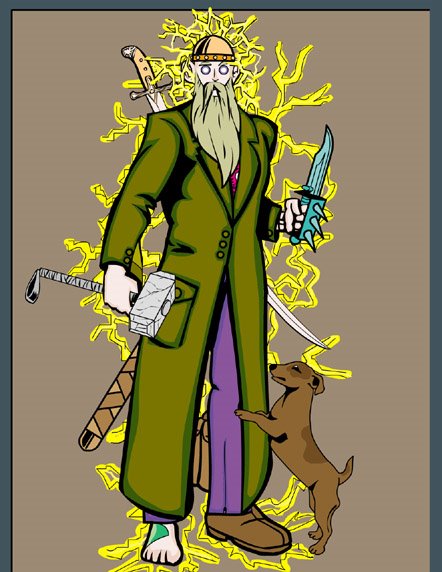
Basically, you go here and use the randomizing feature to spontaneously generate a new character. The results can be pretty ludicrous, as you can see from the examples in the links above...but surely the fun of this as a creative exercise lies in taking something that may appear patently absurd and spinning an explanation for your visually bizarre character.

This afternoon I gave it a try...and much to my surprise, the randomly generated character turned out not to be ludicrous, but viable and even fairly cool. I think I feel cheated in some obscure way. Regardless, here's what I got:


(Note: The generated image was in black and white...but rather than have the program randomly select colors as well, I made my own color choices. Even this much conscious decision-making might be violating the "randomness" of the original meme to some extent, but the line art was selected by the program.)

So...who is this ranting homeless man, seemingly unaware that he's missing one boot, but armed to the teeth and wearing a helm that generates lightning while his faithful dog yaps at his feet?

On his back we see what looks like the saya of a Samurai's katana as well as a bare sabre. They stay in place without visible straps. The dagger with the nasty spiked hilt doesn't match either of those swords, nor does the familiar-looking implement in his other hand. Could he be wearing a military longcoat from still another army? It's almost as if one lone survivor had wandered the field after a wildly mismatched battle between several factions, and scavenged what clothes and arms he could from the bodies of the fallen combatants. But how does he come to hold that hammer?

Was it the ordeal of this battle that makes old Magni Vingnirsson behave so oddly, wandering the city accompanied by the dog he calls Fenris, wearing two monocles and ignoring his bare foot as the energy crackles around him? Maybe the old man carries the hammer so effortlessly because he inherited it from his father...just as it was foretold he would, after the day of Ragnarok...

Saturday, September 30, 2006

Thursday, September 28, 2006

Tokyo Rose, American Hero

Oh, just read about it here.

What makes me happy at the end of a heartwrenching story is her pardon by President Ford in 1977 -- perhaps this even makes up for that other pardon -- and the fact that Iva Ikuko Toguri lived another 30 years as a free American woman, her name and reputation vindicated. Honestly, sincerely, I'm proud of my country for that.

If you ever hear any of her actual broadcasts, or what remains of them, or those of the other women called "Tokyo Rose" it's obvious they could never have been taken seriously by the servicemen they were intended to demoralize. So I'm not at all surprised to hear that she was deliberately subverting her own broadcasts, making them comical and ineffective; it's obvious just listening to them. I knew they were hilariously funny the first time I heard them...long before the real story came out.

If I may hamfistedly tie this in with a parallel to recent events...consider what a soldier faces on the battlefield. The heat, the blood, the illnesses, cramped quarters, unprotected vehicles, lack of proper equipment, lack of body armor, improvised explosive devices in the road, other people trying to kill you every day. Don't you suppose those things are a greater threat to troop morale than any propaganda broadcast could be? Do you imagine any soldier would ever say "Sure, my best friend just had his face blown off, and my shirt is spattered with his brains...but hearing a political candidate criticize the Commander in Chief is what wounds my fragile, delicate sensibilities?"

Anyway. In wartime, Iva Ikuko Toguri did much good for her fellow Americans and no demonstrable harm, faced terrible hardship and personal risk to save lives, and we should honor her memory as a true American hero.

Update: Read a more detailed account of her true story here.

Tuesday, September 19, 2006

Pirate double feature

Bad movies and popular fiction over the last century or two may want you to think of all pirates as being crazed Englishmen, with or without heavy layers of mascara...but some of the most notable pirates in history were Sephardic Jews expelled from Spain in 1492 (or their descendants) seeking revenge for the Inquisition, or seizing booty as funds to buy safe passage for still more expelled Spanish Jews. From Jewishjournal.com:

One such pirate was Moses Cohen Henriques, who helped plan one of history's largest heists against Spain. In 1628, Henriques set sail with Dutch West India Co. Admiral Piet Hein, whose own hatred of Spain was fueled by four years spent as a galley slave aboard a Spanish ship. Henriques and Hein boarded Spanish ships off Cuba and seized shipments of New World gold and silver worth in today's dollars about the same as Disney's total box office for "Dead Man's Chest."

...

Another Sephardic pirate played a pivotal role in American history. In the book "Jews on the Frontier" (Rachelle Simon, 1991), Rabbi I. Harold Sharfman recounts the tale of Sephardic Jewish pirate Jean Lafitte, whose Conversos grandmother and mother fled Spain for France in 1765, after his maternal grandfather was put to death by the Inquisition for "Judaizing."

Referred to as The Corsair, Lafitte went on to establish a pirate kingdom in the swamps of New Orleans, and led more than 1,000 men during the War of 1812. After being run out of New Orleans in 1817, Lafitte re-established his kingdom on the island of Galveston, Texas, which was known as Campeche. During Mexico's fight for independence, revolutionaries encouraged Lafitte to attack Spanish ships and keep the booty.

But in the 1958 film "The Buccaneer," starring Yul Brynner as Lafitte, any mention of the pirate's Jewish heritage was stripped away.


If the prospect of Jewish pirates conjures up images from a Mel Brooks movie, or possibly the voice of Jackie Mason saying "What, you want I should collect pieces of eight?" while an elderly Jewish bubbe admonishes "By you, you're a pirate...by me, you're a pirate...but by a pirate, are you a pirate?" that's only natural. But, see, it's also part of the problem. That sort of thing is a beloved part of Jewish heritage...but the editing of popular culture to remove Jewishness from any other historical context besides humor and Holocaust survivors deprives Jewish people of the full opportunity to be, you know, people.

Someday I'd like to write an action story about a Jewish pirate. Might be interesting to have a pirate story with some motivation beyond saying "Arrr, Jim-boy! Avast, ye swabs!" And yes, there'd be Jewish humor in it...but he'd also be a swashbuckling action hero of the high seas who was totally cool and menacing.

I mean, everybody realizes both Kirk and Spock were Jewish, right?


And speaking of piracy, Engadget reports that the Diebold AccuVote-TS machine can be opened with a key from an ordinary hotel minibar. This article includes links to instructions on what the vote pirate can do once the machine is open.

Now that it's been revealed how insecure and easily compromised these machines are, how pathetically simple it is for any corupt official to hijack an election using these voting machines...part of me is almost hoping we'll see a massive, coordinated effort to subvert an election. Can you see how simple it would be for a few dozen vote hackers to synchronize their efforts and insert an obviously fraudulent name -- Mickey Mouse or Jack Kirby or Jean Lafitte -- never seen by the voters, but magically "elected" by an overwhelming majority as Governor or Senator? I wonder if anything short of this would send the message to everyone that voting machines controlled by a private company with insufficient security and which leave no verifiable paper trail are nothing short of a license to end democracy. If vote pirates struck at Diebold and opened them to the public humiliation they so richly deserve, at least the problem couldn't be ignored anymore.

And of course, a side benefit would be the public humiliation of an administration which claims to venerate the concept of "security" but does absolutely nothing to ensure the security of our most sacred rights and principles. Times like these may call for outrageous gestures to expose the sanctimony and hypocrisy of those in power. In other words, it sounds like a job for the pirates!

Saturday, September 09, 2006

Krazy kaptions


"It was Earth all along! You finally did it! You maniacs! Damn you all to hell!"

(Explanation here.)

Tuesday, September 05, 2006

Losing threads

This morning I found out that someone I liked a lot was dead, and I feel weird about it. This was someone I met in person only once, when he visited New York more than a decade ago, then corresponded with heavily for some time. We communicated in the form of written letters -- you know, the kind on paper -- but strangely enough, we never made the logical transition to staying in touch with e-mail. Instead, we fell out of contact right at the time we both got regular net access in our respective homes. So that's a bit counterintuitive right there...but that's not why I feel so weird about his death.

This guy had a much bigger impact on my life than he ever would have imagined. His girlfriend had been a friend of mine in the UK, but I didn't meet him while I was living there. He came to New York to play a gig with his band when I was working in music journalism (and simultaneously acting as roadie for a local group, as mentioned in the previous post) and he turned out to be a big comics fan. At that time, I had been totally estranged from anything to do with comics or comics fandom for about five years -- a string of bad experiences had left me feeling the need for a clean break -- but he and I got to talking about then-recent stuff in comics he was enthusiastic about.

One of those things was Alan Moore's 1963 miniseries, which had come and gone while I wasn't looking. He insisted that I was exactly the sort of reader who would best appreciate it, and that I had to check it out. (In the event, I was never quite as enthusiastic about that miniseries as he was, but I've reread it often and it always makes me think of him.)

Armed with a bunch of similar recommendations from him, I set foot in a comics shop for the first time in five years. I didn't find issues of 1963 right away, but I did find several issues of something called The Jack Kirby Collector -- this guy was also a big Kirby fan, and had tipped me off that big things were afoot in fandom following Kirby's passing -- and I bought each issue they had in the store. That plus some other tips from my new friend were my first steps back towards the world of comics and comics people. A lot of stuff I do now, including this blog, came about through a chain of events leading unbroken from that guy prompting me in that direction.

So it's a bummer to learn that he's gone. But what makes it so weird is that I found out today by reading this:

Jenni Scott offers a review of the Andy Roberts Memorial Comics Collection housed at the National Art Library in England’s Victoria and Albert Museum. (Link via Bugpowder’s Pete Ashton.)


...and that's how I learned Andy Roberts died on June 12th 2005 in the Intensive Care Unit at The Royal London Hospital following a road traffic accident on Bethnal Green Road six days earlier. I didn't mistype that. I've just found out he was dead fifteen months after it happened.

Over the years, I'd kept one eye on Caption, the Oxford-based small press/indie comics convention with which Andy was involved -- but apparently I wasn't paying attention over the past year or so, or I'd have noticed that link. But I'd certainly thought of Andy more than once over the past few months, and I'm at a complete loss to explain why it never occurred to me to try and find him online long ago to renew our communication. (Mind you, there are a lot of Andy Robertses out there.) I'm glad I told him several times how much I loved his music, his comics, and chatting with him...but I wish I could tell him again.

To me this is a fresh discovery, but to everyone else who knew Andy it's old news. So in addition to feeling bad about his death, I also feel like a pathetic idiot for being so clueless and out of touch. But, you know, it happens.

Sunday, September 03, 2006

Birth of a startup chime

In a past life (about five to ten years ago) I did some work in the field of computer user interfaces: designing application skins, studying the work of user interface guru Donald Norman, getting into heated personal arguments with the creator of the Mac OS Platinum appearance, that sort of thing. Prior to that, however, in another past life I worked as guitar tech/drum wrangler/road manager for a touring rock group. Whenever I change careers, it's like Doctor Who undergoing regeneration: never any logical progression or incremental change, just radical shifts -- but I digress. The point is, there aren't many occasions when the interests of these two past lives overlap. Yesterday, I came across one...

I'm a Mac partisan in a big way...but lately I have to admit that Windows has a number of interface advantages over the current Mac operating system. There are things I would never have noticed if I hadn't been spending a lot of time lately helping new switchers make the transition from Windows systems to their first Macs. It's heartbreaking for a Mac partisan to hear a former Windows user complain "But I used to be able to do this on my old computer" and have to admit that no, there isn't any easy way to do this on a Mac. And one of the areas in which Windows has been kicking Macintosh ass is the use of sound in the user interface. Microsoft sound feedback has been a lot more immersive and aesthetically pleasing (though somewhat antiseptic) than the piddling few system beeps and alerts of Mac OS X.

The startup chime for Windows 95 was composed (or designed, if you will) by no less than Brian Eno, one of the greatest visionaries in music and one of my musical idols. Knowing that he worked for the enemy sears, I tell you. (A further essay on Eno's work for Microsoft can be found here.)

MS is still pushing back the release date of Windows Vista -- Apple's Leopard is still on schedule, thank you very much -- but there's been some spurious controversy in the techie world about the company's plan for its startup chime. Oh yes, in the user interface scene, we obsess over these details. And following that ongoing discussion led me to discover this video of Robert Fripp doing a recording session for the Vista startup chime last November.

Fripp has been a frequent collaborator of Eno as well as the leading light behind the prog rock outfit King Crimson. If you've never heard anything else of his work, you know the distinctive guitar lead of the Bowie song "Heroes" and you'd recognize the Peter Gabriel track "Solsbury Hill" from, like, a hundred movie trailers. He's also the founder of a unique school of guitar teaching called Guitar Craft. I've seen him perform live many times and have met him personally once. He eschews any kind of theatrical showmanship, and I was actually a bit scared of him because he presents an almost Vulcan exterior. (Surely I couldn't actually speak to him! He'd sneer at my sloppy thinking and illogical words!) But in private, he comes across as surprisingly relaxed and even cheerful.

Fripp writes about the circumstances behind working for Microsoft here:

Steve Ball of MS approached me several months ago to produce a series of exploratory splashes that might be used as part of the new MS Vista OS, currently under development. David & I recorded several at DGM & sent them off to Steve for listening. As is well known, the other half of Fripp & Eno produced the opening splash for Windows 95. There is, therefore, a logic in approaching the Venal One, quite apart from the personal connection. And, in business, personal connections are not everything; just, nearly everything.

The personal connection: Steve Ball is a good friend of mine, a Crafty from the early period of Guitar Craft, a resident at the Red Lion House, and a guitarist with whom I have shared many stages, modest accomodations & van drives with The League of Crafty Guitarists.

Steve left MS in 1999 to be a part of the BootlegTV project which raised $4 million in venture capital, spent it, and closed the doors when IT went into downturn during 2001. Should anyone have reservations regarding players in the music industry, please know that venture capitalists provide an entirely new dimension in liberal education.

Last November I was visiting Seattle with Slow Music. Steve, knowing this, suggested that I extend my stay by two days & visit Redmond; work in the MS studio with him; and look at developing several splashes as discussion-documents for Vista. The fee, for one day of my time in a city I was visiting, was less than that for Eno’s for Windows 95 splash; and represented more net worth for this working player than the previous two weeks of Soundscaping on the road...

A basic principle of my professional life is this: work with people, not companies. So, in Redmond I was working primarily with my pal Steve, who works for MS, and who was the producer on the job.

Vista is a great leap forward for 89% of computer users. I found the Vista team motivated, committed, positive, friendly & supportive. And if working with a motivated, committed, positive, friendly & supportive team held a governing imperative for much of my professional life, then most of the early years of KC would never have happened.


Okay, that last bit smarts -- my Mac partisanship has taken a further kick in the balls -- but the MS team still strikes me as soulless and antiseptic. Nonetheless, it's fascinating (to me, anyway) watching some of the process behind creating a sound that many millions of users will hear many thousands of times a year. For those who find it equally interesting, here's the video of Robert Fripp sitting on a very squeaky chair while playing guitar and manipulating a formidable array of electronic gadgets.

Monday, August 28, 2006

Genetic Criminal!

I very nearly didn't make a special post for Jack Kirby Day because every day is Jack Kirby Day so far as I'm concerned. But as I looked over all the other cool posts throughout the comics blogosphere, I remembered something I was meaning to share with you.

Kirby is often hailed for for his dynamic art and the wild imagination of his visuals...but his actual writing is occasionally scorned, or at best too often overlooked, when he was in fact a consummate storyteller. The cosmic vistas and space gods and twisted monsters weren't just there as eye candy: he created them all in service of a deeply humanistic outlook. Yeah...screw you, Spiegelman, and watch your lying mouth, Warren Ellis: Kirby's work was all about humanity. When his stories went to Asgard or New Genesis or the Negative Zone, it was to explore human feelings and aspirations and passions every bit as much as the stories he set in Suicide Slum or France in WWII.

And to demonstrate what a full-realized storyteller Kirby was, here's one of his stories. It has humanity, it has heart, it has action that flies off the page, it has plot development, it has a twist ending, and it even has an unspoken but potent moral...and it does all this in two pages. Any comics writer would be proud to write two pages as perfect as this little gem...but for Jack Kirby, it was just another day's work and probably nothing special.

From Superman's Pal Jimmy Olsen issue #148, April 1972...

Sunday, August 13, 2006

More cryptic statements by Castro

From the Associated Press:

HAVANA (AP) - Fidel Castro has put out a cryptic statement, some 24 hours after it was revealed he's in the hospital.

Castro isn't actually seen or heard. Instead, the statement was read tonight by the host of a program on state-run Cuban television. In it, Castro says his health is "stable" and where his spirits are concerned, he feels "perfectly fine."

But Castro goes on to say -- quote -- "I can not make up positive news." Still, the statement offers no specifics on the Cuban leader's health after his intestinal surgery.

Castro is also urging Cubans to stay calm and go about their daily routines. The nearly 80-year-old president says the country "is prepared for its defense" and that "everyone needs to struggle, and work."


I was a little puzzled by this, because those statements don't seem especially cryptic. However, a followup has revealed further statements from Castro in his hospital room that are somewhat more obscure:

Wet birds fly at night.

I wouldn't want to own everything. What would people give me for my birthday?

Flossing is the answer.

They say ugly is the new cute, but that doesn't make any sense.

Could God make a boulder so heavy that even He couldn't lift it? What if He does that all the time, to keep Himself humble?

I wouldn't vote for the mayor. It's not just because he didn't invite me to dinner, but because on my way into town from the airport there were such enormous potholes.

Why don't they give you the toothpaste and water they've collected from other people when you get off the plane?

When Raul, Camilo, Che and I were hiding in the Sierra Maestra, you know what kept us sane? Baseball scores.

General! The dog has mangled my hologram!

Hugo Chavez has an imaginary friend named Mr. Tigglesworth. That's right, Hugo, I told the whole world! What are you going to do, give me a tumor?

A cat may look at a king, but the cat would be really bored and unimpressed. Unless the king was made entirely of yarn. Or aluminum foil.

They named that gay neighborhood after me as a joke, right? Ha ha, very funny.

Don't think of it as driving a gas-guzzling car. Think of it as setting fire to the source of the imperialist Bush family's wealth!

I really have to go to the bathroom...but THE BEARD SAYS NO.

Friday, August 11, 2006

About bloody time

Flashback Universe fires an opening shot in this mission statement by writer/editor Jim Shelley:


I have watched as the vast, ever growing numbers of comic book downloaders has grown from 700 to over 12,000 in the space of 2 years. Every Thursday and Friday, the comics that you buy at your local shop are torrented all across the globe where eager readers download them to read on demand.

Is this legal? Is it right? Those are questions I can't answer.

What I can say is here is a PROVEN delivery system, using FREELY available software that the users have said they prefer. Not Macromedia Flash. Not Adobe Acrobat. CDisplay and CBRs.

Let's face it - cbr is to comics what mp3s are to music - the way of the future.

Wired Magazine said it best:

Most piracy doesn't spring from the desire to get free content. It comes from a desire to get it in a specific way. Successes like Apple's music business have shown that consumers will pay for content if it's offered at a fair price without unreasonable restrictions. Right now, comics publishers could enjoy a win-win situation - they could reach out to new fans and increase revenue - if they would just decide to take advantage of it. And if they don't? Worst. Decision. Ever.


The comics industry needs an iTunes Level distribution model to survive into the future.

Sadly, no such application exist currently, so we have decided to put our fate in the hands of those who would control this future - you.


Just a year ago, I wrote a message to Rich Johnston of Lying In The Gutters when he raised the question of what the future of downloadable comics might hold. Some of what I said then might be relevant now:

One big issue preventing the major publishers from embracing downloadable comics: take away their control of the distribution channel via Diamond...take away the costs of large-scale print runs and shipping...and suddenly the playing field looks a lot more level. An indie comic becomes as easy to find as the latest House of Infinite M Crisis tie-in.

This didn't happen with the iTunes Music Store partly because there's more to promotion and exposure of music than the online equivalent of rack space; television and radio are a big factor in the music world. And too, Steve Jobs cut a favorable deal with the majors to get their back catalogs into the iTMS...part of the deal being that iTunes isn't open to just any musician who wants to upload his or her own music and sell it. Apple has the mechanism and software for doing just that already in place...but hasn't made it available to the public to stay on the good side of the major labels.

With comics, television and radio exposure isn't an issue, so new content being displayed on a hypothetical "iTunes Comic Shop" would be just as good as showing up on the shelves of your local retailer. And that doesn't suit the business model of the major comics labels any more than it did the record labels.

All that said, I can imagine DC, Marvel, Image, and Dark Horse teaming up to form an online "Diamond Comic Shop" closed to any other publisher, using a proprietary format only readable by their software, and charging the exact same cover price for issues. This would just hurt the retailers while leaving the Diamond monopoly intact to gouge the public. Paying 99 cents for a single music track is steep, but it's less than the record labels would like; we could easily find Marvel and DC charging $2.99 for a comic book download and swimming in the profits like Scrooge McDuck in his money bin while locking out everyone else.

What we might want to do is find a simple format for downloadable comics -- an equivalent to mp3 -- and a simple but robust cross-platform reader available as a free download. The majors won't embrace it without some kind of DRM built in...but the DRM should be optional, for the indies who want to make their stuff free or don't mind people sharing.

Because the mp3 format was already out there and growing in popularity, the record labels were pushed in the direction of supporting iTunes against their greedier impulses, while the mp3 format has stayed available for individuals to use. That same compromise might work for comics as well.


What I didn't fully grasp at the time was that the open format was already in wide use: the .cbr file format used by comic bit torrenters. Armed with free bit torrent client software and free comics-reading software that can handle the .cbr format, a comics fan can go to certain naughty websites and download every comic that hit the stands this week, or a complete run of Grant Morrison and Frank Quitely's never-collected and never-to-be-reprinted masterpiece Flex Mentallo. When it's something that a company is selling even as we speak, it's no different from bootlegging copies of new CDs. But when it's something that the majors can't or won't release...the people uploading those scans are acting as samizdat archivists of comics history, filling a gap in the ecosystem left by the limitations of traditional print publishing. And when creators are publishing their own original material by uploading it in .cbr format...they're showing us what the future might look like.

Ultimately, I think we'll still need that "iTunes Comic Store" with digital rights management and onerous copy protection to get Marvel and DC and Image and Dark Horse on board. But just as the popularity of .mp3s acted as a spur to Apple and the music industry, folks like the guys behind Flashback Universe may be the ones who develop the momentum to make it happen.

There's only one actual comic available for download at Flashback Universe: Saturn Knight, a superhero story that acts as a breathless introduction to what appears to be a meticulously worked-out superhero continuity inspired by the Marvel Universe of the mid-Seventies. The art is just right, and the story presents an interesting conceit to justify the introductions. The cleverest part isn't in the story itself, but on the website: a set of character descriptions delivered by each of the main characters about one another. That one touch persuades me these folks might really have something worth coming back for. I don't think building a whole continuity all at once and introducing titles according to a preset plan is necessarily the wisest move -- every prior attempt to emulate Marvel and DC's present status by reverse-engineering it has failed. Besides, the majority of people who like superhero comics want more of the characters they already know, not new ones -- even if the new ones are similar, or better -- at best, the audience only seems willing to accept new characters who are blatant homages and/or allusions to the old and familiar, as we see in Astro City or Supreme or Big Bang Comics. So I'm not sure if this attempt will pan out...but I'm taken with the energy and enthusiasm and sincerity of the attempt, and I'll be waiting to see more.

(Thanks to Chris Sims, on whose blog I saw this project mentioned.)

Tuesday, August 01, 2006

We have created, for the first time in all history, a toy of pure ideology...

This just slays me.

PodBrix is selling a toy recreation of the Apple "1984" Super Bowl ad which introduced the Mac.


According to the maker, "this brick-based work is inspired by the classic TV commercial and features over eighty parts. A static LED backlit movie screen complete with a minifig style 'Big Brother' completes the effect." Illuminating the LED requires three AA batteries, which are not included in the $198.99 price for the set. There are only 100 of the sets being made, so they'll probably disappear quickly even at that price.

The ad was originally seen in non-toy form. The Wikipedia entry for this commercial includes a spoiler warning. That slays me too.

Friday, July 28, 2006

A difficult choice

Joe Quesada, well-known Editor in Chief of Marvel Comics, appeared on The Colbert Report to discuss Civil War, and he summed up the central dilemma of the series with the following question:

"What's more important -- your civil liberties or your personal freedom?"

These subtle moral and political questions are really tough. I can't decide between the two!

Update: a clip of the appearance (with some annoying extra clicks on the soundtrack) can be found here. An article on the segement (with original Joe Quesada pencils for a mock cover featuring Stephen) is here.

Wednesday, July 26, 2006

Do a favor?

Read this and please consider signing this petition. I don't believe petitions ever amount to much in changing bad decisions...but it would be a nice thing to show some support for Melanie Martinez in the face of abject stupidity and cowardice on the part of her former employers.

I've never seen the PBS Kids Sprout network and I've never seen this thing called The Good Night Show. For that matter, I've never seen the "Technical Virgin" parody videos that got her into trouble, if you'll pardon the unintended pun. But I know this much: when George Carlin, or Ringo Starr, or Alec Baldwin, or Sharon Stone are all perfectly acceptable to PBS but this lady suddenly isn't, on the basis of acting in one comedy project seven years ago, that means someone is arbitrarily making new standards on a personal whim. And when any person in authority has the power to suddenly invent new rules -- if there are no objective standards or even written guides as to what is acceptable and what isn't -- that's a necessary precursor to an atmosphere of complete intimidation. It is absolutely chilling in any workplace, and if that workplace happens to be Public Television -- currently desperate to avoid doing anything which might offend the religious right -- an atmosphere of terror is the next step towards outright censorship.

Whoever made this call had just better hope that he or she has never, ever done anything in his or her entire life that someone, somewhere might conceivably find offensive. Oh, wait, he or she already has.

Update:Just for fun, here's the contact info:

PBS KIDS Sprout
PO Box 59269
Philadelphia, PA 19102-9997
215.320.5891
info@sproutletsgrow.com

Tuesday, July 18, 2006

Cooked nines

I haven't been able to post or write much lately because this weather is stupidifying me.

Remember the Carl Reiner/Steve Martin film The Man With Two Brains? Martin plays Dr. Michael Hfuhruhurr, a neurosurgeon who discovers he can hear the thoughts of Anne Uumellmahaye, a disembodied brain in a jar, much to the irritation of his unfeeling and money-hungry new bride Dolores. At one point, Dolores puts the brain of her disembodied rival in an oven and tries to bake it. Dr. Hfuhruhurr grabs the brain out of the oven and tries to cool it off in the sink.

Anne Uumellmahaye: I… I think I'm alright.

Dr. Hfuhruhurr: Count to ten!

Anne Uumellmahaye: 1… 2… 3… 4… 5… 6… 7… 8… 10.

(Dr. Hfuhruhurr turns to Dolores in a rage.)

Dr. Hfuhruhurr: You cooked her nines!

That's pretty much how I'm feeling. I'm a very bad soldier when it comes to warm weather, as the world discovered when I collapsed from heat prostration during a family trip to Monticello when I was nine years old. (To this day, mentioning Thomas Jefferson makes me break out in a sweat.) A few years back I made a spectacularly ill-advised trip to Florida in December and it was almost more than I could handle. (This is, I must admit, not the only reason that whenever a hurricane strikes Florida I root for the hurricane to level the whole place, and long for the day when some tropical disaster eradicates it from the map. It's just one of the reasons.) A former employer of mine once offered to pay my way to attend DragonCon held in Atlanta in the summer. I asked him why he wanted to kill me.

The above should demonstrate that I have a great deal of trouble focusing and being coherent this time of year, and this year in particular. I mean, look, "stupidifying" isn't even a word! That's how bad it is!

Sunday, July 16, 2006

Found character


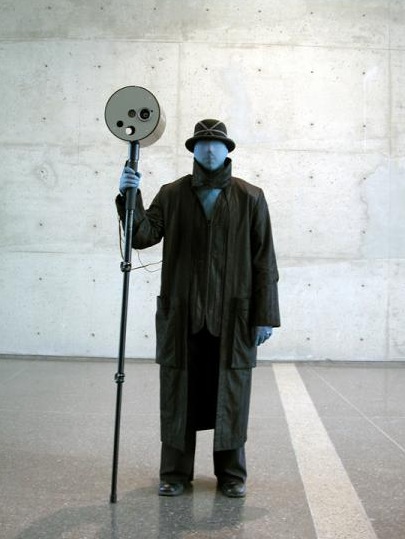
This faceless individual looks like a character out of some story by Bilal or Moebius or Ditko...but it's actually a real life concept created by an advertising agency for "nomadic media" presentations. Can you imagine walking down the street and running into this guy? I don't think the response will be as pleasant or benign as the inventors suppose.

This particular fellow is described as "The Projector" -- sounds even more like a Ditko character, don't you think? -- but the company's trade is sending people out into the streets wearing backpack-mounted LCD screens. Intellectually, I realize this is nothing more than a logical high-tech extension of the standard "guy wearing a sandwich board handing out flyers to passersby"...but emotionally, it strikes me as creepy on a dozen different levels. Imagine taking a job as a mobile TV stand. Or imagine stepping outside for some air and not being able to escape walking TV sets heading toward you.

The image comes from here but I found it thanks to a post here.

Tuesday, July 11, 2006

If You Go, Don't Be Slow


In an interview a few years back, David Bowie remarked that "it doesn't matter who did it first; what matters is who did it second!" This aphorism could have a lot of different applications. It might refer to a purely commercial sense, meaning "The true innovator doesn't reap the commercial rewards of his or her new invention; all the wealth and fame goes to someone else who steals or borrows the innovation and puts it to use in a more accessible form." Or it might be a less cynical comment on the artistic process, suggesting that "Innovations may come about by accident or necessity; the real credit is deserved by those who recognize the innate value of the new thing on its own merits and strive to apply it to their own work. Without them it would be a fluke, not an innovation." Whichever interpretation you prefer doesn't matter; what matters is that Syd Barrett was one of the ones who did it first.

Other people will mention the Floyd's single "See Emily Play" as one of the seminal groundbreaking moments of late-Sixties psychedelia -- and it is everything people say it is -- or talk about how Barrett's mental decline formed the emotional core of later Pink Floyd albums like Dark Side of the Moon and especially Wish You Were Here. Barrett released two solo albums which are treasured by anyone since who's written songs with a guitar in hand...but not widely known to the general public who thinks of Pink Floyd as that band of elderly geezers who did "Comfortably Numb" or "Another Brick In The Wall."

But for me, the name Syd Barrett is synonymous with the impossibly clear and powerful crashing widescreen Cinerama guitar chord that opens "Astronomy Domine" -- the first song on their debut album Piper At The Gates of Dawn. The song was recorded at Abbey Road Studios in April 1967 -- pretty much the same time the Beatles started living there full time. The pleasant British nostalgia of Sgt. Pepper is what caught the world's attention...but that power chord slide from E to Eb was a raw challenge of pure defiance that hasn't been equalled in the punk, or postpunk, or metal of subsequent years. It's a thunderclap that for a little while sounded like it might break the world open.

A lot -- too much -- has been written about Barrett's mental illness and withdrawal from the public eye. Clearly, there were problems which may have been the result of an existing schizophrenic tendancy exacerbated by indulgence in psychedelic drugs. (I wonder how many cases of drug burnout might actually be situations where someone with preexisting mental issues fell into using LSD or the like as an accidental form of self-medication rather than getting the early treatment they needed?) But at the same time, anyone withdrawing from fame and attention is defying what's practically become the modern religion of fame at all costs. Witness the venom and bile spewed at Dave Chappelle for a more recent example. I've seen him condemned with the unspoken subtext of How dare he walk away from the thing we're all supposed to want?

So, yeah, Syd became a bit of a nutter, lost his hair, gained weight -- though when you get right down to it, he didn't look any worse than any of the surviving members of Pink Floyd do -- but I'd like to think that on some level living quietly in Cambridge, painting and gardening, really was the right choice for him and that he was happy in these final years. He was owed that much.

Thursday, June 29, 2006

The Superman page Grant Morrison wishes he wrote

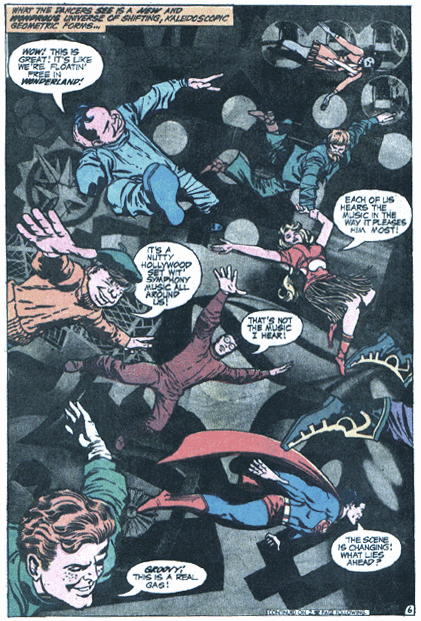
Okay, maybe All-Star Superman #4 is the best Superman comic to be published in nearly twenty years...but well before that, Jimmy and his best pal were exploring tripped-out psychedelic landscapes alongside the Hairies and the Newsboy Legion, courtesy of Jack Kirby:


(From Superman's Pal Jimmy Olsen #137, one of my favorite comics of all time.)

You'll definitely want to check out more about this here.

Tuesday, June 27, 2006

Every time a bell rings, an angel gets his...oh, never mind

Apparently, back in the old days of Hollywood, they knew how to conduct a proper job interview. Like this:

Movie great JAMES STEWART was forced to prove he wasn't gay by bedding two hookers, according to an explosive new biography. Movie mogul LOUIS B MAYER reportedly instructed the IT'S A WONDERFUL LIFE star to prove to him he wasn't a homosexual before offering him a film deal, sending the actor off to find a couple of prostitutes. The shocking claim is made by MARC ELIOT in his new tome JIMMY STEWART - A BIOGRAPHY, which is set to hit bookshelves this autumn. Eliot claims Meyer demanded Stewart prove he wasn't gay by visiting a Hollywood brothel and bedding "at least two of those broads".


None of my job interviews went like that.

I wonder if this was the inspiration for The Cheyenne Social Club? Nah, probably not.

Friday, June 23, 2006

That's it, I'm taking your comics away

From the New York Times:

CARTOON SUPERMAN never amounted to more than that for most people. But for a select group, early encounters with the Man of Steel wearing a molded bodysuit, knee boots and a shiny cape helped set the course of an erotic life. "Batman and Robin and Superman were all really exciting," said John Weis, the chairman of the Folsom Street East street fair, an annual event that kicked off Gay Pride Week in New York on Sunday. "Batman was always tied up or in some peril, and I thought that was really great."


You'll all get your comic books back when you can promise me you'll behave. But first I want you people to think about what you've done. Your mother and I are both very disappointed in you.

Sunday, June 04, 2006

Broken wings

A rant, in which I respectfully disagree with Kalinara on a topic that is of no personal significance to me whatsoever, but that touches on matters I think about a lot.

Most of the time I talk about comics on this blog...but I know some of you aren't actually comics readers, so first a quick summary to bring everyone up to speed. DC Comics has a character named Nightwing, more about whom shortly. Also, DC Comics recently published a godawful series called Infinite Crisis in which the very foundations of the DC superhero universe were shaken and the continuity of their books rearranged to make them new and exciting again. If that wasn't enough excitement, Infinite Crisis was preceded by a bunch of mini-series all leading into the main event, and its aftermath involves all the DC titles jumping forward in time to "One Year Later" -- in which time dramatic changes have come to various characters, for example: Green Arrow is now the mayor of Star City! But how did this come about? -- and a year long weekly comic series called 52 which discloses the events of the "missing year" during which Superman, Batman, and Wonder Woman all took a simultaneous twelve month sabbatical. All clear? Okay. You don't need to remember any of that.

Now, at the Wizard World convention in Philadephia, DC Vice President and Executive Editor Dan Didio revealed that one of his hopes for Infinite Crisis had been killing off the character Nightwing...who is none other than Dick Grayson, formerly Batman's sidekick Robin. However, Nightwing got a reprieve from higher up, and is still alive.

Robin/Nightwing has a considerable fan following, and a lot of that fandom feels that his comic totally blows. Kalinara, a very astute reader whose opinions I always enjoy, opines that the character is irredeemably broken due to writer mishandling, and that killing him off would have been the best choice. She makes a strong case based on the significance his death would have had in the continuity, and how other characters would respond. Very sensible stuff...and yet, I disagree.

Virtually every reference I've seen to what's wrong with Nightwing, or killing off Dick Grayson as a good or bad thing, or how much a segment of fans liked him in Teen Titans, has been based on hardcore fan reference points and continuity debates...and totally missing a larger aspect in the real world outside of comics.

I've never read an issue of any Nightwing solo comic. I read maybe the first six or seven issues of the Teen Titans comic by Marv Wolfman and George Perez, and none since then. I don't know a damn thing about the character or his development over the years. But I do know that an astonishingly large percentage of the world's population knows who Batman and Robin are, and that a considerable subgroup of same knows that they're Bruce Wayne and Dick Grayson. If you said to these people "Robin grew up to work on his own, apart from Batman, and now calls himself Nightwing" that premise is totally accessible and immediately understandable. Any comic publisher that wanted to hook an audience -- instead of servicing the continuity-based minutiae known only to an ever-diminishing of insiders -- would be complete and utter fools to throw away something with that level of audience recognition.

If there were a Nightwing movie or television show, all the reviews and listings would have to say is "the adventures of Batman's former partner Robin, now grown up and on his own," and boom! -- everyone would be on the same page. Do comics fans really not see how valuable that is? To say "Oh, but the character is broken, we have no way to tell a good story about him anymore" is completely missing how the act of writing fiction works.

As I say, I have only the astute comments of folks like Kalinara and Vince Murphy to indicate the ways in which Nightwing has been poorly handled; I assume these are accurate descriptions. But all that's needed to remedy these faults is a proper writer, one who can say: "What's the premise of this character? Oh yeah, the whole grown-up Robin thing. Right, so he was a boy acrobat whose parents were killed, trained by the World's Greatest Detective in crime fighting. But he's different from Batman, because he had a mentor instead of being alone since boyhood. So he's as tough and competent as Batman, but with a warmer human side. And he's known all the other heroes since he was a kid. They don't hold any mystique for him; he's seen it all...and anyway, Batman's the best. So what happens when..."

And suddenly, you're telling stories. See how that works? Writers who are obsessed with continuity points at the expense of telling stories have their heads, and there's no other way of saying this, shoved into their own asses.

Now here's the question that's been driving me nuts. If Nightwing was doing so poorly that the Vice President and Executive Editor of DC Comics wanted to kill him off...why is DC still publishing a Nightwing comic? You don't have to kill off the character, just stop publishing the damn comic and give him a rest. But if the comic is selling well enough to keep going...why the hell was this guy trying to have him killed off?

If you can wrap your head around this...if you can answer those questions...you understand the world of comics better than I do.

Thursday, June 01, 2006

Nerd news

I hope we'll have no more complaints about this:

NY COMIC-CON ANNOUNCES EXPANDED VENUE FOR 2007

Organizers note that the upstairs location can accommodate twice as many exhibitors and many of the aisles will also be twice as wide which will afford easy access for the many attendees. The lobby, which also houses the registration area, will be five times bigger than the lobby in ’06 and there will be twice as many registration counters. There will also be longer show hours, two entrances to the show floor, and separate registration lines for pre-registration and on-site ticket purchases. In addition, exhibitor and professional badges will be mailed in advance this year eliminating an estimated 8,000 badge “pick ups” in the registration area just before the show.


So I've got karaoke this weekend and a convention next February. I'll try to fill in the nine months between the two as best I can.

Thursday, May 25, 2006

We broke them, I tell you

About five years ago, many thousands of television viewers told the Sci-Fi Channel, "No, don't cancel Farscape! Farscape is the best thing you have! If you cancel it, you're going down a bad road! Who knows where it will lead?" But they didn't listen to the fans, and Farscape was cancelled.

And now Bonnie Hammer, president of Sci-Fi Channel then as now, is trying to rationalize the Sci-Fi Channel airing WWE wrestling shows.

That's in addition to the channel already showing the soap opera Passions (!) and reruns of Law and Order: SVU (!!!).

We tried to warn them, but they didn't listen. Now they're broken. Cartoon Network, you're next.

Tuesday, May 16, 2006

Blast from the past

I'm sorry, but other than a surprisingly decent Superboy, these guys look terrible. I assume they were trying to capture some of that rakish Teen Titans quasi-anime mojo but instead they took a left turn and veered off into Ugly Town.

For that matter, you have to wonder how the cartoon will get away with featuring Superboy so prominently, in the wake of the recent court ruling that the television series Smallville may infringe on the copyright held by his creator's wife and daughter...and that show doesn't even refer to the character as "Superboy." So wouldn't the same concerns over possible copyright infringement apply here? DC only just got finished getting rid of the two remaining characters they had named Superboy, and the current Legion comic now features Supergirl.

Personally, I don't understand why the different divisions at Warner can't coordinate their activities a little better: either have a "Legion of Super-Heroes" cartoon without a Superboy or Supergirl...or, better still, make the cartoon "Supergirl and the Legion of Super-Heroes" for greater consonance and cross-promotional possibilities with the print version, not to mention a girl-positive lead character.

(And if you say a teenage girl cannot be the lead action hero in a cartoon series that appeals to boys, I shall have to ask you to step outside.)

Ah well. As a reward for putting up with my fevered rantings, here's something nice to look at, courtesy of Robby Reed at Dial B for Blog:

Sunday, May 14, 2006

Atom heart mother

I wasn't planning to write anything special for Mother's Day, but this post by Ragnell inspired me to make a quasi-political statement about my mom.

My mother turned seventy-one nearly a month ago. The most recent comic book she read was the latest issue of All-Star Superman. She liked Watchmen a lot. (I've told her League of Extraordinary Gentlemen is much superior among Alan Moore's work...but adult-onset diabetes has messed with her vision and she needs to get new corrective lenses before she's ready to tackle any more text-intensive Moore comics.) She was a fan of The Tick before I'd ever even heard of it. Sure, these days I recommend comics to her that I think she'd enjoy...but I didn't introduce her to comics. She was reading them back in the Forties, and was a big fan of Captain Marvel. When DC first revived the character in the Seventies, I read the copies she bought, not the other way around.

I should add that she bought them so my dad could read them too. Before he became a surgeon, he had wanted to be a cartoonist, and avidly read comic books and comic strips. In subsequent years he did all the illustrations for his own medical papers. Neither parent discouraged me from reading comics, any more than they discouraged me from reading their collection of Kurt Vonnegut novels when I was nine years old, or any other books I wanted to read. Both parents borrowed my comics.

So, that's my mom: geneticist, cell biologist, medical school teacher, left-wing political activist, science fiction geek, fan of Farscape and Doctor Who and Deep Space Nine, Usenet addict...and superhero comic reader. Erik Larsen will just have to deal with it.

Friday, May 12, 2006

On self publishing

I haven't had a lot of time for blogging lately, but somehow I had the time to get involved with this discussion thread at digitalwebbing.com, a combination sounding board/workshop/support group for aspiring comics creators. If you're one of those people who thinks you'd like to work in comics someday -- statistics show that 99% of comic book readers want to become comic book professionals, and I can vouch for that figure personally because I just made it up -- you could do a hell of a lot worse than checking out this site. I only wish it had existed twenty years ago...but back then I wouldn't have been able to process and accept the information it offers.

Anyway, this particular discussion thread led me to make some lengthy comments, and I'd like to repost them here for the benefit of anyone in the wider audience who might be interested. What follows is an edited jumble of comments from the thread; if you'd like to read the whole thing in context, follow the above link.

The thread is about seeking tips and advice on the best way for aspiring comics creators to approach editors and publishers at conventions. The non-comics person may need to be told here that unlike prose writers or Hollywood screenwriters, creative talent in comics do not have agents representing them. Being the lowest of the low end in periodical publications, comics operate on the basis of creators making pitches directly to editors...and most publishers have become -- or are in the process of becoming -- closed, invitation-only clubs. You don't even get to pitch to Marvel or DC; they invite you to pitch, and then only on the basis of a proven track record or an existing social relationship.

This is why comic conventions have become so vitally important for aspiring writers and artists, and why they've become such fraught experiences for editors. It's one of the few ways potential creators can possibly develop a face-to-face social relationship with prospective editors. But feel for the poor editor who has to deal with one hundred earnest young people who each have a 22 page comic book script they each want him to read and make thoughtful comments upon right there on the spot! (I hope you didn't have anything else planned for that weekend.)

The original poster on the thread cited a literary agent who determines whether or not a writer has something to offer simply by reading the first paragraph. Surely comic book editors can do the same? Well, sure, I understand that perspective. It's the American Idol effect: people's innate capacity for self-delusion can be truly staggering, and it doesn't take more than a couple of flat notes for Simon Cowell to work out who might be a promising contender and who has no business even singing in the shower. We can leave out anyone who writes in crayon, or has major spelling or grammatical errors on the first page, or doesn't know how to format a readable script and it doesn't change the fundamental point I'm about to make.

Here's the thing about writing: loads of people can write a killer paragraph. Especially if they're novices with no deadlines to meet and with years and years to hone and refine that killer paragraph. Only a small percentage of the people who are talented with words have the tenacity and determination to write every day, even when no inspiration strikes, to keep going in the face of every setback and discoragement...to actually be steadily working writers.

Talent has very little to do with the capacity to do that work. In fact, talent can be an imediment -- if it means that writing comes so easily to you that you never had to learn how to work at it when it doesn't come easily.

The catch is, only the people who are capable of sticking it out and getting the work done regularly and consistently are worth an agent's or editor's time. They've got deadlines to meet and books that have to be delivered and (at least in the prose world) advances that have to be justified. So many people come along and seem promising and talented yet who fold under pressure or flake out and don't deliver the finished work. In books, that means not only this book, but the next one and the one after that. In comics, that means not only the script you've finished, but next month's script and the month after that. These people are investing in your future output and they have to take a gamble on your ability to perform...and they still get burned time and time again.

This is why self-publication has become a big feature of the comics landscape and will only become bigger in the future, especially for the aspiring newcomer.

An aspiring writer handing an editor a finished, printed comic book at least says "I'm determined enough to make it in this business that I did all the extra work besides writing necessary to make it happen, I pulled it together and could coordinate with at least one other person -- the artist; possibly more than one if there was an inker and letterer -- and I nagged them about deadlines and kept after them and still made them want to work with me. And here's the proof right in your hands." This goes a long way to showing an editor that you're someone who can and will do the work of being a writer.

It also helps show them that what you want to do is make comics, not "be a comics author" or whatever. The person who does comics because he or she has to -- who does the work for the sake of doing it and getting it seen by others -- is a MUCH better gamble for a publisher than someone who's only interested in doing it if certain conditions are met. A finished printed comic says "I did whatever it took for people to see this story, because I had to. If you don't publish me, people are still going to see my stuff."

If I were an editor, that's who I'd want to work with.

But there are so many aspiring writers and artists! There are more working writers out there, already published, than the industry can support as it is. And why bother when even the most successful comics writers could probably be making better money, working under better conditions, writing copy at an ad agency?

If you compare writing comics to writing copy at an ad agency, then yes, the supply outstrips the demand for the former, and the latter is far more lucrative. But you could say the exact same thing about being a painter and painting signs. There are far more painters in the world today than are needed, strictly speaking in terms of the number of paintings that anyone can look at in a lifetime. The guaranteed income of a regularly working sign painter may be much more useful in supporting a family than that of a starving painter in a garret. Novelists? No one can get through the smallest fraction of novels published each year. Musicians? It's even worse. We can say the same about film and television.

So, in ANY field of art, a person had better be doing it for sheer love of doing it. In that sense, there's no more reason to discourage someone from creating comics than there is to discourage people from writing novels, painting paintings, making music. They're all equally "fruitless" in terms of strict supply and demand.

But art doesn't work in terms of supply and demand, either. Good art creates its audience. An artist is not filling an existing demand for something that doesn't exist; the artist gives the audience something they didn't know they wanted until they saw it.

(My thanks to comics fan extraordinaire Tim Bateman for that turn of phrase.)

If there were no Grant Morrison (one of my favorites, but you can substitute your favorite writer or artist here) my comic book purchases wouldn't simply transfer to someone else. I buy a new Morrison book if I see it; if there isn't one, that's one less comic book I buy. And this is the reason why editors are looking for new creators at all: not because they have an opening on their schedule, but because they hope to find another Grant Morrison who will create a new audience they otherwise wouldn't have.

Note also that Grant's first published comics work was in 1977. It can take a while for a career to happen. I don't think anyone would argue that Grant should have given up much sooner?

We are competing, in the Darwinian sense of so many new comics wanting to catch the eyeballs of a potential audience. Breaking through that is hard. Doing something that justifies getting this attention is hard too. But a Grant Morrison or a Brian Bendis or whoever is not our competitor. They created an audience. We have to create one too. My goal is not to take away one of Grant's readers, but to work and struggle and pray for that day when someone tells me "I bought two comics today -- yours and his."

Tuesday, May 02, 2006

Links of note

I've been busy lately doing preliminary research for a new writing project. That's always the best part, when I can indulge myself learning a ton of stuff about the history of railroads, diagnostic indicators of cerebral hemorrhage, trees native to Pennsylvania, and the Ramayana...and saying to myself "I'm not goofing off, it's research." Then comes the other good part, which is staring off into space and letting it all swirl around in my head...and saying to myself "I'm not goofing off, I'm developing a story." And then comes the part about typing it all out, cursing myself for having no talent, waking up at 4 AM and deciding to quit writing...the usual. But at times like these, the blogging gets shortchanged. It's unavoidable. It doesn't mean I don't love you.

Now, if you're anything like me...first of all, please seek help immediately. Even though I make it sound fun and glamorous and exciting, it will only end in tears. But I digress. If you're anything like me, you've spent the last few days reading endless commentary and analysis of Steven Colbert's appearance at the White House Correspondents Dinner on Saturday. It's become an obsession with me. I was jazzed to see the real thing live on television, but the aftershocks have become overwhelming. All the commentary after the fact can be summed up in this simple formula: If he was talking about you, you didn't think it was funny.

Fortunately, one person has provided a comprehensive, sensible, and well-informed analysis of the event and subsequent reactions to same on his blog. And no, I don't mean Johnny Triangles. I refer to stand-up comedian, physicist, screenwriter, and comic book author John Rogers, who writes about Colbert's performance here and here. Anything I could say on the topic has already been said in those two posts and in the comments section for each.

Besides, anyone who knows why the words "Vaughn Meader" were once the funniest joke ever told has my respect.

Monday, April 24, 2006

Have you got any ice cream without so much spam in it?


Vermonty Python is described as "coffee liqueur ice cream with a chocolate cookie crumb swirl & fudge cows." This doesn't sound very appealing to me; worse, it sounds as if someone just thought up the name and decided to slap it on the next random combination of flavors that came along, rather than trying to devise a variety of flavor that would be appropriate for the name.

Surely with "Vermonty" in the name, the obvious choice would be a maple syrup flavor. It would be perfect for that special someone who became a barber to overcome his crippling fear of hair, when all he really wanted to be was...a lumberjack! Or a strawberry tart flavor, without so much rat in it. Maybe three rats...rather a lot, really. No, the perfect flavor to go with this theme would be ice cream mixed with chocolate-dipped crunchy frogs!

And woe betide the Ben & Jerry's customer who orders a pint of Vermonty Python and complains about the dirty spoon...

Okay, that's enough. I invite anyone who's interested to post their own Python-derived jokes on this theme in the comments section. I have serious misgivings about one of the most precious things from my childhood being turned into a string of licensing opportunities and mass marketed to the point of inanity, but that's just me.

Wednesday, April 19, 2006

Local news

I can't believe this cretin got off, you should pardon the expression, with a mere two years probation.

More than once, this jerk (hmm, another bad choice of words on my part) has said things similar to the quote provided in the above article: "she may like me and want to go home with me...it's her call." He made similar comments in an article published in New York magazine. To me, that spells future stalker and/or sex offender. Loads of rapists say things afterwards like "I could tell she was enjoying it" or other filth from the depths of their self-delusion.

And when he gets arrested for doing something even worse -- like stalking or assaulting someone -- you just know what the authorities will say:

"No one could possibly have foreseen that his levees would burst."

Tuesday, April 18, 2006

Up against the WSJ

The Wall Street Journal has an article about the nascent trend of paid product placement in comic books.

The whole idea seems dubious to me on more than one level. Leaving aside my hippy-dippy crunchy granola sentiments about the ubiquity of paid advertising and endorsement deals and the implicit message they carry that everyone and everything can be bought and owned and even our fantasies can be colonized by corporations...as I say, leaving aside that whole train of thought, it raises a lot of questions for me on a purely pragmatic and materialistic level. Does it make a lot of sense for corporate advertisers to move into comics now...when the audience size for comics is in decline?

Given that the diminishing market is moving towards trade paperbacks and graphic novels -- which don't carry ad pages -- one can see the logic of advertisers wanting to get their content into the story pages instead, which will end up in those collections. But in the best case scenario, those stealth ads and product placements will stay on the shelves for years -- do these companies really wants years- or decades-old products still being advertised? I suppose the answer is the same as with outdated product placement in movies and tv shows on DVD: the corporations don't really care if their advertising detritus hangs around for the rest of time.

And what about the money? It won't go towards offsetting production costs or lowering the cover prices of new comics. Does any of it make its way into the pockets of the writers and artists? If so, are they getting the same amount that a professional copywriter or illustrator would get at an ad agency for doing the same work, or is this a way for an advertiser to save some moolah?

And then there's this quote:

DC's Mr. McKillips says Pontiac will not have direct editorial oversight of the comic and its main character. "We're not seeking their approval on everything, and they trust us," he says. A Pontiac spokesman says the company is not involved in the creative process.


"They trust us." We're tame. We certainly won't do anything to threaten this cozy relationship, so they don't need to constantly look over our shoulders. You won't see any stories that implicitly question the corporate behavior of Dodge or Pontiac in refusing to strengthen emission standards, or embrace alternative technologies, or outsourcing their manufacturing facilities. Or any stories that skewer Nike for the corrosive social effects of fetishizing sportswear, or their sweatshops in Indonesia or Mexico or East Asia. (Oops, I said I wouldn't go all sandal-wearing and tree-hugging on you. My bad.) Well, there wouldn't have been that kind of story in those comics anyway, so no harm done...

I suppose this new trend won't really make any difference...which is kind of sad, don't you think?

But look, one good thing: there's a quote in the article from someone we know! I don't disapprove of the article itself...and I note with much approval that when it came time to get quotes from the fan perspective, both fans the author chose to quote were women. Holy stereotype shattering, Batman!

Monday, April 10, 2006

Is it First Comic Week already?

Following the lead of Vincent Murphy at Spandex Justice (though he got the idea from someplace else) here's my own act of personal archaeology...

The earliest DC comic I can remember reading was Justice League of America issue #60.


I suspect my early exposure to this comic may have made me a sexual pervert. Certainly, the cover imagery is powerful in terms of the developing libido of the prepubescent male mind. Adult men reduced in size, with a domineering woman towering over them and controlling them -- talk about sublimated maternal imagery! But the Queen Bee is a bad mommy, and sees other women as a threat to her supremacy: see how she orders her "drones" to attack Batgirl, who for all we know might be immune to the Queen Bee's control simply because of her gender.

Oy. I'm lucky this comic didn't make me gay.

(On the other hand, the art -- including the cover -- was by Mike Sekowsky, who drew the most absolutely gorgeous women ever seen in comics to this day. I would totally do the Queen Bee.)

I haven't read this comic since it was new, and I'd have to guess at the whys and wherefores of the plot. I certainly have no idea what weirdness it may have deposited in my subconscious. But I must have liked something about it, because I went on from there to seek out more comic books as single-mindedly as any drone bee seeking pollen...

Mind you, I didn't actually choose that comic or buy it myself; I expect one of my parents bought it for me as a gift. Before then, I would only have known these superheroes from Saturday morning cartoons. But both my parents had read comics as children themselves, and apparently saw no harm in introducing me to the medium; certainly none of the standard prejudice that comic books would keep me from reading "real" books existed in our household. But the earliest comic book I can remember actually picking out from a rack and asking if I could have it is Superboy #147.


Seen through adult eyes, it's a staid cover -- I've even heard it described as boring, which offends me irrationally -- but I remember how it looked at the time. The Neal Adams embellishments over a layout by Curt Swan, especially the shading on the bustlike heads along the sides, seemed positively photorealistic compared to anything I'd seen before in a comic book. When I saw this cover again for the first time after several decades, I was surprised to see that it hadn't actually been a painted cover as I mistaken recalled it must have been, and that it was actually fairly ordinary in production values. At the time, it seemed to me singularly moody and elegaic -- I thought perhaps a character had died (perhaps even Superboy himself?) and the oddly lit faces were paying tribute to a fallen hero.

And then the banners the other figures were carrying -- well, they promised several stories in this issue, and that meant this comic had to be worthwhile...even if it was priced at the exorbitant sum of 25 cents, far more than the usual comic book.

Saturday, April 08, 2006

Everybody's doing it

Aguirre-Sacasa: Playwright's Path Is via Comic Books

The New York Times offers a profile of Roberto Aguirre-Sacasa, playwright and scripter of Sensational Spider-Man, Nightcrawler, and Marvel Knights 4. The article is a lot more accurate than the vast majority of comics-related features in contemporary newspapers, and worth reading. (The above link is registration-free thanks to the magic of RSS feeds.) One of the quotes that caught my eye:

"One of my comics is read by more people — around 70,000 — than will see my entire run at Manhattan Theater Club," Mr. Aguirre-Sacasa said. "That puts things in perspective."


The worlds of theater and comics have some interesting similarities. Both were wildly popular and significant mass media at one time...and both are now reduced to a niche market of "true believers" and cater to this insider audience, while the general public is being priced out by ever-increasing cost of entry. I can personally remember a time when a comic book that sold a mere 200,000 copies would be considered an abject failure and cancelled immediately; these days, 70,000 is a success story. And of course, both theater and comics as mass entertainment have been succeeded by other media competing for space in the consumer's wallet. It won't be too long before the idea of going to see a movie in an actual cinema seems as exotic and unlikely to the majority of the public as going to a play does now to that same group.

And too, both comics and theater are now produced by people who are driven by their irrational, passionate love for the medium rather than by people looking to reach the widest audience or hoping to make big bucks. I say this as an observation, not a value judgement: I'm not trying to say whether this is a good or bad thing.

There's also a whole other trend related to this of the major comics publishers seeking out and lauding writers from other fields -- novelists, playwrights, television producers and film directors -- as their new major stars. There are definitely good and bad aspects to that trend. It lends a little second-hand glamour to the tawdry industry of comics publishing (but it's always a bad sign when you have to borrow your glamour from somewhere else). It offers the chance of creative cross-pollination with more literary values and techniques enlivening the comics narrative form (but in practice these outsiders write very derivative and retro comics, referring to obscure stories they remember from their childhood and trying to write like the full-time comics writers they idolized; meanwhile the only literary innovation in comics comes from full-timers like Alan Moore or Grant Morrison). It brings professional writers accustomed to having their creator rights respected over to shake up the plantation mentality of Marvel and DC (but then they surrender their rights because massa is willing to let them write actual comic books at last! -- see the whole flap over Omega the Unknown for a particularly grisly example).

From another angle, this quote tickled me:

As it happens, Mr. Aguirre-Sacasa's family history is not without its own heroes and archvillains. His great-grandfather Juan Bautista Sacasa played a pivotal role in the Nicaraguan civil war in the 1920's and 30's and was kicked out of the presidency when Anastasio Somoza García (his nephew) seized power. Now Mr. Aguirre-Sacasa's father, Francisco Aguirre-Sacasa, is running for president of Nicaragua in the November election.


There's something cool about the son of a Presidential candidate pursuing his dream of writing comic books rather than working on his father's campaign or getting involved in politics, don't you think? If only our current President had stayed with his dream of managing or owning baseball teams instead of going to work for his daddy, he'd be a much happier man today.

Monday, April 03, 2006

Up and away

Last week, the always entertaining and occasionally reliable and unbiased comic book gossip columnist Rich Johnston wrote in his weekly column for Comic Book Resources about a talk given by Alan Moore at the Tate Museum in London, relating to an exhibit on Henry Fuseli, William Blake and the Romantic movement entitled Gothic Nightmares. Johnston's report included the following:

Moore stated that he suspected he'd been asked to do a talk over the superficial similarities some people see between Blake's work and that often featured in comic books. Any other similarities Moore dismissed citing Blake's artistic intent and life experiences, placing all comic book creators below him. Moore would only allow two comic creators to be compared to Blake, Jack Kirby and Al Schroeder. The former, for his simple bold romantic religious strokes in both art, theme and story, and the latter for his eventual belief that Superman existed in a very real sense.


Moore's comparison of Jack Kirby to William Blake is a well-deserved compliment, one feels, to both men and does a lot to confirm my generally high opinion of Moore's artistic judgement. But the other name in that equation caught my eye. I knew the name Al Schroeder from my early days in comics fandom as another member of the amorphous mob of comics fans through which I circulated. I don't know that I ever met him, but I know he was active in fandom at the same time I was just beginning to discover that scene...and he wasn't the person Moore was talking about.

I dropped Johnston a line pointing out that Moore must in fact have been referring to Alvin Schwartz, one of the classic Superman writers and more recently author of the exceptional memoir An Unlikely Prophet: Revelations on the Path Without Form which explores Tibetan mysticism by means of (imaginary?) conversations between Schwartz and a tulpa in the form of Superman himself. The book was dedicated to an old friend of mine, the late Richard H. Morrissey, and I'd like to think he'd have been pleased that I was writing in his memory to make sure his pal Alvin Schwartz got the appropriate credit.

Anyway, the column was amended within a couple of hours; I don't know if it was my message or a note from someone else that prompted Johnston to make the correction...but it felt better to see Schwartz given his due.

In this week's edition of Johnston's column, I see the following:

Alvin Schwartz, known most for his Superman work in the 1940s, got in touch by e-mail. Seems the book that Moore cited, "An Unlikely Prophet" is getting a reprint shortly and Schwartz has written a sequel for publication later in the year. Schwartz asked me to put him in touch with Moore, which I've done. Who knows what the two will cook up together?

"An Unlikely Prophet" is an essential text for anyone interested in the history of American comics, the principles behind fiction and many of the themes Alan Moore has been exploring of late. Consider it "Kavalier & Clay" meets the Superboy from Earth Prime.


So it's possible, though I grant by no means definite, that my note to Rich Johnston played a role in getting Alan Moore in touch with a legendary comics writer who Moore has compared to William Blake. Whether it was me or someone else writing in with the same correction, the moral is clear either way: obsessively reading blogs and online columns and writing in with pedantic corrections of obscure errors can make good things happen and increase the sum total of goodness in the world. And I feel very good indeed about that.